|
Örjan Martinsson
| |
|

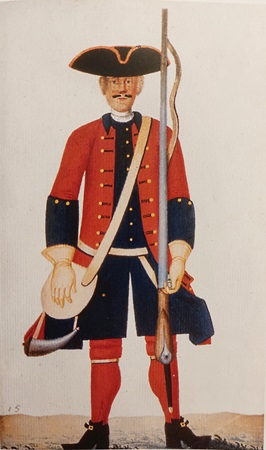
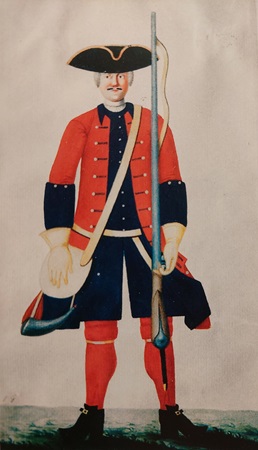
Drawings from 1728 by Worgewitz depicting a
Danish and a Norwegian artilleryman.
The artillery branch of Denmark-Norway's armed forces
got its first permanent organisation in 1684 and was then divided into three
corps (Danish, Holstein and Norwegian artillery corps). But artillery has of
course existed in Denmark-Norway much earlier than that and this page
presents its uniforms and organisation during the period 1670-1730. This
period covers the Scanian War 1675-1679 and the Great Northern War 1700 &
1709-1720, both of which were fought against Sweden.
This page only covers uniform details specific to the
artillery. An artilleryman's uniform was basically no different from the
infantry, so for details on how the uniforms were designed, I refer you to
my page on infantry uniforms.
|
|
Artillery Uniforms in General
Artillerymen were armed
with swords which were initially carried with shoulder belts, but which in
1703 were replaced with waist belts. Both were made of buff leather.
Until 1709, all three artillery corps had separate uniforms. However,
even after 1709 there were variations between the corps as the
officially mandated uniforms were not always those issued. See the
separate uniform accounts for each artillery corps to see which uniforms
are mentioned in the sources.
In 1709, the king decided
that all three artillery corps would have the same uniform, which would
consist of a red "surtout" with blue facings and a blue "livkjole" with
red facings. Exactly what is meant by surtout and livkjole at this time
is unclear because they actually refer to the same item of clothing, the
regular uniform coat. Surtout is just a newer French word that had come
into use around this time. It is possible that the surtout refers to an
overcoat that would be used in bad weather ("rain coat") and
which had recently replaced the sleeveless cassock in the Danish army.
If so, it is the same colour combination as in the uniform issued to the
Holstein Artillery Corps in 1701. It is also possible that the word
livkjole at this time referred to a waistcoat, also called "camisole",
which was worn under the regular coat ("liv" and "kjole" literary means
"waist" and "coat".
The uniform regulation of
1711 stated that the entire army should have red coats and that the
facing colour of the artillery should be violet. Here, however, it
seems to be uncertain to what extent uniforms with violet colour were
actually issued. In Daniel Schorr's article (page 34) it is
mentioned that the Danish and Holstein corps probably had blue colour
instead because there was already blue cloth available and that this
possibly applied to the Norwegian corps as well. Karsten Skjold Peterson
has given various bids for the Danish Corps in his books. In 2005 he
stated that in 1711-1716 they had violet cuffs, but dark blue leg clothes
(breeches & stockings). In 2014, however, he had changed this so that the
cuffs, leg clothes wear and waistcoat were dark blue 1710-1716.
With the introduction of the
1716 uniform regulation, however, it was definitely dark blue that was the
facing colour of the artillery, the regulation also stated that they should
have brass buttons and, like the rest of the army, have red leg clothes.
Worgewitz's drawings from 1728, which can be seen at the top, depict
exactly this model of uniform. Note that the artillerymen in Worgewitz's
drawings differ from other regiments in that they have turnbacks. Another interesting
difference, found only in a series of plates by Zimmer from 1730, is the
number of buttons on the double-breasted coat: the Danish corps had 2x10
buttons, the Holstein corps had 2x11, and the Norwegian corps 2x9
buttons.
I only have two pieces of
information about what colour the gun carriages had. According to
Daniel Schorr (page 34), who wrote only about the Norwegian army, the
gun carriages were red with the metal fittings painted yellow. This colour
combination is also mentioned in the article on the Scanian war by
Hasselager/Snorrason (page 49). |
|
Scanian War
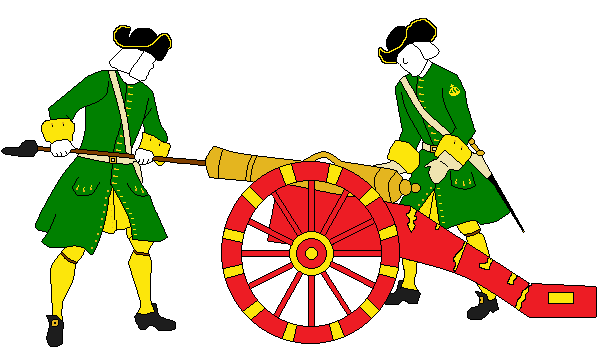
1675 – April/May 1676 &
autumn 1678 – 1679 |
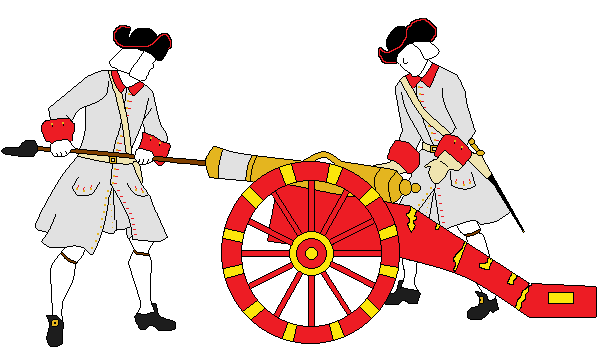
May/June 1676 – autumn 1678 |
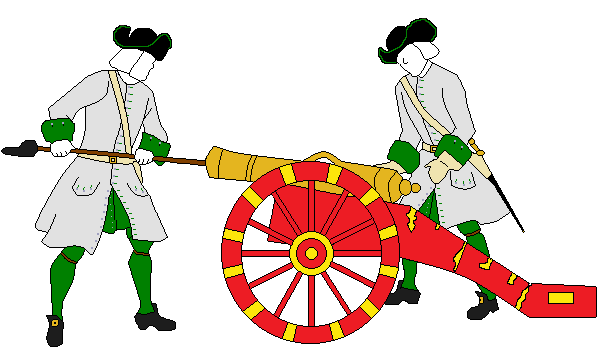
Fortress artillery
in the autumn of 1678 – 1679 |
|
Green
coat with yellow cuffs and yellow. Possibly pewter buttons 1675-1676,
but brass buttons 1678-1679. |
Grey
coat with red cuffs and lining and pewter buttons. Probably still a
royal mark on the sleeve. Red collar is mentioned for drivers. |
Possibly grey coats with green cuffs and pewter buttons. This may also
have been the uniform worn by the drivers in the field artillery. |
Since the artillery was
considered a "royal regiment", the artillery uniform at the beginning of the
war probably had a C5 or crown in yellow on the left sleeve. It is more
uncertain whether this was the case at the end of the war.
At the beginning of the war,
men from the New South Jutland Infantry Regiment were transferred to the
artillery to serve as drivers and they wore red coats with blue cuffs and
pewter buttons.
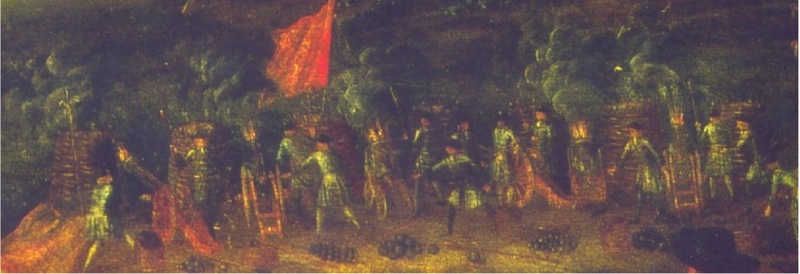
The Danish artillery is
depicted in three paintings by Claus Møinichen, painted in 1686-1688,
depicting the sieges of Wismar in the autumn of 1675 and Landskrona in the
summer of 1676. The uniforms in these paintings differ from those described
in the archival sources. Instead of green uniforms, Møinichen has depicted
artillerymen dressed in blue coats with blue cuffs (and light grey or white
hats) at the siege of Wismar. In the paintings depicting the siege of
Landskrona, he has depicted the artillerymen in all grey coats without red
cuffs (and with black hats). The stockings are white or grey in all
paintings.
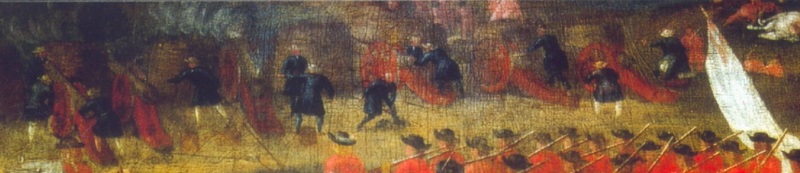
Detail from a painting depicting the Siege of Wismar
which lasted from 6 November to 13 December 1675
Detail from a painting depicting the siege of
Landskrona which lasted from 5 July to 3 August 3 1676
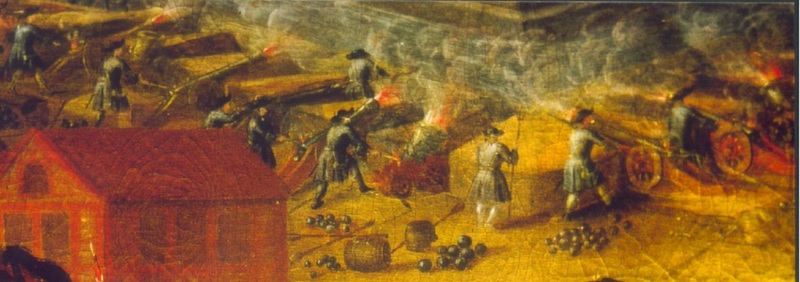
Detail from another painting depicting the same siege
of Landskrona
Organisation
The Danish artillery, which
only numbered 250 men in 1670 (the Norwegian artillery is
reported separately below), was greatly expanded at the outbreak of war.
For the first time, an independent field artillery was now organised. It
came to consist of a staff of 19 men and four companies of 111 men. This
included 58 guns with calibres of 12, 10 and 3 pounds. In addition, each
infantry battalion had two three-pound guns. On 14 March 1676, a
reorganisation of the field artillery took place. The staff still consisted
of 19 men, but the companies then had the following composition:
|
Pyrotechnic Company |
|
Craftsmen's Company |
1 Captain
2 Lieutenants
12 Pyrotechnics
4 Gunners
9 Crewmen |
1 Captain
2 Lieutenants
1 Sergeant
1 Wheelwright with 4 journeymen
2 Cooper
1 Stockmaker
1 Farrier with 4 journeymen
1 Blacksmith with 4 journeymen
1 Gunsmith
1 Swordsmith
1 Saddler with 3 journeymen
1 Ropemaker with 1 journeyman |
1 Kaptajn
2 Løjtnanter
1 Stykjunkere
1 Hjulmager med 4 svende
2 Bødkere
1 Skæfter
1 Beslagsmed med 4 svende
1 Grovsmed med 4 svende
1 Bøssemager
1 Sværdfejer
1 Sadelmager med 3 svende
1 Rebslager med 1 svend |
|
2 artillery companies |
1 Captain
2 Lieutenants
4 Sergeants
18 Gunners
18 Crewmen |
A twelve-pounder cannon (or
a 50-pounder mortar) had a crew of two gunners and four crewmen.
A six-pounder cannon (or a 25-pounder mortar) had a crew of two gunners and
two crewmen.
A three-pounder cannon had a crew of one gunner and two crewmen (to move the
cannon three horses were required).
During the war, the artillery's
personnel strength was expanded, including the introduction of a pioneer
company in 1677.
After the end of the war, the
field artillery was disbanded and the rest of the artillery (593 men) was
organised so that 118 men were in the Copenhagen arsenal, 258 men in the
other Danish fortresses, 150 in the Holstein fortresses and the Glückstadt
arsenal and 67 in the Oldenburg fortresses. Then, in connection with the
mobilisation 1683-1684, the personnel was increased again and was then
divided into three independent artillery corps: Danish,
Holstein and Norwegian artillery
corps . |
|
Danish
Artillery Corps
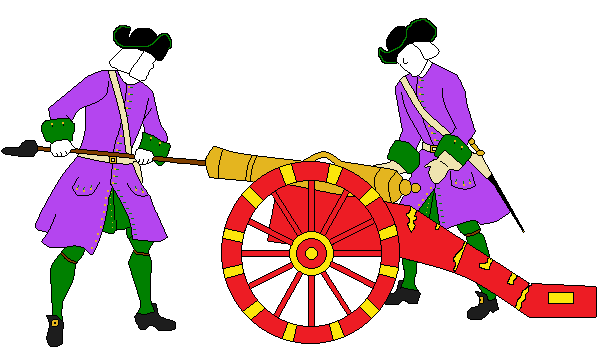
1691-1695 |
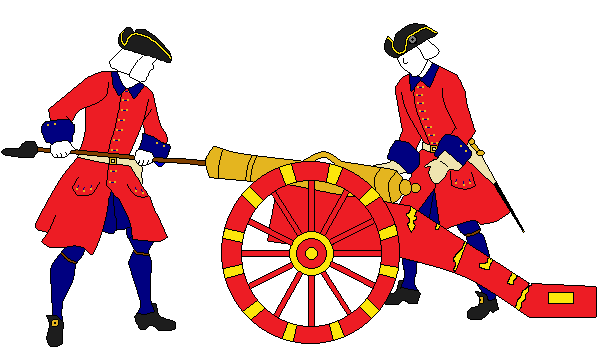
1710-1716 |
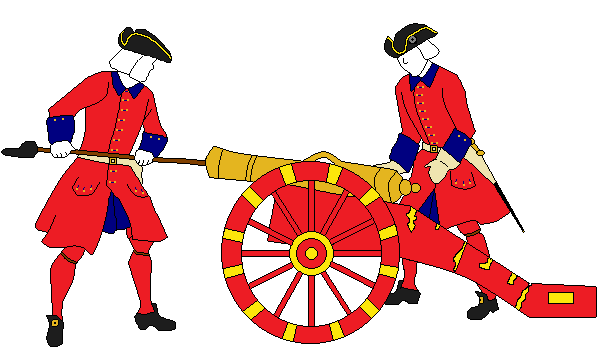
1716-1742 |
|
Violet coat with green
facings, lining, and leg clothes (breeches and stockings). |
Red coat with dark blue
facings and at least from 1711 yellow buttons. Dark blue waistcoat and
leg clothes. |
Red coat with dark blue
facings and lining and yellow buttons, dark blue waistcoat and red
leg clothes. The buttonholes were at least from 1728 dark blue. |
The above is the uniform information that Karsten Skjold Peterson has in
his book from 2014. According to Lars-Eric Höglund, the Danish artillery
had in 1683 violet (violet blue?) coats with red facings and lining. In
1700, according to him, they had blue coats with red.
Organisation 1684
When the
Danish Artillery Corps was formed, it was organised with a staff and an arsenal &
craftsmen company ("Tøjhuskompagniet") with 131 men and six artillery
companies of 40 men each. Each company had three officers (captain,
lieutenant and "stykjunkere"). All in all, the corps had a strength of 371
men.
A bombardier
company was established in 1686 to serve mortars, but it did not last
long. Further organisational changes apparently took place, as the corps
had the following organisation in 1699. Changes may have
occurred at New Year's in 1699, as the Norwegian Artillery Corps was
reduced at that time. In connection with the war preparations of
1699-1700, the corps was expanded and this enlargement was retained after the Peace of Traventhal in 1700.
Organisation 1699
Commander: Major General Laurids Munk
(died 1702) who was also captain of Tøjhuskompagniet.
|
Staff – 15 men (in
Copenhagen) |
1 Major General
1 Major |
1 Arsenal Clerk
1 Assistant Arsenal Clerk |
1 Capitaine d'armes
8 Assistant Capitaine d'armes |
1 Master Gunsmith
1 Regimental Quartermaster |
Tøjhuskompagniet – 102 men (in Copenhagen) Snedker and Tømmermand are two different types of
carpenters. The Danish words for the two types of blacksmiths have prefixes that means "rough" and "small" respectively. |
1 Captain lieutenant
2 "Stykjunkere"
12 Pyrotechnics
12 Gunners
24 Crewmen
1 Drummer
1 Miner Captain |
1 Miner Master
5 Miner Journeymen
1 Gun Powder Master
+ 2 journeymen
4 Invalids
2 Drivers
4 Labourers |
1 Swordsmith
1 Stockmaker
1 Snedker
1 Roof Maker
1 Bridgemaster
1 Saddler
1 Cooper Journeyman |
1 Blacksmith + 8 journeymen
1 Blacksmith + 1 journeyman
1 Carriage Maker + 2 journeymen
1 Wheelwright + 1 journeyman
1 Gunsmith + 1 journeyman
1 Turner + 1 journeyman
1 Tømmermand + 2 journeymen |
Regular artillery companies |
|
Kronborg Artillery Company |
|
Detachment
in Korsør |
|
Detachment
in Hals & Fladstrand |
1 Captain
1 Lieutenant
1 Stykjunker
10 Gunners
20 Crewmen |
1 Captain
1 Lieutenant
1 Stykjunker
12 Gunners
24 Crewmen |
1 "Styk"-Lieutenant
2 Gunners
5 Crewmen |
1 "Styk"-Lieutenant
2 Gunners
5 Crewmen |
|
8 men |
8 men |
|
4 x 33 men
(three companies. in Copenhagen, and one company in Nyborg & Fredericia) |
39 men
(in Kronborg Castle in Helsingør) |
TOTAL
SUM: 304 men |
|
Organisation 1701
Commander: Major General Laurids Munk
(died 1702) who was also captain of Tøjhuskompagniet.
|
|
Staff – 16 men |
|
Artillery companies – 5 x 53 men |
1 Major General
1 Major
1 Arsenal Clerk
2 Assistant Arsenal Clerks |
1 Capitaine d'armes
8 Assistant Capitaine d'armes
1 Master Gunsmith
1 Regimental Quartermaster |
1 Captain
1 Lieutenant
1 Stykjunker |
2 Sub Pyrotechnics
16 Gunners
32 Crewmen |
Tøjhuskompagniet – 104 men |
1 Captain Lieutenant
1 Stykjunker
12 Pyrotechnics
2 Sub Pyrotechnics
16 Gunners
32 Crewmen
1 Drummer |
1 Miner Captain
1 Master Miner
5 Miner Journeymen
1 Gun Powder Master
+ 2 journeymen
4 Invalids
2 "Opvartere til vagten"
2 Drivers |
2 Labourers
1 Swordsmith Journeyman
1 Stockmaker Journeyman
1 Carpenter Journeyman
1 Roof Maker
1 Wainwright Journeyman
2 Cooper Journeymen |
1 Blacksmith + 8 journeymen
1 "Small" blacksmith Journeyman
1 Carriage Maker + 1 journeyman
1 Wheelwright + 1 journeyman
1 Gunsmith + 1 journeyman
1 Turner Journeyman |
|
TOTAL
SUM: 385 men
Organisation 1709
Commander: Colonel Martin Maul who was also captain
of Tøjhuskompagniet.
|
|
Staff – 16 men |
|
|
|
Artillery companies –
5 x 89 men |
1 Colonel
1 Lieutenant Colonel
1 Major
1 Arsenal Clerk |
2 Assistant Arsenal Clerks
1 Capitaine d'armes
8 Assistant Capitaine d'armes
1 Regimental Quartermaster |
|
1 Captain
1 Lieutenant
1 Stykjunker
3 NCOs |
4 Sub Pyrotechnics
26 Gunners
52 Crewmen
1 Drummer |
Tøjhuskompagniet – 135 men Snedker and Tømrer
are two different types of carpenters. |
1 Captain Lieutenant
1 Stykjunkere
3 NCOs
4 Sub Pyrotechnics
26 Gunners
52 Crewmen
1 Drummer |
1 Miner Lieutenant
5 Miner Journeymen
1 Pyrotechnic Lieutenant
12 Pyrotechnics
1 Gun Powder Master
+ 2 journeymen
4 Invalids |
2 "Opvartere til vagten"
1 Driver
2 Labourers
1 Swordsmith Journeyman
1 Stockmaker Journeyman
1 Snedker Journeyman
1 Roof Maker |
2 Cooper Journeymen
1 Blacksmith + 2 journeymen
1 "Small" blacksmith Journeyman
1 Nail Smith Journeyman
1 Carriage Maker + 1 journeyman
1 Turner Journeyman
2 Tømrer Journeyman |
|
TOTAL SUM: 596 men |
In the winter of 1708-1709,
the artillery companies had been expanded with 3 non-commissioned
officers, 2 sub pyrotechnics, 10 gunners and 20 crewmen. When the war broke out in 1709, three Danish companies were assigned to
the field army. These were reinforced with 12 men from each company at
home. In addition, the field companies each received an extra lieutenant
and drummer. |
|
Holstein
Artillery Corps
|
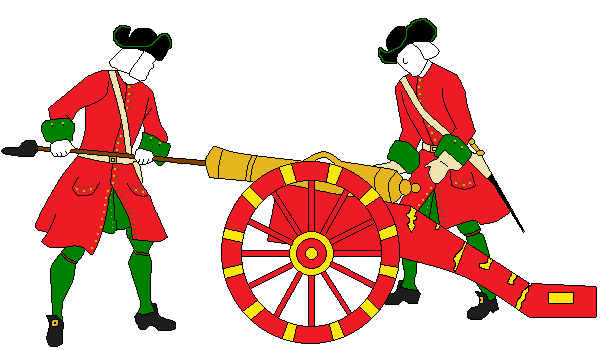
1691-1695 |
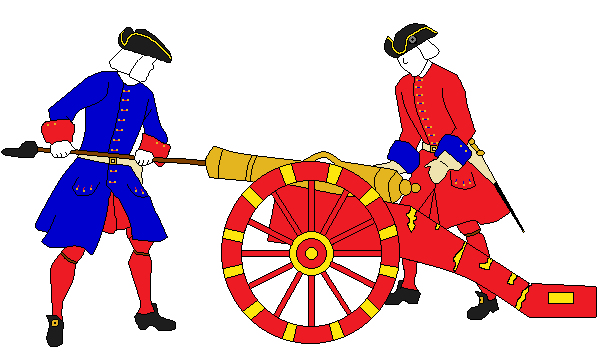
1701- |
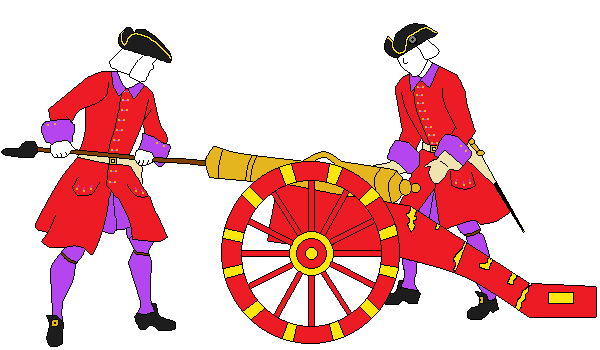
1714-1716 |
|
Red coat with green facings and lining. |
Blue coat with red cuffs and stockings, and a red raincoat with blue cuffs and lining. |
Red coat with violet facings and lining |
When the
Danish army was on campaign, most of its field artillery came from the
Holstein Corps.
Organisation 1684
When the Holstein Artillery Corps was formed, it was organised with a staff
and a Pyrotechnic & Craftsmen Company with 42 men
and six artillery companies, each with 69 men. Each company had four
officers (1 captain, 2 lieutenants and 1 "stykjunkere"), four non-commissioned officers and a drummer.
In total, the corps had a strength of 456 men.
In 1689, two artillery companies in Oldenburg, each with 50 men, were
subordinated to the Holstein Corps. Further organisational changes
apparently took place since the corps had the following organisation in 1699:
Organisation
1699
(459 men distributed on a staff, 8 companies
and 2 detachments with major general Andreas Harboe as its commander)
Staff
(in Rendsburg) |
|
Pyrotechnic & Craftsmen Company
( in Rendsburg) |
|
Holstein artillery companies |
|
Oldenburg Artillery Company |
1 Major General
1 Lieutenant Colonel
1 Major
1 Arsenal Clerk
1 Assistant Arsenal Clerk
1 Judge-Advocate
1 Surgeon
1 Capitaine d'armes (in Oldenburg) |
1 Tøjmester
1 Pyrotechnic Lieutenant
1 Stykjunker
12 Pyrotechnics
1 Miner Lieutenant
6 Miner Journeymen
1 Blacksmith + 4 journeymen
1 Gunsmith
1 Turner + 1 journeyman
1 Carpenter + 4 journeymen
1 Wheelwright + 4 journeymen
1 Carriage Maker + 1 journeyman
1 Saddler + 1 journeyman
1 Cooper |
|
1 Captain
1 Lieutenant (a Captain Lieutenant in the Colonel's Company)
1 Stykjunker
3 NCOs
2 Sub Pyrotechnics + 2 journeymen
14 Gunners
36 Crewmen
1 Drummer |
1 Captain
1 Lieutenant
1 Stykjunker
2 Pyrotechnics
2 NCOs
10 Gunners
20 Crewmen |
|
6 men
(excluding officers) The Judge-Advocate
was also Regimental Quartermaster and Adjutant.
|
37 men
Detachement |
6 x 61 men
(6 companies stationed in Rendsburg, Glückstadt
and Fredrichsort) |
1 Gunner
1 or 2 Crewmen |
|
45 men |
2 + 3 men
(in Steinburg and Hitler Skanse) |
|
The Holstein artillery
corps was also strengthened during the mobilisation in the
winter of 1699-1700 by expanding each company with six men and also hiring
an additional 12 pyrotechnics. However, unlike the Danish Artillery
Corps, this expansion was not made permanent and in May 1701 its strength was
actually lower than it had been in August 1699.
Organisation
1701
(415 men distributed on a staff and 8 companies commanded by
major general Andreas Harboe)
|
|
Staff |
|
Pyrotechnic & Craftsmen Company |
|
Holstein artillery companies |
|
Oldenburg Artillery Company |
1 Major General
1 Colonel
1 Major
1 Tøjmester (in Glückstadt)
1 Tøjvarter
1 Arsenal Clerk
1 Assistant Arsenal Clerk
1 Judge-Advocate & Regimental Clerk |
1 Lieutenant
12 Fyrværkere
1 Master Miner + 6 journeymen
2 Gunsmiths
1 Carriage Maker + 1 journeyman
1 Wheelwright + 2 journeymen |
1 Captain
1 Lieutenant
1 Stykjunker
1 NCOs
2 Sub Pyrotechnics
16 Gunners
32 Crewmen
1 Drummer |
1 Lieutenant
1 Stykjunker
2 Sub Pyrotechnics
16 Gunners
32 Crewmen
(the company had no captain as the major was its company commander) |
|
5 men
(excluding officers) |
27 men |
6 x 55 men |
52 men + the major |
|
Organisation
1709
(620 men distributed on a staff and 8 companies commanded by
brigadier Martin Jacob Wilster)
|
|
Staff |
|
Pyrotechnic & Craftsmen Company |
|
Holstein artillery companies |
|
Oldenburgs Artillery Company |
1 Brigadier
1 Lieutenant Colonel
1 Major
1 Tøjmester (in Glückstadt)
1 Tøjvarter
1 Arsenal Clerk
1 Assistant Arsenal Clerk
1 Judge-Advocate & Regimental Clerk |
1 Captain
12 Pyrotechnics
1 Master Miner + 6 journeymen
2 Gunsmiths
1 Carriage Maker + 1 journeyman
1 Wheelwright + 2 journeymen
1 Saddler + 1 journeyman |
1 Captain
1 Lieutenant
1 Stykjunker
3 NCOs
4 Sub Pyrotechnics
26 Gunners
52 Crewmen
1 Drummer |
1 Lieutenant
1 Stykjunker
2 Sub Pyrotechnics
16 Gunners
32 Crewmen
(the company had no captain as the major was its company commander) |
|
5 men
(excluding officers) |
|
29 men |
|
6 x 89 men |
|
52 men + the major |
The Holstein artillery
corps had also (with the exception of Oldenburg's) had its artillery
companies expanded in the winter of 1708-1709.
When war broke out in 1709,
three Holstein companies were assigned to the field army. These were
reinforced with 12 men from each company at home. In addition, the field
companies each received an extra lieutenant and drummer. |
|
Norwegian
Artillery Corps
|
1685 |
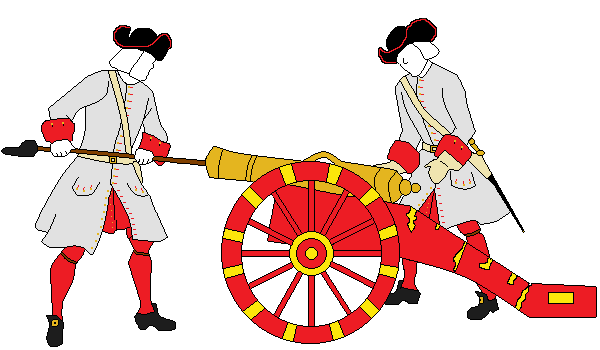
1697 |
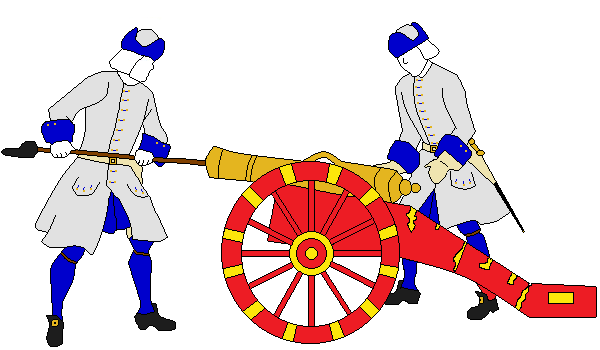
1710 |
|
Violet coat with green facings according to Daniel Schor and
Lars-Eric Höglund. Karsten Skjold Petersen does not mention this
uniform. |
Steel grey coat with red lining and cuffs, cloth cassock (cloak) in
the same colours. Black hat and white neckcloth. |
Steel grey coat with blue lining and
waistcoat. Leather breeches and riding cap or
karpus. A royal decree from 1709 that all artillery corps should adopt a common
uniform consisting of a blue coat and red surtout does not seem
to have been implemented. |
|
1711 (?) |
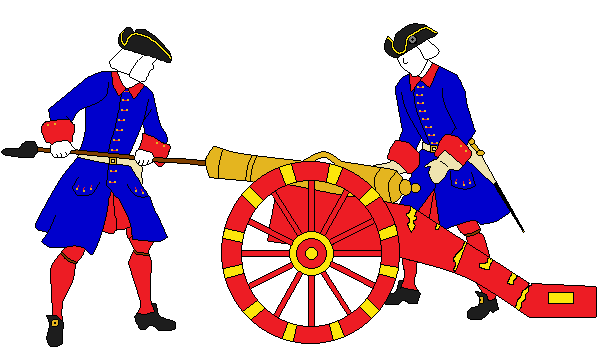
1718 |
1720 |
|
Red coat with violet lining and trousers. This is according to Daniel
Schorr, who mentions that all artillery corps were supposed to have
violet colour, but that a good supply of dark blue clothing meant that
the others probably used it instead and that the Norwegian corps might
also have done so. Karsten Skjold Petersen does not mention this
uniform. |
According to Daniel Schorr, Trondheim's company had blue coats with red
cuffs.
Karsten Skjold Petersen mentions a blue coat with red facings and lining.
But he does not specify if it was the whole corps or just one company. |
Red coat with blue facings and lining, and red stockings according to Daniel
Schorr. Karsten Skjold Petersen only mentions a red coat.
Lars-Eric Höglund has more details: dark blue
waistcoat and breeches as well
as yellow hat lace and brass buttons. |
In a drawing by Worgewitz
from 1728 (found at the top of this page) the Norwegian artillery still
wears the same uniform as in 1720. But the button colour is white even
though the hat galloon is yellow (these colours tend to match each other
at this time). However, Worgewitz's drawings often
contain dubious details, so they should be taken with a grain of salt.
Daniel Schorr also mentions that train personnel had
grey coats of vadmal with red cuffs and brass buttons in 1713.
Organisation before 1699
The Norwegian artillery, which
in 1670 had consisted of 81 men, was given a fixed strength of 202 men in
1680, distributed into two companies of 100 men and a staff consisting of a
major and a clerk. The organisation was later changed to seven
companies of different sizes (one company for each fortress) and the total
strength was increased to 302 men. At New Year 1699, the Norwegian artillery
was reduced by 42 men so that it had the following organisation:
Organisation 1699
(260 men distributed among 7 companies)
|
Akershus Company |
|
Frederiksstad Company |
|
Frederikshald Company |
1 Lieutenant Colonel (David Felber)
1 Lieutenant
1 Stykjunker
8 Pyrotechnics
1 Capitaine d'armes (Arklimester)
10 Gunners
20 Crewmen
1 Master Miner
4 Miner Journeymen
1 Carriage Maker/Carpenter
1 Blacksmith
1 Gunsmith/Stockmaker
1 Wheelwright
SUM: 51 men |
1 Captain
1 Lieutenant
1 Stykjunker
1 Capitaine d'armes (Arklimester)
14 Gunners
28 Crewmen
1 Miner Journeyman
1 Carriage Maker/Carpenter
1 Blacksmith
1 Gunsmith/Stockmaker
1 Cooper
SUM: 51 men |
1 Captain
1 Lieutenant
1 Stykjunker
1 Capitaine d'armes (Arklimester)
8 Gunners
16 Crewmen
1 Carriage Maker/Carpenter
1 Blacksmith
1 Gunsmith/Stockmaker
1 Cooper
SUM: 32 men |
Kongsvinger Company |
Bergenshus Company |
Trondheim Company |
1 Major
1 Stykjunker
6 Gunners
12 Crewmen
1 Cooper
SUM: 21 men |
1 Captain
2 Lieutenants
1 Stykjunker
1 Capitaine d'armes (Arklimester)
10 Gunners
20 Crewmen
1 Miner Journeyman
1 Carriage Maker/Carpenter
1 Blacksmith
1 Gunsmith/Stockmaker
SUM: 39 men |
1 Captain
2 Lieutenants
1 Stykjunker
2 Pyrotechnics
1 Capitaine d'armes (Arklimester)
10 Gunners
20 Crewmen
1 Miner Journeyman
1 Carriage Maker/Carpenter
1 Blacksmith
1 Gunsmith/Stockmaker
SUM: 42 men |
Kristianssand Company |
1 Lieutenant
1 Stykjunker
1 Capitaine d'armes (Arklimester)
7 Gunners
14 Crewmen
SUM: 24 men |
|
Organisation 1709
(342 men, still 7 companies but now spread over 12
fortresses)
|
|
Akershus Company |
|
Frederiksstad Company |
|
Frederikshald Company |
1 Colonel (Peter Jacob Wilster)
2 Lieutenants
1 Stykjunker
3 Pyrotechnics
1 Capitaine d'armes (Arklimester)
10 Gunners
20 Crewmen
1 Master Miner
4 Miner Journeymen
1 Carriage Maker
1 Blacksmith
1 Gunsmith
1 Hjulmager
1 Turner
2 Cooper
SUM: 50 men |
1 Captain
2 Lieutenants
2 Stykjunkere
3 Pyrotechnics
1 Capitaine d'armes (Arklimester)
12 Gunners
24 Crewmen
1 Miner Journeyman
1 Carriage Maker
1 Blacksmith
1 Gunsmith
1 Wheelwright
1 Turner
1 Cooper
SUM: 52 men |
1 Major
2 Lieutenants
1 Stykjunker
2 Pyrotechnics
1 Capitaine d'armes (Arklimester)
8 Gunners
16 Crewmen
1 Master Miner
1 Carriage Maker
1 Blacksmith
1 Gunsmith
1 Wheelwright
1 Turner
1 Cooper
SUM: 38 men |
Kongsvinger Company |
Bergenshus Company |
Trondheim Company |
1 Captain
1 Lieutenant
1 Stykjunker
1 Pyrotechnic
8 Gunners
16 Crewmen
1 Carriage Maker
1 Blacksmith
1 Gunsmith
1 Wheelwright
1 Turner
1 Cooper
SUM: 34 men |
1 Captain
1 Lieutenant
1 Stykjunker
1 Capitaine d'armes (Arklimester)
10 Gunners
20 Crewmen
1 Miner Journeyman
1 Carriage Maker
1 Blacksmith
1 Gunsmith
1 Wheelwright
SUM: 39 men |
1 Captain
2 Lieutenants
1 Stykjunker
2 Pyrotechnics
1 Capitaine d'armes (Arklimester)
10 Gunners
20 Crewmen
1 Miner Journeyman
1 Carriage Maker
1 Blacksmith
1 Gunsmith
1 Wheelwright
SUM: 42 men |
Kristianssand Company |
Christiansfjæld – 12 men |
|
Skonæs – 8 men |
1 Captain
2 Lieutenants
2 Stykjunkere
1 Pyrotechnic
1 Capitaine d'armes (Arklimester)
10 Gunners
20 Crewmen
1 Carriage Maker
1 Gunsmith
1 Wheelwright
1 Turner
1 Cooper
SUM: 42 men |
1 Stykjunker
1 Pyrotechnic
3 Gunners
6 Crewmen
1 Blacksmith |
1 Lieutenant
1 Capitaine d'armes (Arklimester)
2 Gunners
4 Crewmen |
|
Stavern – 6 men |
|
Basmo – 12 men |
2 Gunners and 4 Crewmen |
1 Stykjunker
1 Pyrotechnic
3 Gunners
6 Crewmen
1 Blacksmith |
Agerøen – 7 men |
1 Lieutenant
1 Stykjunker
1 Gunner
4 Crewmen |
Read also about the Norwegian army's uniforms. |
|
References
Hasselager Olaf – Snorrason, Torstein. Danish Uniforms, Colours and Standards 1675-1679. (2000) *
Höglund, Lars-Eric – Sallnäs, Åke. Stora nordiska kriget 1700-1721, II. Karlstad (2003)
Schorr, Daniel. Notes on the Norwegian Army 1700-1720 (2008) *
Skjold Petersen, Karsten. Den danske hærs uniformer i 1700-tallet. Copenhagen (2005)
Skjold Petersen, Karsten. Kongens klæder. Copenhagen (2014)
Tuxen, A. P. – With-Seidelin C. L. Bidrag til den store nordiske krigs historie.
Copenhagen (1899-1934)
* = articles published on the now defunct website
www.northernwars.com |
|