|
Örjan Martinsson
| |
|

Denmark's first
national militia from 1614 was
abolished after the end of the Scanian War in 1679. Christian V
preferred to recruit foreigners into his army so that the Danish
men could work in agriculture and contribute to the country's
economy. But enlisted soldiers were expensive and an army that
would defeat Sweden needed to be large. Therefore, the new king
Frederik IV realised in 1701 that it was necessary to reintroduce
a national militia. The new national militia became much larger
than its predecessor and when it was at its largest at the
outbreak of war in 1709 it consisted of just over 16,000 infantry
and about 2,400 dragoons. However, casualties during the Great
Northern War resulted in its size being gradually reduced to spare
the agricultural workforce. After the end of the war, the national
militia was only 10,000 strong. Although this was also perceived
as too great a burden and Christian VI chose to abolish the
national militia immediately after his accession to the throne in
1730.
|
|
General History
During the Scanian War of
1675-1679, conscription ceased in Denmark (except for Bornholm) and the
Danish army thereafter consisted solely of enlisted soldiers who were mainly
recruited in Germany. The native population would thus be spared from
military service and instead contribute tax revenue to the Danish crown.
Denmark's ambitious foreign policy, however, was geared to create the right
circumstances for a war against Sweden that would return lost territories.
This required a strong army, but the tax revenue was not sufficient if the
army consisted solely of enlisted soldiers. During the interwar period, the
generals therefore tried in vain to persuade Christian V to re-establish the
national militia, but he remained steadfast until his death in August 1699,
just as Denmark was preparing for a new war.
During the mobilisation of
1699-1700, there were once again proposals to relieve the regular army from
some of its duties by forming a national militia. This would be recruited
through conscription and then used as garrisons in the fortresses so that
the enlisted regiments could instead serve in the field army. The new king
Frederik IV opposed this because, like his father, he believed that the
country's economy would be damaged if agriculture was deprived of labour.
But the short war in 1700 revealed that the Danish army was not large enough
to defeat Sweden under the prevailing alliances. War experience meant that
proposals for a national militia were once again put forward, and this time
Frederik IV chose to listen to them. The result was the ordinance on "Establishing
the National Milita in Denmark " which was decreed on 22 February 1701. The differences compared to the old national militia that was abolished in
1679 and the new one that was now established, were first and foremost that
the size of the new one was much larger. While the national militia infantry
only consisted of 4,911 privates at the time of the Scanian War, the new
national militia was initially to have an infantry force of about 13,700
privates (another regiment was added in 1704 in Oldenburg). The cavalry, on
the other hand, was more limited and consisted of about 2,200 private
dragoons, which was about half of the national cavalry that Christian V
created in the 1670s. But Christian V's national cavalry had in practice not
been abolished. Because even though the cavalrymen now were enlisted and not
conscripted, they were still funded by the so-called cavalry estates that
had been formed during his reign. The extra 2,200 dragoons thus effectively
meant a larger national cavalry than the one that existed in the 1670s. The term of service in Frederik IV's national militia was, at six years,
double that of the old national militia. However, Frederik IV's national
militia had a more limited budget. The ratio of officers to privates was
lower and money for equipment and uniforms was at a minimal level. Much less
time was also spent on training the men, who mainly worked as farm labourers
during peacetime. The training took place after church services on Sundays
and consisted of two hours of drill in the summer and one hour in the winter.
Depending on the time of year, the men were trained every or every other
Sunday. Four times a year, the entire company gathered for joint drill and
once a year the entire regiment would be assembled. The purpose of the new national militia was that it would relieve the
enlisted army from some of its duties by being used as a garrison troop,
coastal defence and for naval service. The entire enlisted army could thus
be freed to serve in the field army. This distinguished Frederik IV's
national militia from its predecessor, which was used in the same way as the
enlisted regiments. In practice, however, the shortage of troops during the
Great Northern War meant that national militia units had to make
contributions to the field army, although except for the cavalry, this did
not happen to the same extent as during the Scanian War. However, this was
done in violation of the ordinance from 1701, which contained a ban on using
the national militia outside the country's borders. The war also brought recruitment problems for a national militia that was
considerably larger than its predecessor. Frederik IV had chosen the largest
size of the various options that had been discussed. And when a third of the
national militia was used to replace losses in the enlisted regiments after
the Battle of Helsingborg, at the same time as the naval service claimed
many lives because of disease, the burden of maintaining the size of the
national militia became too high. Recruitment to the national militia was
becoming increasingly onerous for the agriculture, which formed the basis of
the Danish economy. The size of the Danish national militia infantry was
therefore reduced in stages from the original 13,700 privates to 10,200
privates in 1711 and to 7,300 privates in 1717. When Frederik IV died on 12 October 1730, his successor Christian VI decided
to abolish the national militia that same month. The justification for this
was that the national militia was a "large and soon-to-be insufferable
nuisance and burden" for the whole country, and especially for the young
men. The abolition came as a great surprise to all parties involved. However,
after persuasion campaigns, Christian VI agreed to reintroduce the national
militia in a new form as early as 1733. It was primarily the landowning
aristocracy that was the driving force behind the reestablishment of the
national militia. However, their main motive was not to strengthen the
country's military defence. The real goal was to make Danish men of military
age serfs in the same way that had partly happened in the final stage of
Frederik IV's national militia. |
|
Organisation
On 22 February 1701, Frederik
IV issued an ordinance establishing a national militia in Denmark. Seven
regiments, each with 12 companies, forming three battalions, were to be
created. However, the Fynske National Regiment received 13 companies because
the Langeland company, which was originally intended to belong to
Viborg-Lolland, was transferred to them at a late stage. Each company was to
consist of at least 150 privates, but they could be up to 200 strong
depending on the availability of men in the recruiting districts. Almost all
officers were appointed on 26 March, and the privates were then recruited
during the spring and summer. The number of officers and private infantrymen
together was about 14,800 men.
The so-called cavalry estates
that were responsible for supporting the national cavalry regiments were
initially exempt from conscription of national militia soldiers. The idea
was that they would later set up national militia dragoons. However, because
so many young men tried to avoid conscription by moving to them, the
conscription of dragoons was brought forward to 1702. These were first
included in the national militia infantry regiments until they formed their
own regiments in 1704 (two with nine companies each and formed into three
squadrons) with a total personnel strength of about 2,400 men.
The Danish king also ruled the
German counties of Oldenburg and Delmenhorst, and despite the bad
experiences from the Scanian War, the plan from the very beginning was that
they too would recruit a national militia regiment. However, the work of
raising this regiment dragged on and the conscription was not carried out
until 1704. This regiment was weaker than the Danish ones and consisted of
eight companies with a total of 1,222 privates plus 109 "prima plana" (=
staff personnel). However, no national militia was raised in the duchies of
Schleswig-Holstein, which had a long history of substandard national militia
units during the 17th century.
Infantry
Organisation
Regimental Staff
(Viborg had extra personnel) |
Company Staff |
|
Regiments
(12 companies) |
Privates
1702 |
Privates
1706 |
Average Company Size
(1706) |
Dragoons
(1702) |
1 Colonel
1 Major
1 Ensign (2 in Viborg)
1 Regimental Clerk
(also Judge-Advocate)
1 Judge Advocate
1 Surgeon (2 in Viborg)
1 Provost
1 Provost assistant |
|
1 Captain
1 Lieutenant (2 in wartime)
(the colonel’s company and the major's company lacked a captain) |
West Zealand |
2,152 |
2,179 |
c. 182 |
640 |
|
East Zealand |
2,130 |
2,130 |
c. 178 |
74 |
|
Funen (13
companies) |
2,010 |
2,004 |
c. 154 |
442 |
|
Århus |
1,874 |
1,872 |
c. 156 |
330 |
9 Corporals
(8 from 1711) |
Ribe |
1,800 |
1,835 |
c. 153 |
429 |
|
Ålborg |
1,838 |
1,859 |
c. 155 |
227 |
|
2 Drummers |
Viborg-Lolland |
1,875 |
1,893 |
c. 158 |
33 |
|
Sum: 6 (10) men |
13 men |
|
13,679 |
13,772 |
c. 162 |
2,195 |
|
Oldenburg had a regimental
quartermaster instead of a regimental clerk. In addition, according to
Tuxen, they had two ensigns. |
Oldenburg
(8 companies.) |
1,222 privates
(in 1704) |
c. 152 |
|
Initially, all private soldiers
in the national militia were musketeers, but in 1704 each national militia
company was to equip two men as pioneers and eight men as grenadiers.
The literature does not agree
on how many ensigns (= colour bearers) each regiment had. According to Tuxen
(vol. 2, p. 70), each battalion was to have an ensign, which was normal for
Danish infantry regiments. Rockstroh (vol. 2, p. 447) states, on the other
hand, that the national militia infantry only received one ensign per
regiment, except for Viborg-Lolland, which received two. The justification
was that colours were expensive and, since the national militia was not
intended to fight in pitched battles, a colour was only needed when new
soldiers were to swear their oath. Viborg-Lolland received two colours
because that regiment was recruited in two different parts of the country.
This is also the reason why Viborg-Lolland received extra staff personnel in
other categories. Viborg and Lolland were in practice two separate units
with the same colonel.
The literature also disagrees
about how many non-commissioned officers each company had. According to
Rockstroh (vol. 2, p. 445) each regiment was to have 120 non-commissioned
officers. Tuxen, who describes the company staffs in more detail, states
(vol. 2, p. 70) that they initially consisted of 9 corporals and 2 drummers
in addition to the two officers that Rockstroh and Tuxen agree on. Tuxen
also mentions (vol. 3, p. 361) that the number of non-commissioned officers
was reduced at the end of 1711 from 9 to 8 in each company.
When the national militia was
converted to a war footing in 1709, each infantry company received an extra
lieutenant, and they were retained until the peace in 1720.
During the war, the number of
privates in each company was reduced in several steps due to recruitment
problems. In addition, a reorganisation took place in 1717 that reduced the
number of Danish infantry companies from 85 to 73. The reduced companies
consisted of the Viborg part of the Viborg-Lolland regiment and eight
Zealand (Sjællandske) companies. What remained of the Viborg-Lolland
and West Zealand regiments were merged and became the South Zealand
Regiment, which also took over the Langeland company from Funen Regiment.
| |
Privates per company |
Total number of privates |
|
1701 |
At least 150 |
c. 13 700 |
|
1711 |
120 |
10 200 |
|
1713 |
100 (only Lolland-Falster) |
10 040 |
|
1717 |
100 (the entire national militia) |
7 300 |
|
1724 |
100 |
7 200 |
A final reorganisation before
the national militia was abolished in 1730 was carried out in 1724. The
number of companies was reduced from 73 to 72 and the geographical
distribution was changed so that Zealand received more companies and
Lolland-Falster received fewer. South Zealand Regiment thus received the
normal number of companies, which were distributed among 6 from Zealand, 1
from Møn, 4 from Lolland-Falster and 1 from Langeland.
Note that Oldenburg National
Regiment is not included in the table above. It is unclear to me to what
extent it was affected by organisational changes since Rockstroh barely
mentions it and it never left its home province during the war. Tuxen
mentions (vol. 3, p. 152) that Oldenburg National Regiment was reduced by
two companies because of Delmenhorst etc. being pawned (summer 1711?).
However, Tuxen states (vol. 6, p. 225) that at the turn of 1712-1713 they
had eight companies.
Cavalry Organisation
|
Regimental Staff |
|
3 Staff Companies |
|
6 Regular Companies |
1 Colonel
1 Lieutenant Colonel
1 Major
1 Regimental Quartermaster
(also judge-advocate)
1 Surgeon
1 Provost |
1 Lieutenant
1 Ensign |
|
1 Captain
1 Lieutenant |
1 Sergeant
1 Furér
4 Corporals |
|
1 Sergeant
1 Furér
4 Corporals |
|
2 Drummers |
|
2 Drummers |
Of the staff companies, the colonel’s company
had a captain lieutenant instead of a lieutenant. |
12 Grenadiers
c. 110 Dragoons |
|
12 Grenadiers
c. 110 Dragoons |
|
Sum:
1,252 men
(Zealand-Funen) and 1,135 men (Jutland) |
The above organisation was the
one that applied in peacetime when the two national dragoon regiments were
formed in 1704. Shortly before the outbreak of war in 1709, the regimental
staffs were expanded with 1 judge-advocate, 1 adjutant, 1 priest and 1 wagon
master. In addition, each dragoon company received an ensign. A more
extensive reorganisation took place on 7 December 1709 when both regiments
handed over men to the Hungarian Dragoon Regiment (221 men from
Zealand-Funen and 135 from Jutland). In addition, the national dragoon
regiments were divided into twelve companies each so that all Danish dragoon
regiments would have the same organisation consisting of 1010 combatants.
When the national dragoon
regiments went on campaign, the cavalry estates lost their workforce, which
they replaced by hiring new servants. But when the regiments were sent home
after the Scanian campaign ended, many dragoons lacked employment and lived
in misery. The king solved the problem by deciding in December 1710 that
they would be paid as enlisted soldiers for as long as the war lasted.
However, they were still recruited through conscription.
During the winter of 1710-1711,
both regiments were converted to cuirassier regiments. According to
traditional belief, this was done as a reward for good performance in
battles (Helsingborg 1710 for Zealand-Funen and Wismar 1711 for Jutland).
However, the Jutland regiment became cuirassiers already on 15 December
1710, while Zealand-Funen was converted on 9 March 1711. When the national
dragoons were converted to cuirassiers, the drummers disappeared and they
were replaced by a kettle drummer in the regimental staff and trumpeters in
the companies.
In 1713 the Danish cavalry was
reorganised so that the regiments would consist of only eight companies. For
the Zealand-Funen National Cuirassiers this meant that four companies were
transferred to the First Zealand Cavalry Regiment, while the Jutland
National Cuirassier Regiment, which had been on campaign, disbanded the four
most depleted companies. The surplus men were transferred to other cavalry
regiments. Although they were still recruited through conscription, the men
of the national cuirassier regiments were treated as if they were enlisted
soldiers and could be transferred to an enlisted regiment without further
ado in the event of reorganisations.
New national dragoons were
introduced after the cavalry estates were reorganised in 1715-1716 and the
Zealand national militia infantry was reduced in 1717. Each cavalry
regiment's district would then also recruit two conscripted dragoon
companies of 100 men each. These companies were combined into three national
dragoon regiments of eight companies each: an East Zealand regiment, a West
Zealand regiment (with four companies on Lolland-Falster) and a Jutland
regiment (with two companies on Funen). The colonels of the new national
dragoon regiments were appointed in December 1717, but it would be until
1723 before these so-called dragoon regiments actually received horses. The
company size was reduced to 75 privates in 1719 and the total strength of a
conscripted dragoon regiment was 664 men. All this information comes from
Rockstroh, who, however, writes for the year 1722 that the dragoon companies
had 88 privates without telling how this change occurred (volume 3, page
78). Such a company size means that the number of privates in each regiment
had increased from 600 to 704 men.
The old national dragoon
regiments, which had become national cuirassiers, were disbanded in 1721
when the army was put on peace footing. The fact that these were disbanded
despite being considered among the better cavalry regiments is believed to
be because they were composed of ethnic Danes. The Danish government
preferred to recruit foreigners into the army so that native Danes could
instead contribute labour to the farms.
Recruitment
Peasants and landowners were
given the responsibility of recruiting soldiers for the national militia,
and the burden was distributed based on how much farmland they owned. The
unit used in Denmark to measure farmland was barrels of “hartkorn” (hard
corn), and Denmark was divided into “lægder” (the Danish equivalent of the
Swedish “rotar”), each of which corresponded to 20 barrels of hard corn.
Each lægd was to recruit one foot soldier. The cavalry estates were exempt
from this division, as they were to recruit dragoons.
Although each lægd was formally
of equal size, the supply of men was not the same. In the parts of the
country with many small farmers (especially western Jutland), it was
necessary to combine several different scattered farms to form lægder of the
right size. But small farmers had limited access to farm labourers who could
be conscripted. In the first round of conscriptions in 1701, this was
clearly noticeable and many lægder were unable to recruit a soldier. After
the summer conscription, there were a total of 915 vacant lægder and almost
all of these (823 vacancies) were from the dioceses of Ribe and Århus in
Jutland. Other provinces had only minor vacancies: 21 in Zealand, 5 in the
diocese of Funen and 66 in the dioceses of Ålborg and Viborg. The solution
to this problem was to make it possible to conscript men in populous lægder
to fill vacant lægder. But even then, some lægder would occasionally be
vacant due to a shortage of men, which is why there are different columns
for the years 1702 and 1706 in the above table for the organisation of the
infantry regiments. The recruitment problems would only get worse during the
Great Northern War, and this led to the system of lægder being practically
abandoned on 3 April 1711. Thereafter, losses were replaced jointly by all
lægder in the respective province.
|
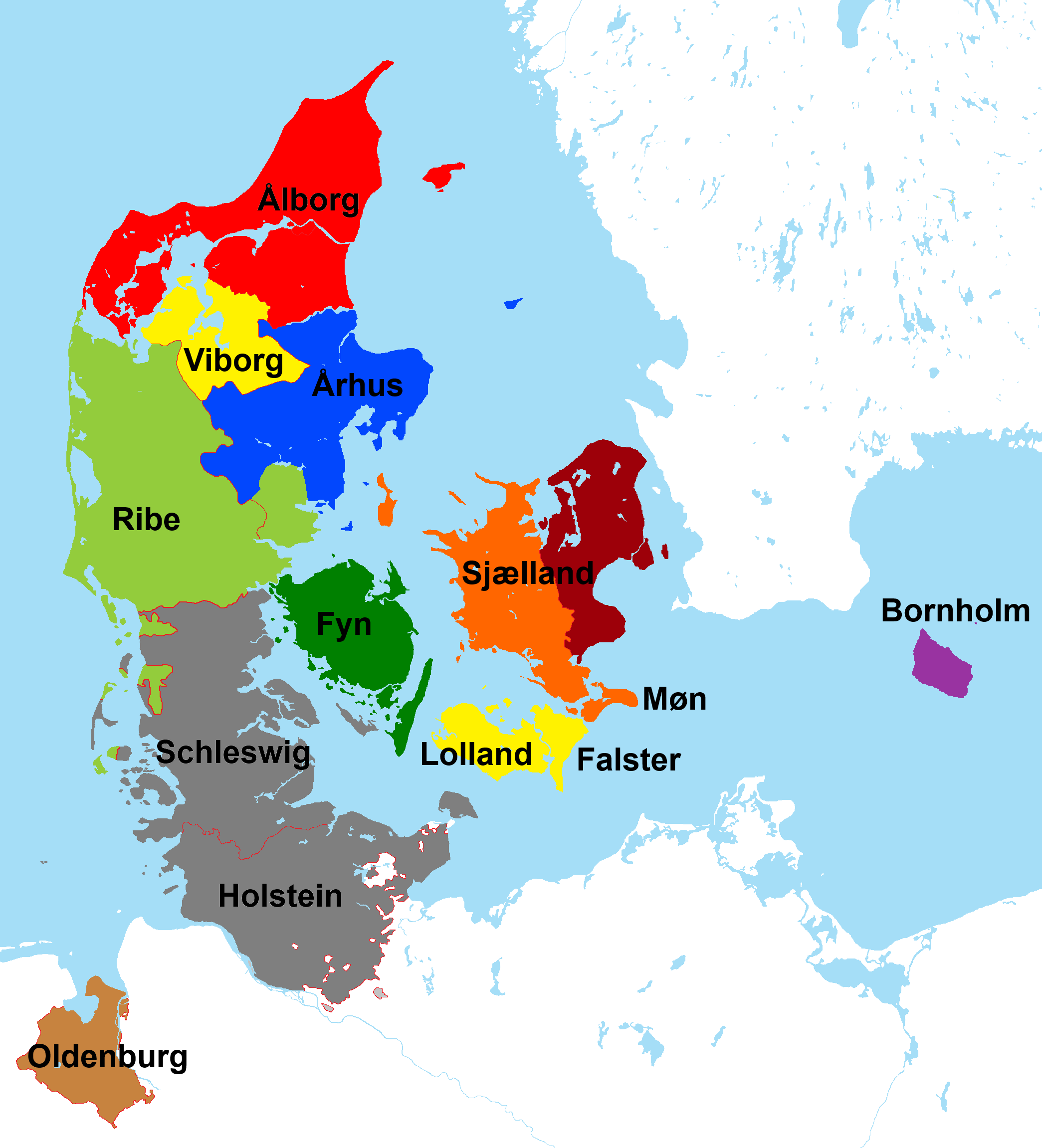 |
Recruiting Districts
(1701-1717)
Danish National Regiments:
 =East Zealand (Østsjællandske)
 =West Zealand (Vestsjællandske)
 = Viborg-Lolland
 = Funen (Fynske)
 = Ålborg (Ålborgske)
 = Århus (Århusiske)
 = Ribe (Riberske)
Note that smaller islands often
supplied men to the navy instead of the national regiments. An example
of this is Samsø between Zealand and Jutland which, despite being orange
on the map, did not contribute men to the West Zealand Regiment.
 =
Bornholm Militia =
Bornholm Militia
(described
on another page)
 =
Oldenburg (Oldenborgske) =
Oldenburg (Oldenborgske)
 = Schleswig-Holstein
(no national militia was recruited in these two duchies)
|
When Denmark was divided into
lægder in 1701, it quickly became apparent that it was not possible to
accommodate a full regiment of 1,800 men in each of the four Jutland
dioceses. Only the diocese of Århus was large enough and it had to
contribute to the Ribe regiment by allowing it to recruit soldiers in the
southern counties of Stjernholm and Skanderborg. The Ålborg regiment
recruited 520 men in the part of Ålborg county that belonged to the diocese
of Viborg (south of the Limfjord). The rest of the diocese of Viborg only
managed to recruit 550 men, so that more than two-thirds of the regiment was
recruited on the islands of Lolland and Falster, which were in a completely
different part of the country.
The term of service for the
individual soldier was originally set at six years. However, since the
entire national militia was raised at the same time, it meant that almost
the entire militia would be replaced by new, untrained soldiers in 1707. To
prevent the quality of the national militia from deteriorating drastically
when war with Sweden was imminent, the term of service was extended so that
only 20 men per company were allowed to leave each year. When war broke out
in 1709, the term of service was extended indefinitely.
The Great Northern War resulted
in high losses of men, which put pressure on the farmers and landowners who
were supposed to replace the losses with new conscripts. Already during the
Scanian campaign of 1709-1710, the field army suffered such extensive losses
in the Battle of Helsingborg that the Danish government judged that it was
not possible to replace them by enlistment. Instead, a third of the Danish
national national militia (about 4,600 men) was used to fill gaps in the
enlisted regiments during the spring of 1710. National militia soldiers who
agreed to be enlisted were promised to be discharged from military service
after the end of the war. It was believed at the time that the war would be
shorter than the six-year term of service in the national militia. Another
attraction was that enlisted soldiers were spared from service in the navy,
where mortality was high. Every year during the period 1710-1712, over 3,000
national militia soldiers were commandeered to the navy.
The national militia would then
replace the soldiers who enlisted with new conscripts. But the national
militia's own losses also needed to be replaced, which meant a total need to
conscript 7,000 men. This was a heavy burden for the Danish farmers, which
was made worse by the fact that they also had to replace all the soldiers
who died of disease during naval service. When so many young men were
conscripted as soldiers, the shortage of labour in agriculture became
increasingly onerous. Therefore, on 3 April 1711, it was decided to cancel
conscription for the national militia during that year. Instead, each
company was reduced to 120 men, which meant a total strength for the
national militia infantry of 10,200 privates. The surplus men were
discharged from military service and could now work as farm labourers
instead. In 1712, however, conscriptions returned because naval service and
a plague epidemic had resulted in the death of at least 2,000 national
militia soldiers.
During the 1712 campaign, the
Danish army suffered another defeat at the Battle of Gadebusch. This time,
the national militia did not have to replace losses in the enlisted
regiments. On the other hand, the Viborg-Lolland regiment had suffered high
casualties, since the Viborg battalion had participated in the Battle of
Gadebusch and the Lolland battalions lost a lot of men due to illness when
they were commandeered to the navy (40% and 33% of the strength had to be
replaced, respectively). The Funen regiment had also suffered high losses
(20%). To reduce the burden on the Lolland farmers, whose soldiers were
frequently used for naval service, the size of their companies was reduced
to 100 privates.
Continuing recruitment problems
led at the beginning of 1714 to the Jutland regiments filling vacancies by
recruiting Swedish prisoners of war. These consisted of 130 Germans, 42
Scanians & "native Norwegians" (= Bohuslän men) and about 400 ethnic Swedes.
The Viborg battalion in particular came to consist of so many prisoners of
war that the Danish army had reservations about using it in the upcoming
campaign. Funen and Lolland-Falster were also subsequently allowed to
recruit Swedish prisoners of war, while it remained prohibited on Zealand
for fear of Swedish landing attempts on the island. However, Swedes
belonging to companies that were commandeered to the navy were left behind
on Zealand. It also became routine to leave the Swedes in Denmark every time
a battalion was on campaign.
A new reform took place in
December 1717. This was because Funen National Regiment had suffered high
mortality during its stay in Norway and that six Jutland companies were
captured by the Swedes when their ship ran aground in November 1716. The
company size was reduced to 100 privates of the "Danish nation" for all
infantry regiments in the national militia. The Viborg battalion had also
almost melted away in Norway and was disbanded (its district was divided so
that Århus and Ribe each received half). The Zealand infantry was
reorganised from 24 companies to 16 in order to increase the number of
cavalry. In total, this meant that the strength of the infantry was reduced
to 7,300 men.
After the peace of 1720, the
term of service was supposed to be six years again, but abuse of power meant
that the soldiers continued to serve indefinitely. The officers wanted to
retain experienced men instead of replacing them with green recruits. The
landowners, in turn, had benefited from the fact that the term of service
had no end date. This meant that the only option for the soldier to end his
military service was to agree to lease one of the landowners' farms. The
landowners could therefore offer worse conditions than if the soldiers had
had greater freedom of choice. Therefore, both officers and landowners
unanimously claimed that it was not possible to find new soldiers to replace
the old ones and that it was thus not possible to grant them a discharge. As
a compensation, Frederik IV decided in 1726 that soldiers who had served for
twelve years would receive higher pay. Less than a month after Frederik IV's
death in 1730, all soldiers were discharged from military service when his
successor Christian VI abolished the national militia (with the exception of
the Oldenburg National Regiment, which is also not included in the
above-mentioned sums). |
|
Great
Northern War
The task of the national militia during the war was to supply men to the
navy and fortress garrisons. It was primarily the regiments on the islands
that bore the heaviest burden for the naval service. The division of labour
for the garrisons was such that the Jutland regiments were garrisoned in the
Holstein fortresses and the Zealand regiments were garrisoned in Copenhagen
and Helsingør. It was only the national dragoons that were intended to be
used in the field armies, but nevertheless the national militia infantry
came several times to contribute battalions from nearby fortresses to the
field army in Scania and northern Germany, respectively, when necessary. In
the final stages of the war, the national militia was also sent to Norway.
However, the Oldenburg national regiment remained in its home province
throughout the war.
Scanian Campaign
1709-1710
On 28 October 1709, Denmark declared war on Sweden, but already on 17
September parts of the national militia had been ordered to mobilise. One
battalion each from the Ålborg and Århus national regiments were then
ordered to march to Schleswig-Holstein together with the Jutland national
dragoons to strengthen the southern border. One battalion each from Lolland
and Funen together with three companies from the Ribe national regiment were
ordered to the fleet. The Zealand-Funen national dragoons were to be part
of the main army that was assembled on Zealand.
At the turn of October-November,
the commander of the army in Holstein used his permission to order
additional national militia battalions to reinforce the border defence if
necessary. The national militia in Schleswig-Holstein thus became twelve
battalions strong in December after a Lolland battalion and the remaining
Jutland and Funen battalions arrived in batches. However, the situation at
the southern border was considered to be calm and the cost of having the
national militia in the field was high. The king therefore gave a
counter-order at the end of December to send six battalions home. The six
battalions that remained in Holstein then consisted of 2 Århus, 1 Ribe, 1
Ålborg. 1 Funen and 1 Viborg. At the end of January, however, the king
ordered a Ribe battalion to return to Holstein, and when the army in
Holstein was forced to hand over two enlisted regiments and the Jutland
national dragoons to the main army in Scania in mid-February, they were
replaced by one battalion each from Ålborg, Århus and Funen. Thus, there
were ten national militia battalions in Holstein at the beginning of March
1710. However, the constant marches back and forth made it difficult to
train the inexperienced men, and only the original six battalions were
properly trained. The best men were also lost in April-May when a third were
selected to fill gaps in the enlisted regiments after the Battle of
Helsingborg.
In early November, the Zealand
national regiments were mobilised and stationed in Copenhagen and Helsingør
as garrison troops, while the Zealand-Funen national dragoons reinforced
the field army in Scania in early December. However, at the end of December,
one battalion from each infantry regiment was temporarily sent home to save
money. At the beginning of 1710, 1 battalion of East Zealand was in
Helsingør and the other three battalions in Copenhagen. The battalions that
had been sent home were later recalled to service when the national militia
infantry began to reinforce the army in Scania. One battalion each from the
Zealand regiments crossed the strait in February and was part of the corps
that blocked the Swedish fortresses in Malmö and Landskrona. These later
withdrew to Helsingborg, where another battalion each from the Zealand
regiments and a Lolland battalion arrived from Denmark. Of the five national
militia battalions in Scania, four participated in the Battle of Helsingborg
together with the Zealand-Funen National Dragoons. The remaining West
Zealand battalion was garrisoned in Helsingborg during the battle. The
Jutland National Dragoons, which had been ordered to reinforce the field
army in Scania, did not get further than Zealand.
After the Scanian campaign had
ended, the Zealand and Lolland battalions that had participated in the
campaign were sent home, while the others were commandeered to the navy on
21 April, together with a Funen battalion and three Ribe companies. The
strength in Holstein was reduced to seven battalions (1 Ålborg, 1 Viborg, 3
Århus, 2 Ribe, 2 Funen). Two Ålborg battalions and one Ribe company were
garrisoned in Fredericia. The Langeland company (Funen Regiment) was
garrisoned in Nyborg and Korsør. An Ålborg battalion was moved from
Fredericia to Vendsyssel during the summer to defend the coast against
Swedish raids. In September, two Funen battalions were moved to Fredericia
in September, while the rest of the national militia in Holstein was sent
home.
The national dragoons were also
sent home after the Scanian campaign. But during their absence, the cavalry
estates had hired new workers, so the dragoons lacked employment. The king
therefore decided in December that they should be paid as if they were
enlisted soldiers for as long as the war lasted, and they were also
converted into cuirassiers. As early as October 1710, they had been drawn
together on Zealand to protect the island against a possible Swedish landing.
German
Campaigns
1711-1715
Concerns about raids by the
Swedish navy meant that the national militia was mainly used to guard the
coasts in early 1711. In April, 2 companies from East Zealand, 4 companies
from Lolland and 6 companies each from Funen, Ålborg, Århus and Ribe were
ordered to the fleet. Four Ribe companies that were originally intended for
the field army and then Norway were commandeered to the navy during the
summer. The remaining 2 Ribe companies were garrisoned in Rendsburg in
Holstein together with 2 Ålborg companies. In Holstein, 2 companies from
Århus were also stationed in Friedrichsort and 3 companies from Funen in
Glückstadt. 3 companies from Funen were also stationed in Frederica in
Jutland.
The Jutland national
cuirassiers set out from their cantonments in central Zealand on 31 May 1711
to head to plague-stricken Helsingør, which was to be cordoned off. At the
end of June they marched to Holstein, except for two companies that had been
infected and were sent to Copenhagen after recovering. The cuirassiers were
relieved at Helsingør by 6 companies from West Zealand, who were sent home
in February 1712. The plague also broke out in Copenhagen in June, and the
troops there were hit harder by the infection because the government was
unwise enough to use them to bury the bodies in the plague cemetery. When
the plague culminated in September, the garrison had been halved. Apart from
the Jutland squadron, the national militia in Copenhagen also included a
Zealand squadron. The infantry component consisted of 4 companies from
Lolland, 5 companies from East Zealand (one of these companies was
transferred to the navy) and 6 companies from West Zealand. The plague
epidemic in Copenhagen did not end until March 1712.
A force consisting of 5
squadrons of Zealand-Funen National Cuirassiers and four companies each
from Ålborg, Århus and Ribe was intended to be transferred to Norway but
they did not get further than the city of Ålborg. Most of the force was sent
to Haderslev in September and then to Funen in October and in November to
Zealand. The Ålborg battalion and two Zealand squadrons were also sent to
Zealand in November.
The national militia's
contribution to the field army in northern Germany during the second half of
1711 consisted of the Jutland national cuirassiers and four companies each
from Viborg and Århus. The national cuirassiers and the Viborg battalion
were part of the corps that from August onwards blocked Wismar. The Århus
battalion was first garrisoned in Rostock in August, joining the Wismar
corps the following month and then returning to Rostock before joining the
main army in Pomerania in October. In January 1712, the Danish army broke
off its campaign and withdrew to Holstein where it wintered until June.
During this period, the field army was reinforced by one battalion each from
Ribe and Ålborg.
The 1712 naval contingent
consisted of four companies from all infantry regiments. The remaining
Zealand companies were garrisoned in Copenhagen together with 4 companies
from Lolland, 3 companies from Funen and 2 companies each from Ålborg, Ribe
and Århus. Of the remaining Funen companies, 4 were stationed in Fredericia
and 1 each in Nyborg and Fladstrand. In Holstein, 2 Århus companies were
stationed in Friedrichsort and 2 companies each from Ålborg and Ribe were
garrisoned in Glückstadt.
The field army with four
national militia battalions and the Jutland national cuirassiers invaded the
Duchy of Bremen in July 1712, which was conquered after a siege of Stade in
August. The field army then returned to Holstein in September and in October
it attacked the free imperial city of Hamburg, which was pressured to pay
246,000 reichsthaler. To meet Magnus Stenbock's army, the Danes entered
Mecklenburg in November. However, the Ribe and Ålborg battalions, which were
in poor condition, were left behind in Holstein (Altona), so only the Viborg
and Århus battalions and the Jutland national cuirassiers participated in
the Battle of Gadebusch in December 1712. The Danish losses were extensive
and the two national militia battalions, which before the battle had a
strength of about 400 men each, were so weakened that Viborg counted 185 men
and Århus 130 men after the battle. These could no longer be used by the
field army and when Magnus Stenbock's army was later besieged in Tönning in
the spring of 1713, only the national cuirassiers and the Ålborg Battalion
were part of the siege army. After Stenbock's capitulation, the Ålborg
Battalion was garrisoned in Rendsburg while the national cuirassiers
remained in the field army.
While Magnus Stenbock's army in
Tönning had surrendered in May 1713, the fortress itself was still held by
the Holstein-Gottorp army and did not fall into Danish hands until early
February 1714. After that, a long-term work began to demolish all the
fortifications. The workforce consisted of 6 companies from Ålborg (arrived
from Rendsburg in March) and 4 Ribe companies, who after completing the work
were sent home in early July. Shortly after, ten national militia companies
that had been stationed in Glückstadt were also sent home (2 Ribe, 4 Århus,
4 Viborg) and the next month, 2 Århus companies were also relieved in
Friedrichsort. With this, the national militia's garrison service in
Schleswig-Holstein was temporarily ended.
The part of the national
militia that was stationed on Zealand (and available to naval service)
consisted at the beginning of 1713 of the Zealand-Funen national
cuirassiers, both Zealand national regiments on foot, 6 companies Ribe, 8
companies Lolland, 6 companies Århus and 7 companies Funen. Some of these
were to serve on the navy while the rest were in garrison or guarding the
coast. The national cuirassiers were transferred to Holstein during the
summer of 1713 and in November 6 companies Ålborg arrived in Zealand. This
force composition then remained unchanged until 1715.
In April 1715, the part of the
Århus and Ribe regiments that had been sent home, received orders to go to
Copenhagen and they arrived there just before they received counter-orders
to go to Holstein instead together with the Viborg battalion. These 16
companies were used as a garrison troop in Rendsburg. Friedrichsort, Altona
and Gottorp. The home-based part of the Ålborg regiment received orders the
same month to relieve the 6 companies of the Funen regiment that were
stationed in Fladstrand, Fredericia and Nyborg. Thus, there were 6
home-based Funen companies on Funen and 2 Ålborg companies in Nyborg while
the remaining 4 Ålborg companies were stationed in the Jutland fortresses of
Fredericia and Fladstrand. In mid-August, however, the entire Funen regiment
was ordered to Copenhagen.
The only national militia units
that participated in the campaigns in Germany in 1715 were the national
cuirassiers. The Jutland national cuirassiers were part of the army that
besieged Stralsund and that conquered Rügen in November, although they had
not yet landed before the Battle of Stresow was fought. The Zealand-Funen
national cuirassiers were part of the force that besieged Wismar.
Norwegian Campaigns 1716-1719
In January 1716, the Copenhagen
garrison consisted of the entire national militia infantry from Zealand,
Lolland-Falster and Funen and six companies each from Ålborg and Ribe (in
addition, the Norwegian Bergenhus Regiment was included in it). In
Helsingør, six companies from Århus were stationed. The other Jutland
infantry companies were garrisoned in Holstein, Jutland and Funen as
described above and the national cuirassiers were on campaign in Sweden's
German possessions. Fear of a Swedish invasion, however, meant that a large
part of the field army was transferred to Zealand and this made it possible
to send home 7 companies from Funen and 4 companies from Lolland and to
spread the Zealand companies out on the island. Outside Zealand, the
national militia had been redistributed so that during the spring there were
6 companies from Ålborg in garrison on Funen, and 6 from Ribe, 6 from Århus
and 4 from Viborg on Jutland.
Charles XII did not invade
Zealand, however, but instead attacked Norway in the spring. To reinforce
the Norwegian army, the four Jutland regiments were ordered to send a
battalion each to Norway. However, the shipment was delayed and the
battalions did not arrive until late May/June and did not have time to take
any action against Charles XII, who called off the campaign a month later.
However, two East Zealand companies serving on the navy participated in the
Battle of Dynekilen.
The Zealand-Funen National
Cuirassiers participated in the siege of Wismar until its fall in April
1716. After that, one squadron was stationed in Holstein and three in
Pomerania. It was the only Danish cavalry unit that did not assemble in
Zealand during the summer to participate in a planned invasion of Scania
together with a Russian army. The Jutland National Cuirassiers, which had
already been sent to Funen during the winter, were included in this force
until the plans were shelved in October and the Russian army left Zealand.
After that, the Danish army went into winter quarters, which for the Jutland
National Cuirassiers was on Zealand. The national militia infantry on
Zealand was also sent home. An East Zealand battalion had been stationed in
Helsingør, while another battalion together with two West Zealand battalions
and a Lolland battalion had been stationed in Copenhagen. A Funen company
had been stationed in Korsør.
Although the campaign in Norway
was over, the four Jutland battalions remained in Norway because Charles XII
was expected to return. It was also decided to transfer three more Jutland
and two Funen battalions as well as the Jutland National Cuirassiers to
Norway. However, a violent storm resulted in the ships carrying 4 Ålborg
companies and 2 Ribe companies being stranded on the Swedish coast in
November. They were captured by the Swedes who refused to exchange them
because Denmark was holding Stenbock's army captive in violation of the
terms of the capitulation at Tönning. These national militiamen were not
released until after the peace of 1720 and were not replaced by new
conscripts until early 1718. Other ships were also hit by the storm and
forced to return, but by January 1717 all the national militiamen who were
not captured were in place in Norway. The Danish soldiers, however, were
unaccustomed to the Norwegian climate and suffered from high levels of
sickness during the winter. The Viborg Battalion in particular had so high
casualties that it was disbanded, and its remaining men were distributed
between Århus and Ribe. The Funen National Regiment also suffered high
losses, while the national cuirassiers escaped relatively unscathed.
As Sweden showed no signs of an
imminent campaign, the Jutland infantry regiments were sent home in June
1717, while the Funen National Regiment remained in Norway and participated
in the unsuccessful attack on Strömstad the following month. In May 1718,
the Funen Regiment was also sent home, and only the Jutland National
Cuirassiers remained of the Danish land militia in Norway. The national
cuirassiers would not return home until the peace of 1720.
In May 1718, 18 Jutland
national militia companies were ordered to serve as garrison troops in
Schleswig-Holstein after the regular enlisted regiments were sent to
Oldenburg to assist with reconstruction after devastating floods. This was a
task that would continue until 1720. The Zealand and Lolland national
militias continued to supply men to the navy during the final stage of the
war. The newly conscripted dragoon regiments were in their home districts
during the same period together with the Zealand-Funen national
cuirassiers.
In July 1719, one battalion
each from Århus and Ålborg was transferred to the Norwegian field army in
Strömstad and subsequently participated in the Bohuslän campaign together
with the Jutland national cuirassiers. In addition, the East Zealand men
serving in the navy participated in the conquest of Marstrand. The campaign
was interrupted already in early August and the Danish national militia
units were sent home to Denmark never to be used in war again. |
|
Uniforms & Equipment in General
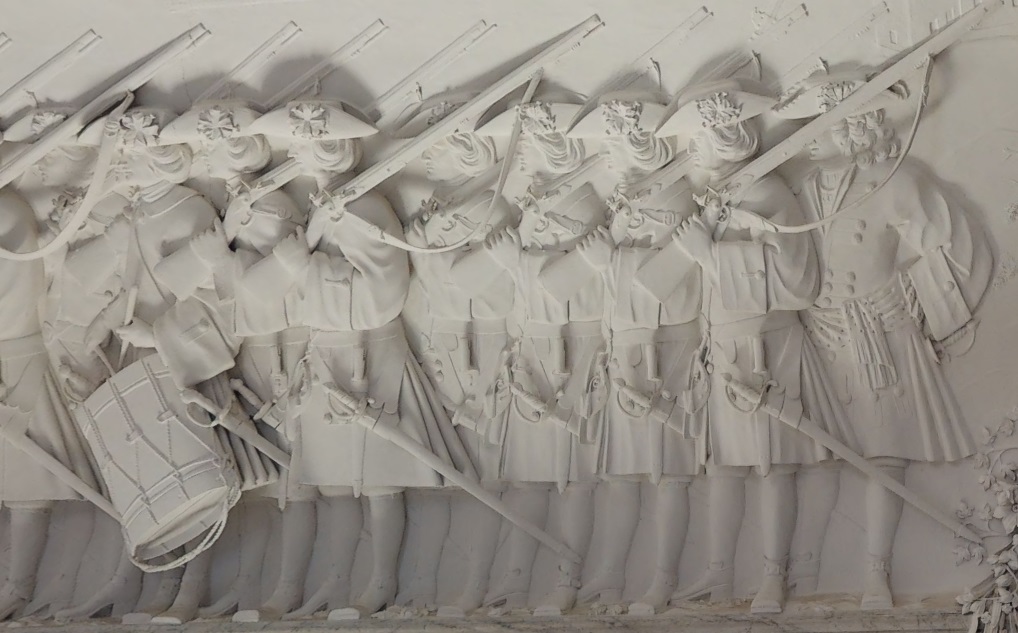
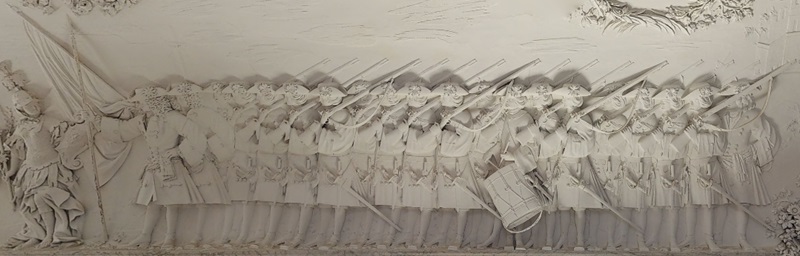
National militia infantrymen depicted in 1704-1706 on
a plaster relief on the ceiling of Rosenborg Castle's Knights' Hall
When the national militia was
raised in 1701, each recruit was ordered to obtain his own piecoat for
protection against rain and cold "which should be cut in the right way
and have the same colours as the regiments were distinguished by". But
the regular coat was to be provided by the crown, while the regulation did
not mention anything about the rest of the uniform. However, the recruits
could not afford to purchase piecoats, and these and the small clothes were
paid for by their lægder against deductions from the soldiers' salaries. The
problem with this procedure became apparent during the muster in 1702, when
the uniforms lacked uniformity. The crown had also not yet delivered the
promised coats because there was a lack of money for this. However, the
worst shortcomings with their armament had been addressed. In 1701, there
had been a great shortage of muskets and bayonets, and only 900 muskets per
regiment were issued. In addition, no shooting exercises were held. But by
the beginning of 1702, most had received their weapons and associated
equipment. For example, the Crown had purchased large quantities of waist
belts and bandoleers made of yellow ox leather from Sweden. These had brass
buckles and sewn-on sword scabbards. However, it was not until the summer of
1704 that the equipment of the national militia was complete.
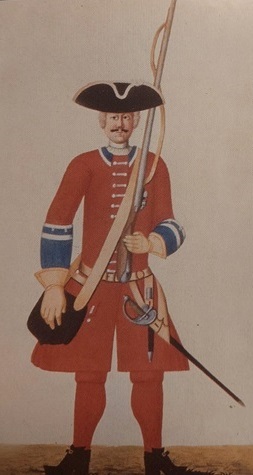
National militia soldier from Ålborg
Regiment depicted by Worgewitz in 1728. Note that the sword has an
iron hilt, even though the current m/1710 stipulated that swords
should have a brass hilt. The national militia were given the old
weapons of the enlisted regiments when these received new
equipment. |
A source from 1702 states that
Funen National Regiment had hats with red lace and cockade. Since red was
the regimental colour of Funen, it is possible that the other regiments also
had lace and cockades in the regimental colour at this time. But in that
case, it was something that the regiments paid for without the involvement
of the Crown. In 1705, the General Commissariat objected to a royal proposal
to procure cockades and hair pouches, which were items they considered
unnecessary. On the other hand, gloves, knee straps as well as knee and shoe
buckles were deemed necessary but something the soldiers themselves should
procure. The following year, however, the king approved that the hats should
be provided with cockades and it is noted that some regiments already had
such. In addition, funds were also granted for gloves, shoe buckles and
powder horns. The colour of the cockades was later, at least, standardised
to black and the colour of the hat lace became the same as the button
colour.
According to the uniform
regulation from 1704, the grenadiers' cartridge boxes were to be provided
with brass plates with the provincial coat of arms and the name of the
diocese. The front of the grenadier caps was to be embroidered with the same
motif. A source from 1708 states that Ålborg National Regiment had grenadier
caps made of fur.
The uniform regulations of 1705
introduced a new type of coat called a surtout. No waistcoat was issued, and
the soldiers continued to have to obtain this themselves. The waistcoats
probably therefore did not have a uniform appearance, which could explain
why the national militia soldiers were always depicted with buttoned coats,
unlike the enlisted soldiers. However, breeches made of broadcloth, hat, shoes,
stockings, neckcloth and waist belt were now issued to them in the same way
as to the enlisted regiments.
After the Battle of
Helsingborg, new conscriptions were held to replace the losses. In
connection with this, it was decided that the soldiers would be provided
with a grey vadmal coat, waistcoat, leather breeches, stockings and
shoes with buckles.
Torstein Snorrason notes
that it was decided on 12 April 1712 that the national militia would keep grey breeches
and stockings in the same colours as before. The new uniform regulation
regarding the colours of these garments would not be applied until it was
time to issue new coats.
In April 1713, all the national
regiments were told that they would have to wear the old light grey uniform
for another campaign season. This was despite the decision from October 1711
that the entire army would switch to red coats. As a last resort, they could have
their coats turned (this probably meant that the coats were split open and
then re-sewn so that the old insides of the broadcloth and lining became the
new outsides). Fabric samples for the new cuffs and collars
for the red uniform were approved in May 1713, and the new uniforms were
then issued to the national militia in 1713-1714.
According to the uniform
regulations from 1723, the national militia was to wear red breeches and
stockings. In addition, new small clothes were to be issued every four years
instead of every six years as before.
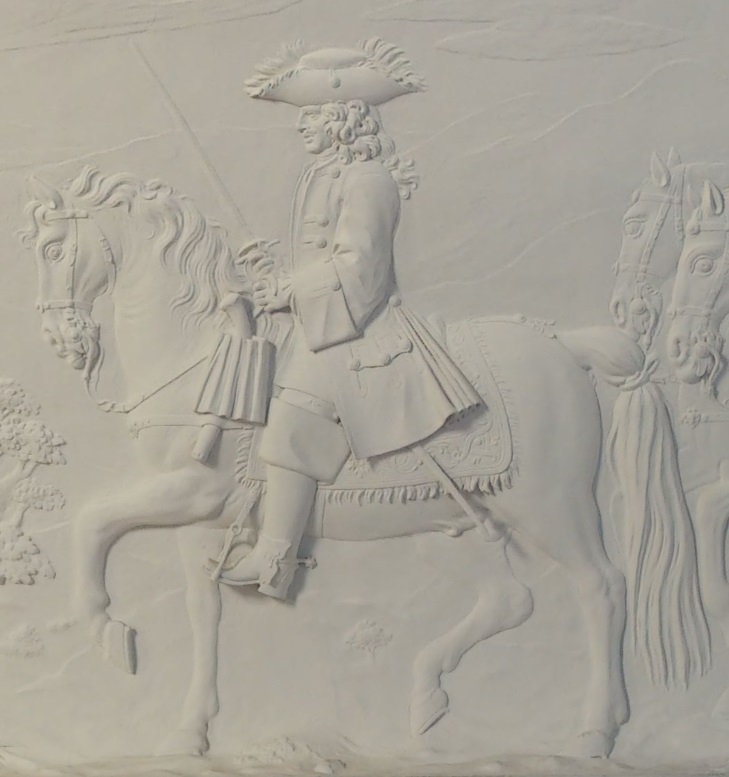
Officer of the national dragoons, depicted 1704-1706
on a plaster relief on the ceiling of the Knights' Hall at Rosenborg Castle
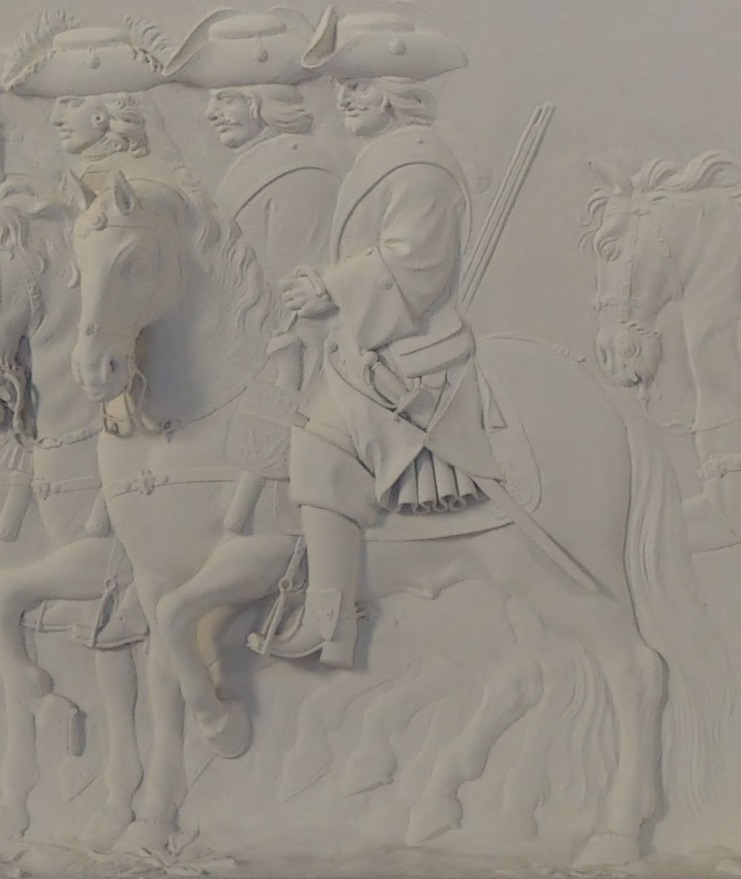
Private national dragoon, depicted 1704-1706 on the
plaster relief in the Knights' Hall of Rosenborg Castle
|
|
INFANTRY
 |
|
East Zealand
(Østsjællandske, renamed in 1717 to
Nordsjællandske)
The regiment was recruited in
the counties of Kronborg, Hørsholm, Frederiksborg, Copenhagen, Jægerspris,
Roskilde and Tryggevælde, as well as part of Holbæk. The first conscription
was completed on 21 June 1701. The twelve companies were named after
districts (herred) and their size varied from 165 (Smørum herred) to
192 men (Horn herred). After the company size gradually decreased during the
Great Northern War, in 1717 there was a reorganisation of the national
militia on Zealand, whose national militia infantry was reduced from 24 to
16 companies, each with 100 men. Twelve of these companies formed a
reconstituted East Zealand Regiment, which was renamed the North Zealand
Regiment.

1701-1713 |
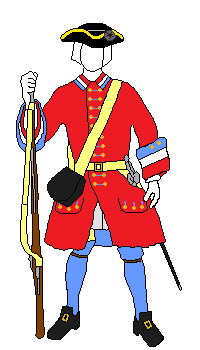
1714-1716 |
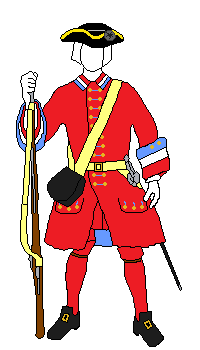
m/1716 |
|
Light grey coat with brass buttons, and lining and cuffs in "de
Bourgogne" (dark red/burgundy). |
Red coat with brass buttons and light blue lining. Striped cuffs (red-white-light
blue). |
Same as before but with red waistcoat and
red leg clothes. |
In May 1713, samples of new
cuffs and collars of wool for the national militia's m/1711 uniforms
were approved. However, the two Zealand regiments had already ordered
cuffs and collars of plush and were given permission to use these.
Skjold Petersen stated in his book from 2005 that the waistcoat and leg
clothes were light blue in 1714-1716, but in the book from 2014 this
information has been removed. In the same way, he has removed the
following information from the first book (unreliable information from
Worgewitz and others?):
1728: Light blue cuffs and
collar. On the cuffs two light red stripes, each surrounded by two white
ones. On the collar only one such set of three-coloured stripes.
1730: Light blue cuffs and collar. On the
cuffs: two red, two white and one light blue stripe. On the collar a white
stripe. White buttonholes.
|
Colonels
|
|
1701 |
Ditlev Reusch |
|
1706 |
Carl. Gustaf Malzahn |
|
1708 |
Rudolf Reinhardt Biege |
1710 Helsingborg |
|
1710 |
August Kaphengst |
|
1711 |
Johan Barner |
1716 Dynekilen
1719 Marstrand |
|
1720-1730 |
Josua Barner |
Regiment disbanded in 1730
|
Great
Northern War
East Zealand Regiment was used almost exclusively as garrison troops on
Zealand and for naval service. The only exception was in February 1710 when
two battalions were transferred to Scania and participated in the Battle of
Helsingborg. There they suffered losses of about 300 men in dead and wounded
and a further 63 men who were taken prisoner.
According to Vaupell, two companies are said to have distinguished
themselves in the Battle of Dynekilen, the conquest of Marstrand and the
attack on Gamla Älvsborg. |
|
West Zealand
(Vestsjællandske, renamed in 1717 to
Sydsjællandske)
In addition to Zealand itself,
West Zealand Regiment was also recruited on Møn (135 men). The islands of
Samsø, Sejrø, Nexelø, Agersø, Omø and Bogø, among others, were actually
supposed to contribute 83 men, but the distances made it more practical for
their recruits to serve in the navy instead. The company size originally
varied from 164 (Ods herred) to 204 men (Bårse herard). Gradually, the size
was reduced to 100 men per company and in 1717, an extensive reorganisation
of the national militia on Zealand was carried out, which reduced West
Zealand to four companies. It was then united with eight companies from
Lolland-Falster and one from Langeland to form the South Zealand Regiment.
Another reorganisation in 1724 reduced the regiment by one company and
changed the geographical distribution to: 6 companies from Zealand, 1 from
Møn, 4 from Lolland-Falster and 1 from Langeland.
|

1701-1712 |
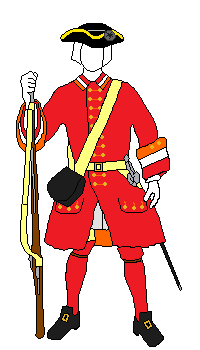
1714-1722 |
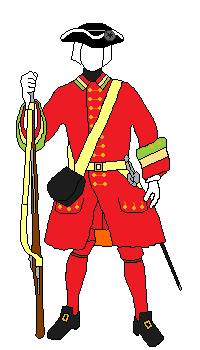
Lolland Battalion
1722-1730 |
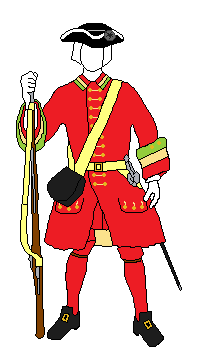
Zealand
Batalion
1722-1730 |
|
Light grey coat with brass buttons. Aurora-coloured lining and cuffs.
The piecoat had blue cuffs in 1701. |
Red coat with brass buttons and Aurora-coloured lining. The cuffs were
striped in Aurora-white-red. |
Red coat with brass buttons and aurora-coloured lining. The cuffs were
striped in green-paille-red as well as red waistcoat and red breeches.
Black neckcloth. First issued yellow hat lace but soon changed to white. |
Red coat with brass buttons and paille-coloured lining. Green-paille-red
striped cuffs, red waistcoat and red breeches. White hat lace and a
neckcloth that was not black. |
The information that the
conscripted soldiers were to acquire a grey piecoat with blue cuffs in
1701 may indicate that the regiment was originally intended to have blue
facings and that it was later changed to aurora. However, Skjold
Petersen has written on the contrary in his first book from 2005 that
the cuff colour of the regular coat was at some point changed from
aurora to blue and then became aurora again in 1712. He supports this
with a reference to Tøjhus accounts, but in the book from 2014 he has
removed that information. In his first book he had also stated that the
regiment wore grey coats until 1714 but that the striped collars were
introduced as early as 1712. In the new book this is also gone and he
has left the year 1713 blank in his table of uniform colours. He has
also removed text that the regiment had collars in feuille morte
"1716-?". In May 1713,
samples of new woollen cuffs and collars for the national militia were
approved. However, the two Zealand regiments had already ordered plush cuffs
and collars and were given permission to use them.
When the regiment was reorganised in 1717, the majority of the men came from
the disbanded Viborg-Lolland regiment and they probably still wore their old
uniforms. The uniform that was issued in 1722 had the colours of the former
Viborg-Lolland Regiment. South
Zealand Regiment was issued new uniforms in 1722 and was then actually
supposed to have paille-coloured lining. However, there was a larger
quantity of aurora-coloured baize available and in order to avoid wasting
it, the two battalions were given different lining colours. The Zealand
battalion got paille as their lining colour and the Lolland battalion got
aurora-coloured lining. However, in addition to the different lining colour,
the Lolland battalion also received yellow hat lace and black neckcloths.
The colonel complained about the lack of uniformity and the king approved
the expense of replacing the yellow hat lace with a white one, but the
lining and neckcloths were left as they were.
For the year 1728, there is again information in Skjold Petersen's book from
2005 that has been omitted in his book from 2015. I suspect that it comes
from a drawing by Worgewitz that he has judged to be unreliable. It is a
uniform that consists of cuffs and collar in paille with two dark green
stripes and a light red one in the middle on the cuffs and a dark green and
a light green stripe on the collar. White buttonholes on the coat.
|
Colonels
|
|
1701 |
Fabian Eppinger |
|
1706 |
Mandrup Due |
|
1708 |
Johan Henrik Bippen |
1710 Helsingborg |
|
1717 |
Erik Juel |
|
1724 |
Bernhard Lippe |
|
1725 |
Gustaf Vilhelm Geistler |
|
1728 |
Fabian Henrik Hohndorff |
|
1730 |
Christian Frederik Reichau |
|
Regiment disbanded in 1730 |
Great
Northern War
West Zealand and later South Zealand regiments were used almost exclusively
for naval service and as garrison troops on Zealand. The only exception was
in February 1710 when two West Zealand battalions were transferred to
Scania. One battalion participated in the Battle of Helsingborg while the
other was garrisoned in Helsingborg. West Zealand's casualties in the battle
consisted of about 300 men killed and wounded and a further 119 men who were
taken prisoner. |
|
Viborg-Lolland
(disbanded in 1717)
This regiment was recruited in
two different parts of the country and in practice functioned as two
separate units with a common colonel. The first conscriptions were completed
in August 1701 when the regiment consisted of eight companies on
Lolland-Falster (1,325 men) and four companies in the Viborg diocese (550
men). The colonel's company was located on Lolland and this island recruited
a total of 901 men. Falster recruited 386 men while a further 38 men were
recruited from the smaller islands of Fejø, Femø, Askø north of
Lolland-Falster.
The size of the Lolland-Falster companies varied from 149 men (Falster's
North Herred) to 182 men (Lolland's North Herred). On 3 April 1711, the size
was reduced to 120 men for all companies of the regiment and two years later
the Lolland-Falster company sizes were further reduced to 100 men. In 1717,
the regiment was disbanded in such a way that the Viborg part was divided
between the Århus and Ribe regiments while the Lolland-Falster companies
were united with four West Zealand companies to form the South Zealand
regiment (see above).
|
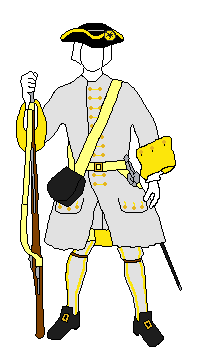
1701-1712 |
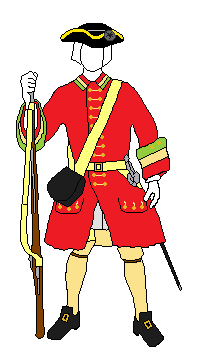
1714-1717 |
|
Light grey coat with brass buttons,
yellow lining and yellow cuffs. |
Red coat with brass buttons and paille-coloured lining. The cuffs were
striped in green-paille-red. The m/1716 uniform was to have a red
waistcoat and red breeches. It is unclear whether these were issued
before the regiment was disbanded in 1717. |
In the book from 2005,
Karsten Skjold Petersen wrote the following about the cuffs: "1714-1716
Paille yellow?" and stated "-1717" for the three-colour cuffs above.
However, in the book from 2014, he stated the period as "1714-1717" for
the three-color cuffs.
|
Colonels
|
|
1701 |
Albert Peperlow |
|
|
1705-1724 |
Erik Juel |
1710 Helsingborg
1712 Gadebusch |
|
Regiment reorganised into South Zealand in 1717 |
Great
Northern War
During the war, the Lolland-Falster companies were used extensively for
naval service and as garrison troops in Copenhagen. The only time they
participated in a campaign was in February 1710 when a Lolland battalion was
transferred to Scania and fought in the Battle of Helsingborg. About 200 men
were killed or wounded in the battle and another 9 men were taken prisoner.
The Viborg battalion was mainly
used for garrison duty in Holstein. It participated in the campaigns in
Germany in 1711-1712 and was then part of the force that blockaded Wismar in
1711 and conquered Bremen-Verden in 1712. It fought in the Battle of
Gadebusch and suffered such heavy losses that only 185 men remained out of
an original force of about 400 men. However, 149 exchanged prisoners from
Wismar were returned in May 1713. The battalion was transferred to Norway in
1716 but did not participate in any battles. However, the battalion was so
severely decimated by disease that it was disbanded in 1717 and its men were
transferred to other Jutland battalions. |
|
Funen
(Fynske)
The first conscription for the
Funen National Regiment was completed on 12 September 1701. The regiment
consisted of twelve companies from Funen with a total of 1,829 men (which
was soon reduced to 1,815 men) and one company from Langeland with 195 men.
The latter company was transferred to the South Zealand Regiment in 1717 and
at the same time the size was reduced to 100 men for all companies (it had
already been reduced to 120 men in 1711).
|
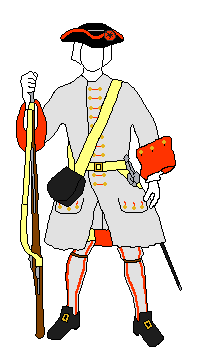
1701-1712 |
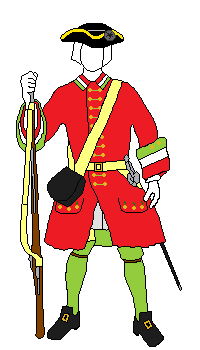
1714-1716 |
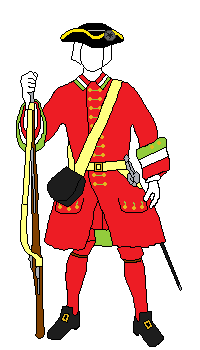
m/1716 |
|
Light grey coat with cinnabar red (vermilion)
cuffs and lining, and brass buttons. In 1702, the hats had red lace and
cockades, while the stockings had red stripes on the sides and on the
back |
Red coat with brass buttons, green lining
and striped cuffs (green-red-white). Green leg clothes since at least
1715. |
Same as before but with red waistcoat and
red leg clothes.
New uniforms were issued in 1718. |
|
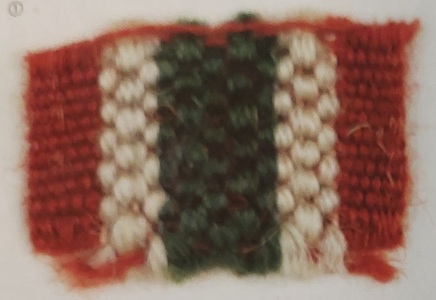
Fabric sample of Funen's cuffs and collar from
1713. |
The information from 1702 comes from the English envoy Vrigny who witnessed
a muster. He also mentioned that only one colour per battalion was issued.
But this is probably a misunderstanding since the whole regiment was
supposed to have only one colour.
Karsten Skjold Petersen wrote in the 2004 book that the lining and leg
clothes were green in the years 1712-1717 and that the coat was grey until
1714. However, he removed this overlap between two uniform models in the
2014 book where he has no information at all about what the uniform looked
like in 1713.
I have depicted the middle uniform in dark green to match a fabric sample
from 1713, while the m/1716 uniform has been given a light green colour
because a plate from 1716 shows its cuffs with a
light shade.
In the earlier book, Skjold Petersen also had information about the
appearance of the uniform in 1728-1730, which he removed in the later book.
It probably came from a Worgewitz drawing that he later judged to be
unreliable. This was a description of a uniform with dark green cuffs and a
collar with two white stripes on the cuffs and a white stripe on the collar.
|
Colonels
|
|
1701 |
Christian Frederik Bielke |
|
1706 |
Ditlev Holstein |
|
1714 |
Henrik Scholten |
|
1715 |
Hans Weinemann |
|
1725-1730 |
Hans Henrik Grambow |
|
Regiment disbanded in 1730 |
Great
Northern War
During the war, Funen National Regiment was used for garrison duty in
several different places in Denmark and Holstein. It was also used
extensively for naval service. However, it never participated in any
campaign, although two battalions were transferred to Norway at the end of
1716 and did not return until May 1718.
According to Vaupell, Funen National Regiment participated in Tordenskjold's
attacks on Gothenburg and Strömstad. |
|
Ålborg
(Ålborgske)
The regiment recruited eight of
its companies in the diocese of Ålborg and four companies in the diocese of
Viborg. The conscription of 1,318 men in the diocese of Ålborg was completed
on 29 July 1701 and on 31 August the conscription of 520 men was completed
in the part of Ålborg County that was in the diocese of Viborg. The size of
the companies was reduced in 1711 to 120 men and in 1717 to 100 men.
|
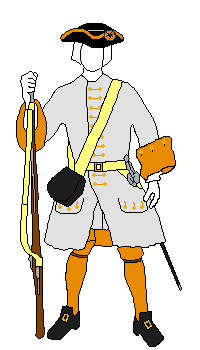
1701-1712 |
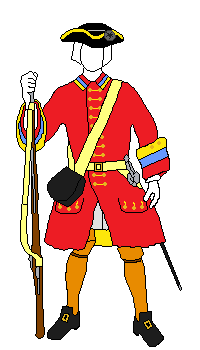
1714-1716 |
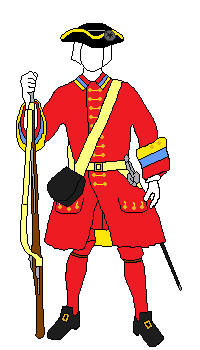
m/1716 |
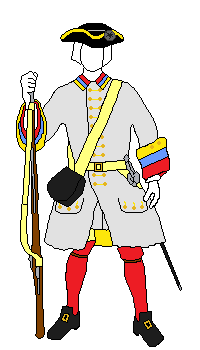
1718-? |
|
Light grey coat with brass buttons. The
cuffs and lining were brown in 1701, feuille morte in 1708 (also the leg
clothes) and "fire yellow" up to and including 1711. Grenadier caps of
fur in 1708. |
Red coat with brass buttons. Yellow
lining and striped cuffs in red-blue-yellow. Leg clothes in feuille
morte. |
Same as before, but with red waistcoat
and red leg clothes. |
Four newly formed companies that replaced
those captured by the Swedes in 1716 received grey vadamal coats,
leather breeches and red stockings. |
|
Tuxen mention a light brown shade (volume
2, page 90), but that and the other cuff colours mentioned for the
period 1701-1711 (brown, feuille morte and "fire yellow") are probably
different names for the same colour shade. I have depicted the blue
colour of the later uniforms as light blue because it is a light shade
depicted on the cuffs flaps in a plate from 1716.
However, the fabric sample from 1713 shown on the right can be
interpreted as a slightly darker colour.
New uniforms are said to have been issued
in 1710.
For Ålborg, Skjold Petersen also stated in
his 2005 book that grey coats were worn until 1714, but that the striped
m/1711 cuffs were introduced as early as 1712. In the 2014 book, he has
removed this information about overlapping uniform models and thus has
no information at all about what the uniform looked like in 1713.
In the later book, he has also removed
information about light brown lining "?-1730" that was in the earlier
book.
|
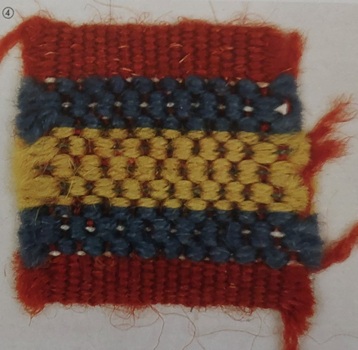
Fabric sample for Ålborg's cuffs and collar
from 1713. |
|
Colonels
|
|
1701 |
Henrik Rosenauer |
1712 Stade
1713 Tönning |
|
1723-1730 |
Carl Ferdinand Stauffenberg |
|
Regiment disbanded in 1730 |
Great
Northern War
During the Scanian campaign of 1709-1710, at least one battalion was
stationed in Holstein at all times, and for a short time all three were
there. After the campaign, one battalion remained in Holstein while the
other two were stationed in Jutland. During 1711, half the regiment served
in the navy, while two companies were garrisoned in Holstein. The other four
companies were originally intended to be transferred to Norway, but were
instead stationed in Copenhagen at the end of the year, where two of them
remained during the following year. Of the rest of the regiment, two
companies were stationed in Holstein in 1712, four companies were ordered to
serve in the navy in 1712, and four companies were part of the field army
that conquered Bremen-Verden. The Ålborg battalion was in poor condition
after the campaign and was left behind in Holstein when the army fought the
Battle of Gadebusch. It did, however, participate in the siege of Tönning in
1713, after which it was again garrisoned in Holstein. All six companies
stationed in Holstein were used as labour in March-July 1714 when the
Tönning fortifications were to be demolished, and after the work was
completed, they were returned to their home district. From November 1713,
the other six companies were stationed in Copenhagen, where they remained
until 1716 and were available for naval service.
Rockstroh has summarized the time the regiment was in service during the
latter part of the war as follows. One battalion (six companies) was
permanently mobilised in the years 1713-1716, in the home district in
1717-1718 and then mobilised for a short time in 1719. The second battalion
(six companies) was also mobilised throughout 1713 and then contributed two
or four companies each year until the end of the war.
An Ålborg battalion was transferred to Norway in the early summer of 1716
and another battalion was supposed to join in November, but their ship ran
aground on the Swedish coast where they were captured. The Swedes refused to
exchange them due to a dispute over the terms of surrender in Tönning in
1713. The Ålborg soldiers therefore remained in Swedish captivity for the
rest of the war and these four companies were only replaced in 1718 by a new
conscription. Meanwhile, the other Ålborg companies had been sent home in
June 1717. One battalion was sent to Holstein in May 1718 for garrison duty
and remained there for the rest of the war. The second battalion
participated in the campaign in Bohuslän in the summer of 1719, which ended
Denmark's participation in the war. |
|
Århus
(Århusiske)
The Århus Regiment, with 12
companies, was recruited entirely in the Århus diocese. The first
conscription was completed on 19 August 1701. However, out of 1,876
lægder, 407 were still vacant and had to be supplemented later with
recruits from more populous lægder. The company size was first
reduced to 120 men in 1711 and then to 100 men in 1717. Despite the
reduction in the regiment's size in 1717, its recruiting district was
expanded by taking over part of the Viborg diocese from the disbanded
Viborg-Lolland regiment.
|
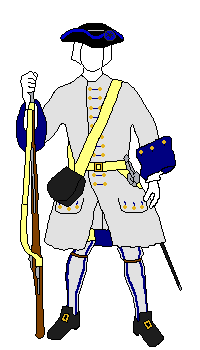
1701-1712 |
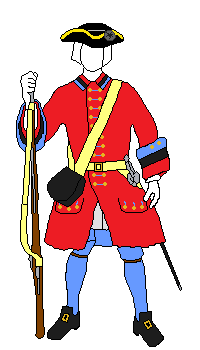
1714-1716 |
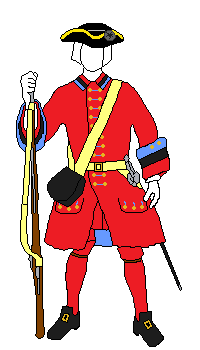
m/1716 |
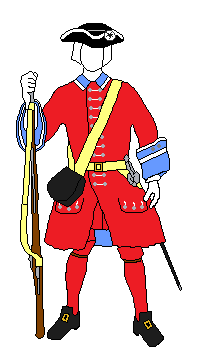
1728 |
|
Light grey coat with brass buttons, and
dark blue cuffs and lining. |
Red coat with brass buttons, blue lining
and striped cuffs (blue-black-red). Blue leg clothes since at least
1715. |
Same as before but with red vest and red
leg clothes. |
Worgewits depicted the regiment with
light blue cuffs and collar with two and one white stripe respectively.
White buttons, buttonholes, hat lace and cockade. |
|
Also for Århus, Skjold Petersen in his
2005 book stated that grey coats were worn until 1714 but that the
striped m/1711 cuffs were introduced as early as 1712. In the 2014
book, he has removed this information about overlapping uniform
models and thus has no information at all about what the uniform
looked like in 1713. |
Drawing by Worgewitz from 1728 depicting an
Århus soldier. |
|
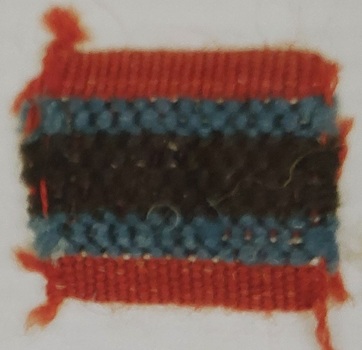
Fabric sample for Århus's lapels and collar
from 1713. |
|
Colonels
|
|
1701 |
Christian Bartholin |
|
1704 |
Christian Jørgen Møsting |
1712 Stade |
|
1712 Gadebusch |
|
Aug.
1720 |
Christian Frederik Haxthausen |
|
Nov.
1720-30 |
Poul Rosenørn |
|
Regiment disbanded in 1721 |
Great
Northern War
At the outbreak of war in 1709, the entire Århus regiment was garrisoned in
Holstein. From April 1711 onwards, half of the regiment was commanded to the
navy. In the following years, these companies served either in the navy or
in Zealand garrisons.
Of the other half, two companies continued to do garrison duty in Holstein,
while the other four companies were part of the field army and participated
in the autumn campaign in Mecklenburg and Pomerania in 1711. In August 1712
they took part in the capture of Bremen-Verden and in December they suffered
heavy losses in the Battle of Gadebusch. Of a force of about 400 men, only
130 men remained after the battle. These were then garrisoned in Holstein.
In May 1713, as part of a prisoner exchange, 113 soldiers returned from
captivity in Wismar. The Holstein half of the regiment was sent home in the
summer of 1714 but returned the following year and was transferred to
Jutland in the spring of 1716.
A battalion was transferred to Norway in the early summer of 1716 and
another battalion was shipped over at the end of the year. Both battalions
returned home in June 1717. A battalion was sent to Holstein in May 1718 for
garrison duty and remained there for the rest of the war. The second
battalion participated in the campaign in Bohuslän in the summer of 1719
which ended Denmark's participation in the war. |
|
Ribe
(Riberske)
The first conscription in the
Ribe diocese was completed on 20 June 1701. However, the diocese could only
be divided into 1,450 lægder, and 361 of them were vacant in
September 1701. In order to achieve a full strength of 1,800 men, the
regiment was also allowed to recruit in the counties of Stjernholm and
Skanderborg in the diocese of Århus. The problem of the vacant lægder
was solved by allowing them to recruit from more populous lægder. The
size of the twelve companies was first reduced to 120 men in 1711 and then
to 100 men in 1717. Despite the reduction in the size of the regiment in
1717, its recruiting district was expanded by taking over part of the Viborg
diocese from the disbanded Viborg-Lolland regiment.
|
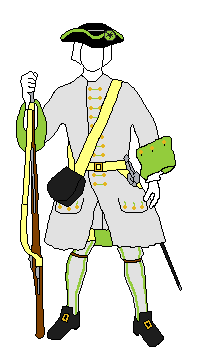
1701-1712 |
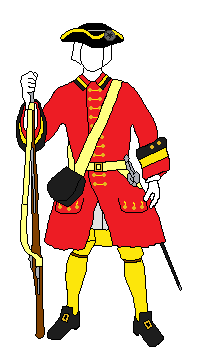
1714-1716 |
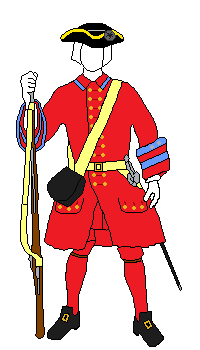
m/1716 |
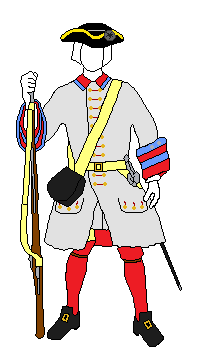
1718-? |
|
Light grey coat with brass buttons, light
green cuffs and lining.
New uniforms were issued in 1710. |
Red coat with
brass buttons, yellow lining and striped cuffs (black-yellow-red).
Yellow
leg clothes since at least 1715. |
Red coat with
brass buttons, red lining and red cuffs with two blue stripes and a
collar with a blue stripe. Red waistcoat and leg clothes. |
Two
newly formed companies that replaced those captured by the Swedes
in 1716 were given grey vadmal coats, leather breeches and red
stockings. |
|
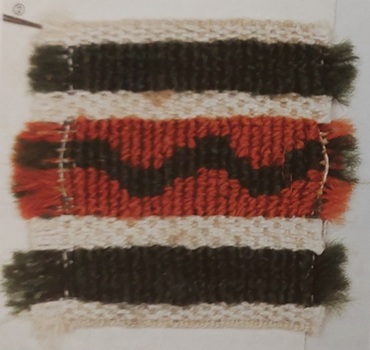
Fabric sample of Ribe's cuffs and collar from
1713.
(has the yellow colour completely faded away?) |
For Ribe, Skjold Petersen
also stated in his 2005 book that grey coats were worn until 1714, but
that the striped m/1711 cuffs were introduced as early as 1712. In the
2014 book, he removed this information about overlapping uniform models
and thus has no information at all about what the uniform looked like in
1713.
As for the cuffs for the m/1716 uniform, I have followed the appearance
in the plate from 1716. However, Daniel Schorr
has a different order of the stripes. I have interpreted Skjold Petersen
and Höglund as describing the order of the plate and not Schorr's. The
plate also shows that the blue colour was a light shade.

M/1716 cuffs according to Daniel Schorr
Further information that
Skjold Petersen had in his old book, but not the new one, is that the
cuffs, collar and lining in 1728-1730 were "blommefarvet" (bleumerant?)
with two light blue stripes on the cuffs and one on the collar. In
addition, the coat was stated to have red buttonholes. I suspect that
this is taken from a Worgewitz drawing that Skjold Petersen may have
judged to be unreliable in retrospect.
|
Colonels
|
|
Mars 1701 |
Valentin Eichstädt |
|
Okt. 1701 |
Johan Peter Ingenhaven |
|
April
1710 |
Hans Jacob Arnold |
|
Juni
1710 |
Jesper Friis |
|
April
1711 |
Ditlev Reusch |
|
Sep.
1711 |
Poul Hegemann |
1712 Stade |
|
1717 |
Georg Lottig |
|
1728-1730 |
Max Vilhem Dombroch |
|
Regiment disbanded in 1721 |
Great
Northern War
Already at the outbreak of war in 1709, part of Ribe Regiment was ordered to
serve in the navy while the main part was sent to Holstein. In the following
years, half of the regiment would serve in the navy or be garrisoned in
Zealand while the other half was in Schleswig-Holstein and neighbouring
areas. In 1711, however, as many as 10 companies served in the navy and only
two were in Holstein.
In 1712, a Ribe battalion was
part of the field army and participated in the conquest of Bremen-Verden
during the summer. Since the battalion was in poor condition, it was
subsequently left in Holstein and did not participate in the campaign
against Stenbock's army. After the fall of Tönning, four Ribe companies were
used as labour to demolish its fortifications in March-July 1714.
A Ribe battalion was
transferred to Norway in the early summer of 1716 and another battalion was
supposed to join in November. However, the ships carrying two of these
companies ran aground on the Swedish coast and were captured. The Swedes
refused to exchange them due to a dispute over the terms of the surrender in
Tönning in 1713. They therefore remained prisoners of war until the peace of
1720 and the companies were not replaced until 1718 by a new conscription.
In the meantime, the other Ribe companies had been sent home in June 1717. A
battalion was sent to Holstein in May 1718 for garrison duty and remained
there for the rest of the war. |
|
Oldenburg
(Oldenborgske)
Oldenburg National Regiment was raised in 1704 and consisted of eight
companies with a total of 1,222 men. At some point it was reduced to six
companies, according to Tuxen as a result of the mortgage of Delmenhorst
etc. (summer 1711?). But Tuxen also has information from the turn of the
year 1712-1713 that it had eight companies. According to the admittedly
unreliable Vaupell, the regiment was six companies strong from the
beginning and became eight companies strong from 1710. From 1734,
according to him, it consisted of twelve companies and from 1754 until
the regiment's dissolution in 1764 it is said to have had six companies.
It is also unclear to me whether the regiment was affected by the
reductions in company size that were implemented for the Danish
regiments. Oldenburg was exempted from supplying recruits to the
enlisted regiments in 1710 and does not seem to have been deployed
outside its home province.
|
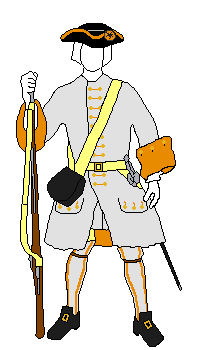
1704-1712 |
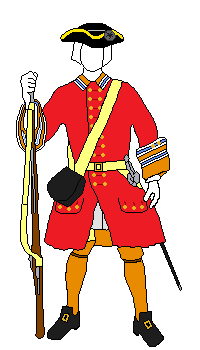
1714- |
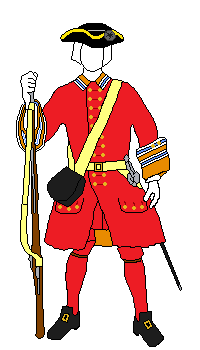
-1731 |
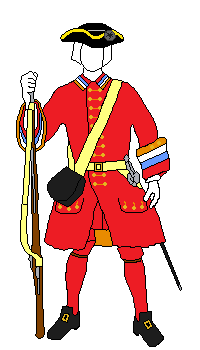
m/1716 |
|
Light grey
coat with brass buttons and feuille morte cuffs and lining. |
Red coat with
yellow buttons and red buttonholes. Lining in feuille morte. Cuffs and
collar in feuille morte with 2x3 stripes in white-light blue-white on
the cuffs and 1x3 on the collar. |
Same as
before, but was to have red waistcoat and leg clothes from 1716 onwards. |
This
uniform does not appear to have been issued, but Oldenburg was,
according to the 1716 regulation, supposed to have four-colour
cuffs in red-blue-white-feuille morte. |
|
Tuxen states that Oldenburg National Regiment
was to have red cuffs on its grey uniforms (volume 2, page 90) and
Höglund describes the cuff colour as reddish brown on the grey coat and
brownish yellow on the red coat. Snorrason has given "red(brown?)
brown" as the facing colour on the grey uniform. Skjold Petersen,
however, consistently writes feuille morte, which is French for "autumn
leaf" or literally: "dead leaf".
Worgewitz depicted Oldenburg's uniform in
1728 with a brown shade that I personally think is too dark to be called
feuille morte. But it is not uncommon for the colour shades in older
paintings to be darker than they would be according to the written
sources. It is unclear whether this is because the colour pigments have
changed with age or whether the artist worked in semi-darkness and
misunderstood the shades.
According to Skjold Petersen, the regiment
was issued new uniforms at the following times: 1704, ?, 1720, ?, 1739.
1749, 1751, ?.
|
Colonels
|
|
1704 |
Christian Brockdorff |
|
1710 |
Hans Jørgen Samsø |
|
1737 |
Christian Frederik Vangelin |
|
1755 |
Johan Peter Montargues |
|
1760 |
Gotfred Pentz |
|
1763-1764 |
Johan Henrik Schacht |
|
Regiment disbanded in 1764 |
|
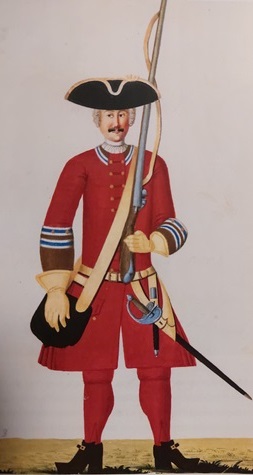
Teckning av Worgewitz från 1728 som
föreställer en oldenburgsk lantmilissoldat. |
Great
Northern War
Oldenburg National Regiment does not seem to have left its home province
during the entire war. It was also only periodically ordered to perform
garrison duty when no enlisted regiments were available. Vaupell relates
that the soldiers in this regiment often obtained sick leave through bribes
to avoid service, which was encouraged by their proprietors (landowners) who
wanted them to remain in their home district the work the land. This abuse
is said to have resulted in companies that were mobilised lacking
three-quarters of their strength. To address this problem, a strict purge of
the officer corps was carried out in 1717. |
|
CAVALRY
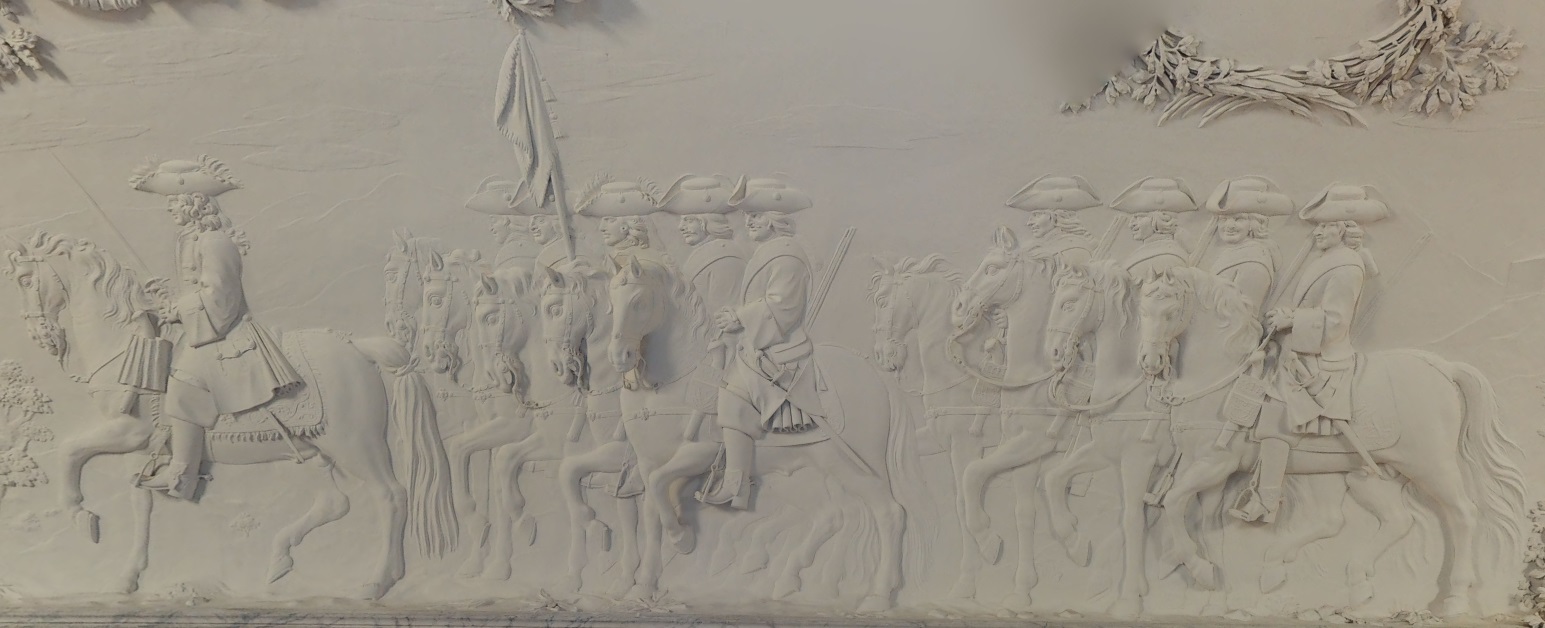 |
|
Zealand-Funen
(Sjælland-Fynske)
Raised in 1704 as a
nine-company national dragoon regiment (1,252 privates) formed into
three squadrons. One recruited in western Zealand, the second in central
and southern Zealand, the third squadron on Funen. In December 1709, the
regiment had to give 221 men to the Hungarian Dragoon Regiment and was
reorganised into a twelve-company regiment consisting of 1,010
combatants. It was converted into a cuirassier regiment on 9 March 1711
and, like the rest of the cavalry, it was reorganised in 1713 so that it
consisted of only eight companies. The four redundant companies were
then transferred to the First Zealand Cavalry Regiment ("1.
Sjællandske"). The Zealand-Funen National Cuirassier Regiment was
disbanded in 1721 when the army was reduced to a peacetime size.
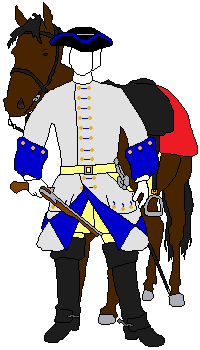
1704 |
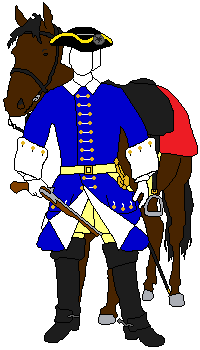
1707 |
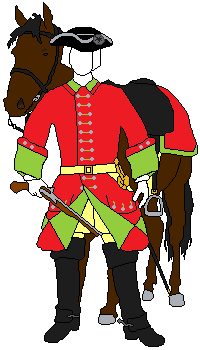 |
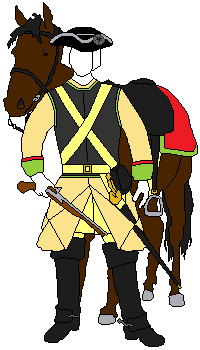 |
|
m/1711 & m/1716 |
|
Light grey
"vadmal" coat with blue lining and cuffs. Leather waistcoat and
leather trousers. Hat with lace. According to Snorrason, the
shabraques seem to have been red. |
The
national dragoons were to have a blue coat with cuffs and collar
in the regimental colour. Yellow buttons and edged buttonholes. Hat
with lace and black cockade. White neckcloth, blue cloak and leather
breeches. A Swedish spy report from 1709 states "blue coats and
cloaks, as well as white cuffs and collars". |
Red coat with light green lining
and light green and red cuffs.
Converted to a cuirassier regiment on 9 March 1711. The uniform regulation
of 24 October 1711 states that the regiment already had the m/1711
uniform. It may therefore have been issued when the regiment was
converted to cuirassiers. Known occasions when the regiment received
new uniforms are 1704 and 1720. |
|
Colonels
|
|
1704 |
Frands Henrik von Sprengel
(killed at Helsingborg) |
Helsingborg |
|
1710 |
Magnus Ernst Prehn |
|
1719-1721 |
Gynter Didrik Finecke |
|
Regiment disbanded in 1721 |
Great Northern War
Participated in the Scanian
campaign from December 1709, and with their blue coats they confused the
Swedes on more than one occasion. In the Battle of Helsingborg, about
200 men were killed or wounded. The colonel was among the killed. 4 men
were taken prisoner and the Swedes also captured the regiment's
colonel's standard.
In 1711, five squadrons
marched to Ålborg from where they were to be transported to Norway. But
the transport was cancelled and they returned to Zealand where they
remained until 1715. During the campaign in Germany 1715-1716 it was
part of the force that besieged Wismar. It was then stationed on Zealand
for the rest of the war.
|
|
Jutland
(Jyske)
Raised in 1704 as a
nine-company national dragoon regiment (1,135 privates). In December 1709,
the regiment had to give 135 men to the Hungarian Dragoon Regiment and was
reorganised into a twelve-company regiment consisting of 1,010 combatants.
It was converted to a cuirassier regiment on 15 December 1710 and, like the
rest of the cavalry, was reorganised in 1713 so that it consisted of only
eight companies. The surplus men were then transferred to other cavalry
regiments. Jutland National Cuirassier Regiment was disbanded in 1721 when
the army was reduced to a peacetime size.
|
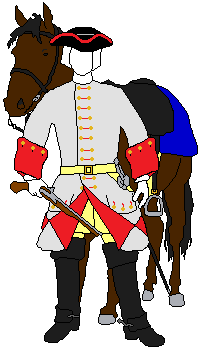
1704 |
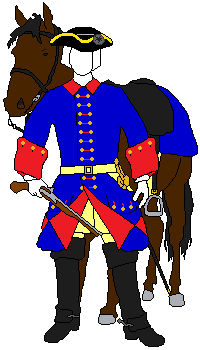
1707 |
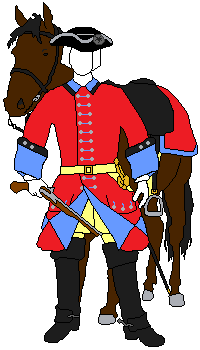 |
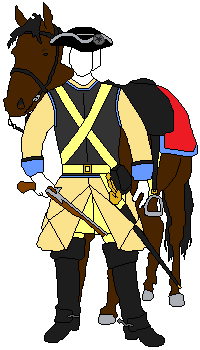 |
|
m/1711 & m/1716 |
|
Light grey
"vadmal" coat with red cuffs. Leather waistcoat and leather trousers. Hat with
lace. According to Snorrason, the shabraques seems to have been blue. |
The national
dragoons were to have a blue coat with cuffs and collar in the
regimental colour. Yellow buttons and edged buttonholes. Hat with lace and
black cockade. White neckcloth, blue cloak and leather breeches. |
Red coat with light blue lining and
light blue and black cuffs.
Received new hats with silver lace when it
was converted to a cuirassier regiment on 15 December 1710. Known
occasions when the regiment received new uniforms are 1704 and 1719. |
|
Colonels
|
| 1704 |
Christian Fursman |
1711
Wismar |
| 1712 |
C. F. Lewetzow |
1712 Gadebusch |
|
1717-1721 |
Niels Vest |
|
Regiment disbanded in 1721 |
Great Northern War
Shortly before the outbreak
of war in 1709, the Jutland National Dragoons were transferred to
Holstein to defend Denmark's southern border. They were later ordered to
reinforce the main army in Scania but did not get further than Zealand
before the campaign was over. They remained in Zealand and were used in
June 1711 to blockade plague-infected Helingør, where one of the
squadrons then became infected itself. The five healthy squadrons were
sent to Holstein to participate in the autumn campaign of 1711. In
connection with the blockade of Wismar, they won a major victory over
the Swedish garrison that had tried to attack them. The entire regiment
participated in the following year's campaign in Bremen-Verden and
fought in the Battle of Gadebusch. It was also part of the siege corps
at Tönning in 1713. Later, the regiment participated in the Pomeranian
campaign of 1715 and was part of the force that conquered Rügen in
November. However, they had not had time to land before the Battle of
Stresow was fought. They were then stationed in Zealand and were to be
part of the Russian-Danish army that was supposed to invade Scania in
the autumn of 1716, but the operation was cancelled. They were then
transferred to Norway and took part in the campaign against Charles XII
in 1718 and the invasion of Bohuslän in 1719 before returning home.
The regiment had fewer
casualties compared to the infantry. Of the 1,045 private Jutland
dragoons that went on campaign in 1709, 600 men were still serving in
1717.
|
|
National
Dragoons Raised in 1717
Three national dragoon regiments that were not mounted until 1723 and each
consisted of eight companies of 100 men (reduced to 75 privates in 1719
and increased to 88 privates not later than 1722). Four companies in the
West Zealand regiment were recruited on Lolland-Falster and two
companies in the Jutland-Funen regiment were recruited on Funen.
|
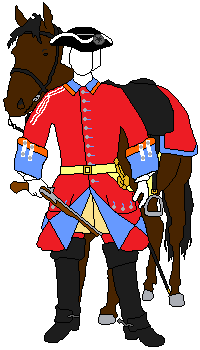
East Zealand
(Østsjællandske)
1722-1730 |
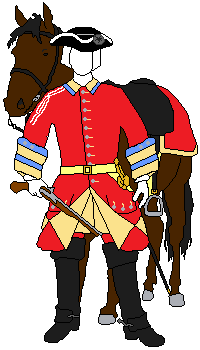
West Zealand
(Vestsjællandske)
1722-1726 |
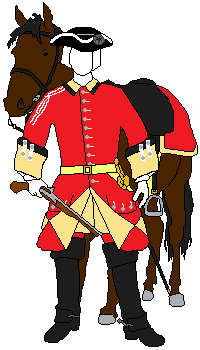
Jutland-Funen
(Jyske og Fynske)
1722-1730 |
|
Red coat
with blue lining, blue cuffs with orange stripe and white lace, and paille yellow
waistcoat. Hsd in 1730 red breeches and white
buttons.
According
to Skjold Petersen, the cuffs were blue in 1720. In the book from
2005, he also had different information than the one from 2014. Then
he wrote that the cuffs had a paille-coloured stripe "1722-?"
and black & white stripes "(1728)-1730".
According
to Höglund, in 1717 they had a red coat with a light blue collar and
a wide white edge. |
Red coat
with paille yellow lining, paille yellow cuffs with two light
blue stripes (only one red stripe 1726-1730) and paille yellow
waistcoat.
Red breeches.
According
to Skjold Petersen, the cuffs were yellow in 1720. In the book from
2005, he also had different information than the one from 2014. Then
he wrote that the cuffs and waistcoat were orange in 1722 instead of paille, but he stated that the cuffs and lining were paille in 1729.
According
to Höglund, in 1717 they had a red coat with a light yellow collar
and a red/white edge. |
Red coat
with paille yellow lining, paille yellow cuffs with black stripe and
white lace, and paille yellow waistcoat.
According
to Skjold Petersen, the cuffs were paille yellow in 1720. In the
book from 2005, he also had different information than the one from
2014. Then he wrote that the cuffs had a light blue stripe in 1722
and black and white stripes "?-1730".
According
to Höglund, in 1717 they had a red coat with a light brown collar
and black edge. |
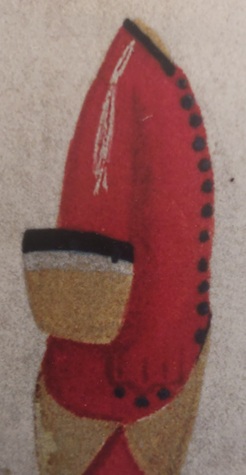
Unless otherwise stated, the uniform
information comes from Karsten Skjold Petersen's book from 2014.
Höglund's information is identical to that found in Otto Vaupell's book
(although no year is given).
According to a regulation from January 1718,
the dragoons would henceforth only wear single-breasted coats. They
would also replace the leather waistcoat by sewing the old coat into a
waistcoat from then on. The newly raised national dragoons, however,
seem to have received leather waistcoats when the first uniform was
issued. Because just a month after the regulation was established, it
was decided that East Zealand would wear leather waistcoats. A new
regulation from 1721 only mentions the lace and not the cockade on the
hat, which may indicate that it had been abolished.
Depictions of the national dragoons' coats from 1730 reveal that they
had shoulder cords similar to the life dragoons. One of these images is
visible on the right and it should also be the one that Skjold Petersen
described in the 2005 book when he stated that the cuffs had black and
white stripes. In the 2014 book, only the black is mentioned as a stripe
while the white is described as a "sleif". My image above follows
the appearance that the "sleifs" on Danish cuffs had in
plate from 1716. Skjold Petersen has also
mentioned in his books that the uniform images from 1728-1730 do not
always correspond to how they looked in reality.
Great Northern War
The regiments never left
their home districts and therefore did not participate in the Great
Northern War.
Colonels
|
East Zealand |
West Zealand |
Jutland-Funen |
|
1717 |
Christian Rantzau |
1717-1730 |
Frederik Eberhertz |
1717 |
Frederik Ehrenfried Amthor |
|
1720 |
Christian
Frederik Haxthausen |
|
1727 |
Gynther Didrik Finecke |
|
1730 |
Johan Vilhelm Münnich |
|
1729-1730 |
Frederik Vilhelm Schindel |
|
Regiments disbanded in 1730 |
|
|
Colours and Standards
Although it was normal in the Danish army for each battalion to have its own
colour, the national militia infantry only received one colour per regiment.
This was to save money because the national militia was not intended to be
used in battle and therefore only needed colours for the soldiers to swear
their oath of allegiance. The exception was the Viborg-Lolland regiment,
which received two colours because it was recruited in two different parts
of the country. The English envoy Vrigny, who witnessed a muster of the
Funen National Regiment in 1702, wrote that it had one colour per battalion,
but this was probably a misunderstanding.
Virtually nothing is known about the appearance of the national militia
infantry colours. The only information that Höglund has is that the
Oldenburg regiment was to have colours with the king's monogram. He also
describes two drawings of colours that lack regimental affiliation. One has
an angel in a cloud blowing a trumpet with the motto "Forfecter Land og
Cronen, Saa blaeses i Basunen". The other has an angel in a cloud, armed
with a helmet and sword with the motto "Uden Schold og Waaben intet Land,
Bestandig Fred erholde Kand".
Vaupell claims that the national militia's colours consisted of the "Dannebrogen"
(= flag of Denmark), but this is a claim that, according to Höglund, has
been questioned by later historians. The Danish national militia that was
formed in 1801 did indeed have Dannebrogen colours, but judging from
the better-known colours and standards of the mounted national militia units,
it seems more likely that Frederik IV's national militia had provincial
symbols as motifs. However, the colours below, which is in the Swedish Army
Museum's collections, may have been carried by a national militia battalion.
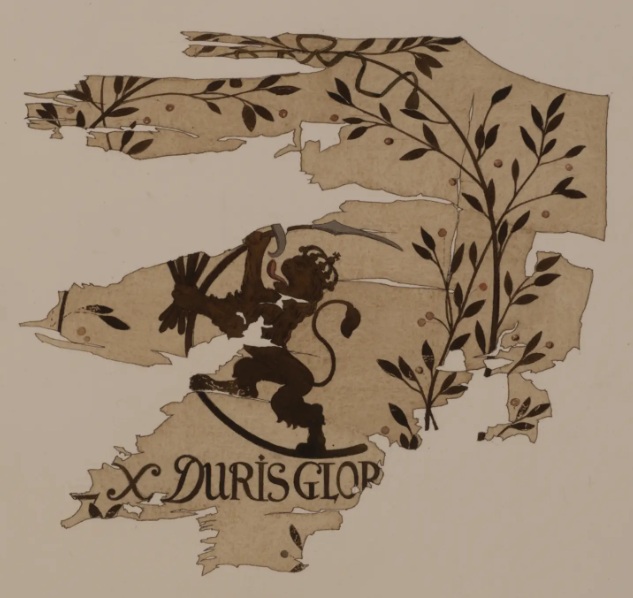
Drawing by Jonas Jonsson depicting AM.080078
The colour above is white and the motif depicts the Norwegian national coat
of arms, an axe-bearing lion which in this case also holds three hammers and
a pair of pliers. The lion is surrounded by a silver-coloured laurel wreath
with a brown outline and red berries. Below the lion is a motto that
originally had the text "EX DURIS GLORIA". What makes this a possible colour
for a Danish national militia regiment is that its pole has a paper label
from the 19th century that contains the text "Nr 2 ...Stenbock vid
H...1710". Since no Norwegian regiment participated in the Battle of
Helsingborg, this should have been a repurposed colour carried by a Danish
regiment, if the label is correct. The most likely candidate would then be
the East Zealand Regiment which participated in the battle with two
battalions, but which only had one regular colour. They possibly received a
repurposed Norwegian flag colour from a storage when they were sent across
the strait in February 1710 to reinforce the army in Scania. But if the
national militia received old colours already when it was raised in 1701,
it may also have been carried by the West Zealand or Lolland regiments that
contributed a battalion each to the battle.
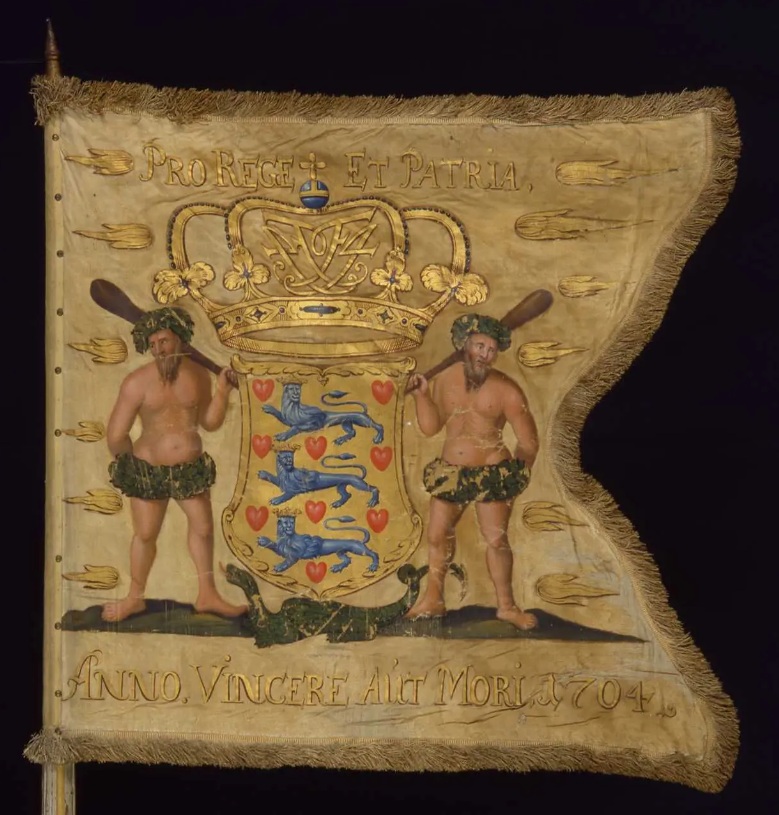
Colonel's colour of Zealand-Funen National Dragoons
that was in use
1704-1710 – AM.080245
One national militia unit that definitely lost a colour in the Battle of
Helsingborg was the Zealand-Funen National Dragoons. Their colonel's colour
that can be seen in the photo above, is preserved in the Swedish Army
Museum's collections. According to Höglund/Sallnäs, the company colours
would have been red but with the same motif. However, in both the text and
the image, they have indicated a silver-coloured wyvern under the shield.
The preserved flag, however, has a green dragon under the shield (wyverns
are depicted with two legs and dragons with four legs). The text reads at
the top "PRO REGE ET PATRIA" (For King and Fatherland) and at the bottom
"ANNO. VINCERE AUT MORI. 1704" (Year. Win or die. 1704).
When the national dragoon regiments were formed in 1704, they only had three
ensigns each, so they should only have been assigned three colours each.
Shortly before the outbreak of war in 1709, all companies were to have
ensigns and in December the national dragoon regiments were reorganised from
nine companies to twelve companies. Whether all companies had been issued
colours before the Scanian campaign ended is, however, something that I do
not know. In any case, all the colours must have been replaced when both
regiments were reorganised into national cuirassiers in the winter of
1710-1711, and instead received the following cavalry standards.
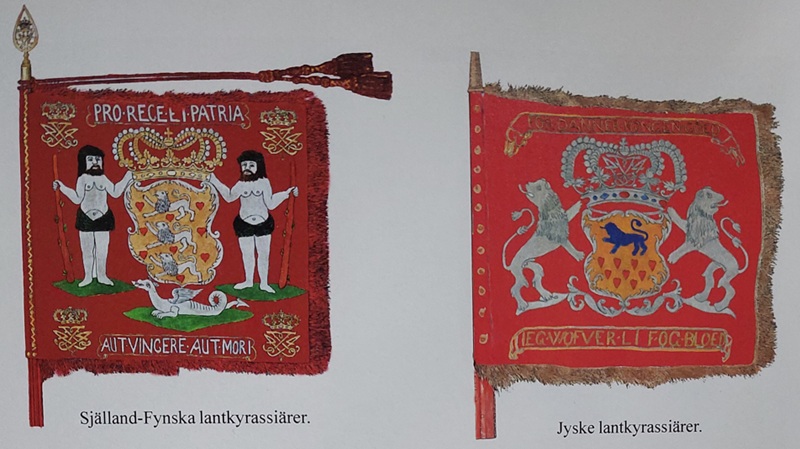
The company standards of the national cuirassiers
interpreted by Höglund/Sallnäs
Note that Höglund/Sallnäs has once again depicted the Zealand-Funen cavalry
standards with a silver-coloured wyvern, and I do not know if it is correct
this time. The fact that the lions are silver instead of blue is an odd
detail that is not mentioned in the text (the dragoon colour was, however,
depicted with blue lions in Höglund/Sallnäs' book). The text of the company
standard is identical to the previous colonel's standard except that the
year is not stated. It was normal for each standard/colour to have its own
motto. According to Höglund/Sallnäs,
the Jutland dragoon colours are unknown, but it is quite reasonable that
they resembled the cuirassier standard in the same way that the
Zealand-Funen dragoon colours and cavalry standards resembled each other.
The text on the white colonel's standard of Jutland was "FOR KONGENS ÆRE OG
HANS LAND FEGT RÆDELIGT DU DANSKE MAND". The company standard had the
following known mottos "FOR DANNERKONGEN GØD JEG WOFVER LIF OG BLØD" and
"TAPPER OG RETFÆRDIG WÆRE GIFWER SEYER OG FØR TIL Æ". I have reproduced the
mottos in Danish letters, but in Höglund/Sallnäs's text and picture they
have written AE and OE instead of Æ and Ø.
Regarding the national dragoon regiments that were formed in 1717, Höglund/Sallnäs
states that only the colours of the West Zealand national dragoons are known.
The colonel's colour and at least one company colour are said to have been
handed over to the Norwegian Nordenfjeldske Dragoon Regiment as early as
1718/19. However, I have not been able to find these colours in the
Norwegian Digitalt museum. However, I have found a colonel's colour and
a company colour that originally belonged to the East Zealand National
Dragoons and which, after the abolition of the National Militia, were issued
to the Second Søndenfjeldske Dragoon Regiment in 1731. A similar company
colour that is supposed to have been issued to the First Søndenfjeldske
Dragoon Regiment also appears to be from the same set (the text on its page
in Digital Museum, however, contains very little information). Daniel Schorr
states that the Nordenfjeldske Dragoon Regiment received surplus colours
from the Second Søndenfjeldske in 1719 when the number of colours was
reduced from one per company to one per squadron. I suspect that Höglund/Sallnäs
has confused the regiments and two separate events where dragoon colours
changed hands. It is not reasonable that Nordenfjeldske received repurposed
colours from two different regiments in 1719. Höglund/Sallnäs' descriptions
of West Zealand's colour are, however, not identical to the photographs of
East Zealand's former colours.
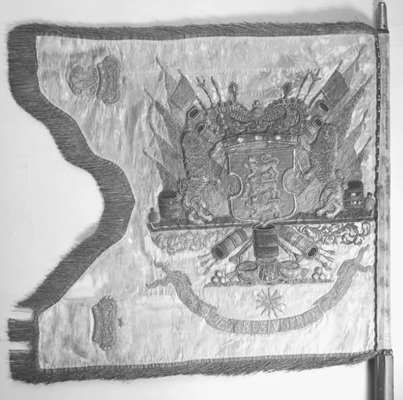
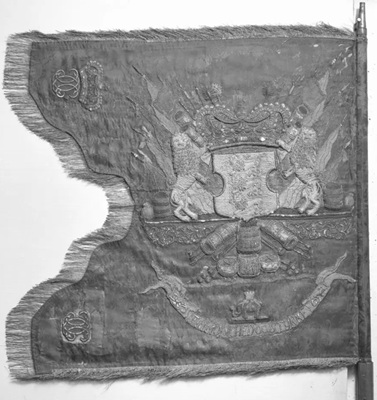
Black and white photos of a white colonel's colour (FMU.006094)
and a
red company colour (FMU.006092)
carried by East Zealand National Dragoon Regiment 1718-1730 and then by
Second Søndenfjeldske Dragoon Regiment
The colours have Christian VI's monogram in the swallow tails instead of
Frederik IV's, so they were obviously modified when they were transferred to
Norway in 1731. The motif is the same on both the colours above and on the
colour below that was issued to the First Søndenfjeldske Dragoon Regiment.
The only difference is the motto and the small symbol above the motto. The
colonel's colour has the text "Jeg Er Veiviseren" under a
twelve-pointed star. The company colour above has the text "Frimodighet
og styrke" under an elephant. The company colour below has not been
described as clearly by Digitalt museum and I have not been able to decipher
either the text or the symbols above it. All colours have silver fringes.
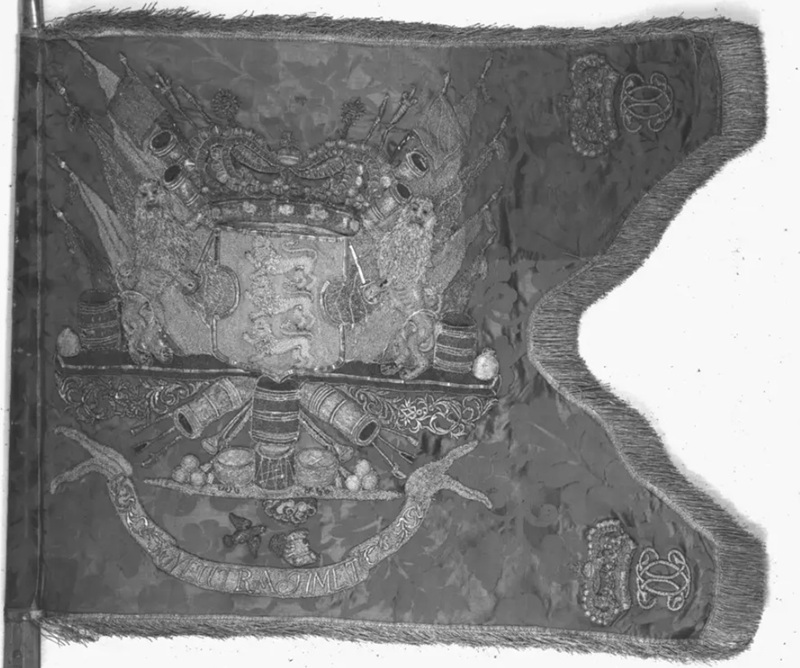
Black and white photo of a red company colour (FMU.000047)
that I assume was carried by the East Zealand National Dragoons 1718-1730
before they were issued to the First Søndenfjeldske Dragoon Regiment.
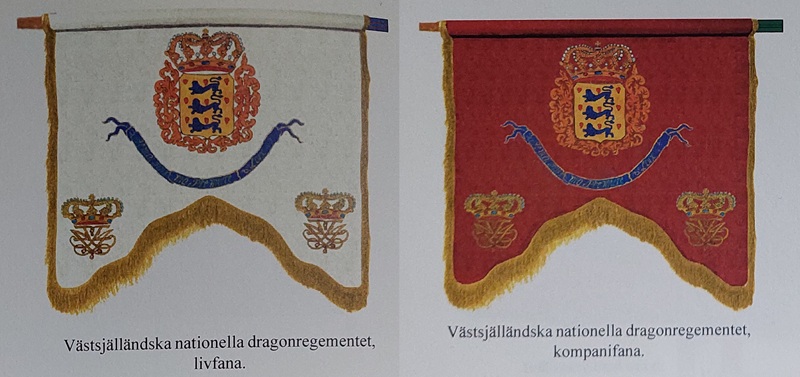
Correct West Zealand or misidentified East Zealand
colours interpreted by Höglund/Sallnäs?
The mottos that Höglund/Sallnäs describes for their West Zealand colours are
completely different from that of the East Zealand colours. The colonel's
colour has the text "D'ETRE FIDELLE A MON DIEU ET MON ROY" while the company
colour has "PLUS TOUT MOURIR QUE MANQUER A MON DEVOIR". |
|
References Höglund, Lars-Eric – Sallnäs, Åke.
Stora nordiska kriget 1700-1721, II.
Karlstad (2003)
Rockstroh, K. C. Udviklingen af den nationale Hær i Danmark i det 17. og 18. Aarhundrade. Copenhagen (1909-1926)
Schorr, Daniel. Danish-Norwegian uniforms 1709-1720. *
Schorr, Daniel. Notes on the Norwegian Army 1700-1720. *
Skjold Petersen, Karsten. Den danske hærs uniformer i 1700-tallet. Copenhagen (2005)
Skjold Petersen, Karsten. Det ulykkelige slag – Helsingborg 1710. Copenhagen (2017)
Skjold Petersen, Karsten. Faner og Estandarter i Den Danske Hær. Næstved (2016)
Skjold Petersen, Karsten. Kongens klæder. Copenhagen (2014)
Snorrason, Torstein. Danish Uniforms 1699-1712. *
Snorrason, Torstein. Tilføjelser til tidligere artikler om danske
uniformer 1700-1712. (article in Chakoten 2002, No. 4)
Tuxen, A. P. – With-Seidelin C. L. Bidrag til den store nordiske krigs historie. Copenhagen (1899-1934)
Vaupell, Otto. Den danske hærs historie til nutiden og den norske hærs historie indtil 1814. Copenhagen (1872-1876)
* = articles published in 2008 on the now defunct website
www.northernwars.com |
|