|
Örjan Martinsson
| |
|

During the 17th and 18th centuries,
the Danish army consisted partly of enlisted regiments and partly
of national regiments. The national regiments, also called the
national militia or land regiments, were recruited through
conscription. Unlike in Sweden, the conscripted regiments were
regarded by the Danish kings as a low-budget alternative to the
preferred enlisted troops. This meant that the Danish national
militia organisation did not have the same stability and quality
as its Swedish counterpart. One can therefore speak of three
different Danish national militias that existed in 1614–1679,
1701–1730 and 1733–1764.
This page describes the history of
the national militia that existed from 1614 to 1679 and the
subsequent fates of the enlisted regiments that descended from
this national militia until 1730. I do not cover general changes
in the organisation of the Danish infantry regiments from 1670 to
1730 because that is covered in my page on the
organisation of the Danish-Norwegian army.
|
|
General History
Like Sweden, the King of Denmark had an ancient right to call
every able-bodied man into military service
and during wartime peasants had been conscripted to serve in the
king's army. However, during peacetime,
the peasants did not have to serve in the military and since
Denmark had a long period of peace from 1570
to 1611, the civilian population lacked military experience in the
early 17th century. The peasants who
were conscripted during the Kalmar War from 1611 to 1613 did not
impress their King Christian IV, who
wrote in 1611 that "they are worse than beasts”. However,
it was clear that the growing armies of the
neighbouring countries, especially Sweden, made it necessary even
in peacetime to have trained regiments
that could defend the country's borders at short notice. Christian
IV preferred to have enlisted regiments but
the State Council (Rigsrådet) did not want to pay for this. Instead, they
decided on 17 November 1614 to establish a
4,004-man national militia by conscripting peasants.
|
Ordinance of 1614 |
Jutland (Jylland)
Funen (Fyn)
Zealand (Sjælland)
Scanian lands (Skåneland) |
2 001 men
200 men
200 men
1 603 men |
9 companies
1 company
1 company
8 companies |
|
Sum |
4 004 men |
|
The burden was very unevenly distributed, as it was almost
exclusively peasants from the border provinces who were to be
conscripted. However, this was because the islands were to supply
personnel to the navy instead of foot soldiers. A worse inequality
was that the burden to recruit soldiers were laid almost
exclusively on peasants who owned their own lands (7 out of 8).
For purely selfish reasons, both the king and the nobility wanted
to protect their own income by exempting peasants working on crown
and noble lands from military service (the lands owned by the
nobility made up half of the peasants).
The conscripted men were organised in 1615 into two regiments with
a manpower that deviated somewhat from the decision the year
before (2003 Jutlanders and 1592 men from the Scanian lands). The
Jutlanders were organised into nine companies and were included
together with the Funen company in the Jutland Regiment. The
Zealand company was included in the Scanian Regiment which also
consisted of four Scanian companies (751 men), three Halland
companies (627 men) and one company from Blekinge (214 men). The
staff was paid for by the crown and constituted just two officers
per company.
The first uniforms were issued in 1618, but they consisted only of
a cassock and a wide-brimmed hat. The colours varied between the
different companies. An example is "gule med røde Ruder" (yellow-red
chequered).
The development of events outside Denmark's borders, the outbreak
of the Thirty Years' War and Sweden's expansion on the other side
of the Baltic Sea, meant that the demands for a larger army
increased. A reorganisation of the national regiments was
therefore carried out in 1621, which meant that the strength was
increased by 1,000 men. This was done by allowing the crown
peasants to contribute to the army to a greater extent.
|
Ordinance of 1621 |
Jutland (Jylland)
Funen (Fyn)
Zealand (Sjælland)
Scanian lands (Skåneland) |
1 800 men
400 men
1 200 men
1 600 men |
9 companies
2 companies
2 companies
8 companies |
|
Sum |
5
000 men |
|
Despite the expansion, the old division of two national regiments
remained. The Zealand men were first organised into three
companies, but shortly after their conscription, this was changed
to only two companies. This resulted in a low proportion of
officers in relation to the number of privates, which made the
companies difficult to manage. During peacetime, however, the
conscripted soldiers had mainly been used as labour for
construction work.
Emperor War 1625–1629
When Christian IV intervened in the Thirty Years' War
in 1625, he was prevented from using the national regiments
because they could only be used for the defence of the homeland.
However, starting in 1624, he had plundered them of officers and
3,000 soldiers through enlistment, with which he formed the King's
Life Regiment (also called the "Blue Regiment" after their
uniforms). The vacancies in the militia regiments were immediately
filled through new conscriptions. However, Christian IV was still
not satisfied and in the winter of 1625–1626, another 3,000 men
were conscripted in the same manner, and these formed the Danish
Regiment, which was also called the Red Regiment (in addition to
red coats, it is also said to have had red, yellow or blue
breeches). The latter regiment consisted of 10 companies (4
Jutland, 3 Scanian, 2 Zealand and one Funen). In the Battle of
Lutter am Barenberge in August 1626, the Danish Regiment fought
bravely but suffered a crushing defeat, with seven companies wiped
out. The remainder were used to fill gaps in the King's Life
Regiment, which had also suffered heavy losses.
The defeat at Lutter am Barenberge and the loss of its best men
exposed Denmark to an imperial invasion. It was obvious that the
existing national regiments were not sufficient, and in August
1627 the State Council agreed to a temporary reinforcement of this
force by 12,000 men. This time the Salvation Army was also to
contribute soldiers.
|
Temporary reinforcements in 1627 |
Jutland
Funen & Langeland
Lolland-Falster
Zealand
Scanian lands |
5 000 men
1 500 men
1 000 men
2 000 men
2 500 men |
|
Sum |
12 000 men |
The reinforcements would form three new regiments, the Jutland men
with Vogn Vognsøn as colonel, the men from the islands with Jesper
Friis as colonel, and the Scanian men under the command of
Christian Eriksen.
However, already in September 1627, Jutland was invaded by
imperial troops, and the king's rapid flight and use of scorched
earth tactics made him unpopular among the Jutlanders. The
invasion effectively disbanded the Jutland units, as no Jutland
company was evacuated (except for one or two companies of cavalry
raised by the nobility) and not a single Jutland recruit joined
the king's army during the two-year occupation.
In the rest of the country, the mobilisation continued in
1627–1628. In Zealand, a total of 15 temporary companies were
raised with a combined strength of 4,100 men. Together with 1,200
men from the regular companies, these formed the Zealand Regiment
in April 1628 with Jesper Friis as colonel. Additional new
regiments were formed in Lolland-Falster with Christoffer Steensen
as colonel (2,500 men divided between 2 Falster companies and 4
Lolland companies) and in Funen & Langeland with Holger
Rosenkrantz as colonel (16 companies). In Scania, the old regiment
was reinforced to 2,500 men (at least 12 companies) and then at
least 20 new companies were added that were not included in the
Scanian Regiment’s organisation but were still under the command
of its colonel Falk Lykke. The total strength was at least
7,000–9,000 men.
The Interwar Period
1629–1643
When peace was concluded with the emperor in 1629, the army was to
return to a peacetime footing. Christian IV, who had never been
interested in conscripted soldiers, then chose not to re-establish
the Jutland Regiment. The regiments on the islands seemed to be
going the same way, as no musters or exercises were held with them.
Only the Scanian Regiment was safe due to the threat from Sweden.
However, the State Council did not share the king's opinion
about the national militia and in 1632–1633 managed to bring about
a reorganisation and expansion of the permanent national
regiments.
|
Reorganisation in 1632 |
Jutland
Zealand
Scanian |
c. 2 700 men
c. 2 200 men
c. 2 100 men |
8 Jutland & 2 Funen
companies
4 Zealand & 2 Falster-Lolland comp.
8 companies |
|
Sum |
c. 7
000 men |
|
The idea was that the Funen companies would be transferred to the
Zealand Regiment so that all regiments would have the same number
of companies. However, this was not implemented before the
Torstensson War and then a separate Funen regiment was formed
instead.
Each company now consisted of 1 captain, 1 lieutenant, 1 ensign, 3
sergeants, 1 capitaine d'armes ("vaabenmester"), 3
corporals, 10 gefreiter and 2 or 3 drummers. In the following
years, the organisation would be expanded further so that the
companies would also receive 1 piper and 1 furér. In addition, the
regimental officers would be provided with 1–3 "life shooters" and
the regimental staff would be expanded with 1 regimental provost,
1 provost assistant and 1 regimental quartermaster (also
regimental clerk), 1 field surgeon, 1 assistant surgeon, 1
provision master and 1 field chaplain. As early as 1636, however,
a reduction took place so that ensigns were only appointed in
wartime and that each company would only have one drummer.
However, concerns about the increasingly strong Sweden made the
demands for further reinforcements stronger. In 1638, the nobility
agreed to create independent “nobility companies” (adelskompanier) by conscripting
peasants on their lands, which was carried out in the winter of
1638–1639. These companies were only temporary, but the nobility
agreed to several extensions so that they effectively formed a
permanent part of the army. However, they were temporarily
disbanded in 1649–1652 when the crown had financial problems.
|
Nobility Companies in 1638 |
Jutland
Funen
Lolland, Falster, Zealand
Scania, Halland-Blekinge |
900 men
300 men
360 men
450 men |
4 companies (one in
each diocese)
1 company
1 company
2 companies |
|
Summa |
2 010 men |
|
In 1642, the national militia was doubled by introducing reserve
troops. These reserve soldiers were not organised into their own
companies and thus did not have their own commanders. Instead, it
was the commanders of the regular companies who would train them
so that they could replace losses in these companies. The national
militia now consisted of 9,000 regular soldiers and 8,400 reserves.
Torstensson War
1643–1645
In December 1643, Lennart Torstensson's Swedish army carried out a
surprise attack on Jutland. As in the previous war, the national
militia was now temporarily reinforced. Shortly before the
outbreak of war, the Zealand regiment had been expanded by four
companies, so that it had the same number as the Jutland regiment.
Recruitment for the new companies had been done by conscripting
crown peasants. After the outbreak of war, the reserve soldiers
were allowed to serve in their own companies and a Funen regiment
was separated from the Jutland regiment.
The Interwar Period
1645–1657
The Torstensson War ended with the peace of Brömsebro in August
1645, in which, among other things, Halland was ceded to Sweden.
The wartime experience had revealed that the Danish army needed a
higher proportion of cavalry, which meant that national cavalry
squadrons were formed. But the only reduction in the national
infantry was that the reserve soldiers disappeared. The number of
regular foot soldiers was increased slightly, despite the loss of
Halland, and was distributed among five regiments. The Jutland
regiment was thus divided into two regiments, which however had
the same colonel. The two regiments on the islands also had the
same colonel.
|
Reorganisation in 1647 |
|
Jutland |
2 800 men |
16 companies |
Funen & Langeland
Lolland, Falster |
500 men
600 men |
8 companies |
|
Zealand |
1 700 men |
8 companies |
|
Scania & Blekinge |
1 500 men |
11 companies |
|
Summa |
7
100 men |
|
A company would now have 1 captain, 1 lieutenant, 1 ensign, 1
capitaine d'armes ("vaabenmester"), 2 sergeants, 1 furér,
4 corporals, 8 gefreiter and 1 piper.
This organisation, however, did not last long, as it turned out
that the tax revenues were not enough to finance it. And when the
Thirty Years' War ended in 1648, Sweden began to reduce its
military power, which reduced Denmark's need for a strong army. In
1649, the nobility companies were disbanded, while the national
regiments were reduced to three, so that the organisation was
similar to that which had been in force before 1638. Once again,
the ensigns and also a large part of the non-commissioned officers
disappeared from the peace organisation.
|
Reduction in 1649 |
|
Jutland |
7 companies |
|
Zealand (with Funen) |
8 companies |
|
Scanian (with Blekinge) |
5 companies |
The nobility companies were re-established in 1652 and together
with the three national regiments, the conscripted infantry had a
total strength of approximately 8,000 men when Denmark declared
war on Sweden on 1 June 1657.
Charles X Gustav's War
1657–1660
Already in the spring of 1657, preparations had been made for the
coming war against Sweden. The regiments that were assigned to the
Scanian front, Zealand and Scanian, were given a higher proportion
of officers by reducing the size of the companies to approximately
100 men. This meant that these regiments then consisted of 22 and
24 companies respectively. The Scanian regiment also included the
nobility companies, while the nobility companies from Zealand and
Lolland-Falster formed their own regiment with 700 men divided
into seven companies. The Jutland regiment and its nobility
companies, which together consisted of 2,300 men, were, however,
only divided into 14 companies.
During the summer of 1657, further conscriptions were carried out,
which meant that an additional three Jutland regiments, each with
1,000 men, and a Funen regiment of about 1,600–1,800 men were
raised. However, the quality of these completely new regiments was
poor, and they never had time to receive any uniforms. The new
Jutland regiments were garrisoned in Frederiksodde, where they
were lost when the Swedes took the fortress on 24 October 1657.
The Funen regiment was disbanded after the Swedes crossed the
Little Belt on 30 January 1658 and then occupied Funen.
Further conscriptions were also carried out in Scania and
Blekinge, but these men did not form new regiments but were mainly
used as garrisons in fortresses, thereby freeing up older troops
for the field army.
As a result of the Peace of Roskilde on 26 February 1658, the
Scanian Regiment was disbanded. As compensation for this, it was
decided in May that Jutland would have two national regiments, and
a colonel was appointed for the new regiment. However, no new
conscriptions were carried out during the short peace period and
only 600 men remained of the old Jutland Regiment. It was not
until 1659 that conscriptions could be carried out so that the
Jutland regiments could be organised into eight companies each.
When war broke out again against Sweden on 5 August 1658, it
became difficult to conscript additional soldiers because the
Swedes quickly took control of almost all of Denmark. To
strengthen their own army and deprive the Danes of potential
recruits, the Swedes carried out extensive drafts in occupied
territory. The Danes who were forced to serve in the Swedish army
and did not manage to escape were sent primarily to the Baltic.
The exact number is unknown, but sources from Jutland contain
anecdotal information that "every third man" or "every
fifth man" was taken away during the occupation that lasted
almost two months. After the liberation of Jutland, conscriptions
were only carried out in the areas north of the Limfjord. This was
because most of the province was earmarked for the maintenance of
the allied troops that had come to Denmark's rescue. Recruitment
to the national regiments was further complicated by the Danish
government's preference for using conscripted soldiers to fill
vacancies in enlisted units.
The Interwar Period
1660–1675
After the Peace of Copenhagen on 26 May 1660, conscriptions were
carried out to complete the three national regiments before they
were sent home (Zealand and North and South Jutland). Unlike
previous wars, the enlisted regiments were not disbanded because
the now absolute monarch Frederick III wanted as large a standing
army as possible. However, it was clear that Denmark's economic
resources were severely limited, and a series of reductions took
place, which, among other things, led to the merger of the two
Jutland regiments. However, the merger was restored as early as
August 1661 when it was also decided to form a fourth national
regiment on Funen. Although enlisted regiments were preferred, the
realisation had sunk in that they were too expensive and that the
national regiments were needed to maintain a large standing army.
|
Reorganisation August 1661 |
|
South Jutland in Ribe and Århus dioceses |
|
North Jutland in Viborg and Ålborg dioceses |
|
Funen on Funen, Lolland-Falster, Møn, Langeland
and other islands |
|
Zealand on Zealand and Samsø |
Each regiment was to have eight companies, and each company was to
have a captain, a lieutenant, two sergeants, three corporals and a
drummer. The company staff was expanded in 1664 with an ensign and
a non-commissioned officer. The ensign's task was to carry the
colour and these had been returned to the arsenal after the peace
in 1660. However, in 1663 there were demands from the officers to
have them back, which led to the reintroduction of ensigns and the
issuance of a regulation in 1664 that determined the appearance of
the colours of the national regiments.
Since conscriptions were carried out irregularly, often at
intervals of several years, the effective strength of the national
regiments varied. However, in connection with the armament for a
short war against England in 1666, an effective strength of 5,347
men was achieved. Due to problems with so-called “deserted farms”
that could not contribute to the recruitment of soldiers, the
recruitments districts (one "lægd" for each individual
soldier) were reorganised in 1673 and made larger to distribute
the burden more fairly. This meant a reduction in the nominal
strength of the national militia to 4,911 men. Before the reform,
the nominal strength was about 5,730 men. All regiments continued
to have eight companies, and the reform sought to make the
companies of equal size within the regiments, even if they
differed between the regiments.
|
New “lægder” in 1673 |
|
South Jutland |
1 182 men |
|
North Jutland |
984 men |
|
Funen |
1 245 men |
|
Zealand |
1 500 men |
|
Sum |
4 911 men |
During the 17th century, conscription had also taken place in
Schleswig-Holstein, but it had proven very difficult to form
militarily useful national units in these duchies. The population
had little interest in contributing to the defence of Denmark, and
the young men could easily move to another German principality if
the government became too demanding. However, despite strong
resistance from the local population, the new absolute monarchy
decided to establish a national regiment in Schleswig-Holstein in
1663. However, getting the regiment complete and in good condition
would be a persistent problem.

Scanian War
1675–1679
In the summer before the outbreak of war in September 1675,
Denmark carried out a comprehensive mobilisation of its army
according to a previously drawn up plan. The national regiments
were doubled (colours for this purpose had already been made in
1673). In Danish territory this was done by a second conscription
which created duplicates of the old regiments. The regiment in
Schleswig-Holstein was divided into a Schleswig and a Holstein
regiment which were reinforced with forcibly recruited soldiers
from the Holstein-Gottorp army which had been disbanded after a
Danish invasion. In the County of Oldenburg which had become
Danish in 1667, a national regiment was raised for the very first
time.
In total, there were now 11 national regiments, organised into 12
companies of 100 men. The exception was the four Danish duplicates,
which were to have only eight companies with the same organisation
as in 1673. The idea with the increased number of companies was to
form eight-company strong field regiments, while the other four
companies were to be used as garrison troops. From 1676 onwards,
the old Danish regiments were considered to be enlisted, since
only the losses of the new regiments were replaced by conscription
from the “lægder”. The old regiments that were replenished
through enlistment therefore began to be named after their
commanders, while the new regiments took over the provincial names
entirely.
After the Battle of Lund, the new national regiments were
reorganised so that they too would consist of 12 companies of 106
men (including staff) and be paid in the same way as enlisted
soldiers. Perhaps the plan was to repeat what had happened in 1675
and create a third set of national regiments while the second set
was converted into enlisted regiments. A new complete conscription
was also carried out in 1677, but the army's heavy losses during
the previous year's campaign meant that the new conscripted
soldiers were used to fill vacancies in the other regiments, both
enlisted and national. In addition, they were distributed without
regard to geographical origin. In connection with the new
conscriptions, it was decided that the companies would be
increased to 150 men (of which 132 were privates) for all
regiments. This was not achieved, however. And in October 1678,
the company size was reduced to 125 men (including staff). But
losses during the war made it difficult to reach even that nominal
size for the regiments.
The End of the National Militia
During the Scanian War, the distinction between enlisted and
national regiments gradually disappeared, and when peace was
concluded, all regiments were enlisted. The old national regiments
had filled vacancies through enlistment from 1676 and were then
considered enlisted. From 1677, conscripts were used to fill
vacancies in both enlisted and national regiments without any
regard to geographical origin. In addition, all national regiments
were paid by the crown in the same way as enlisted regiments
instead of by the peasants in the “lægder”. During the war
and at the conclusion of peace, there were also mergers of units
that took no account of whether they were enlisted or national.
The difficulty of conscripting people in the duchies of
Schleswig-Holstein and the county of Oldenburg meant that
conscription there were quickly replaced by taxes to fund
recruitment of enlisted soldiers instead. Later, the same thing
happened in the Danish kingdom, where the last real conscription
took place in the winter of 1677–78. The very last "conscription"
took place in November 1678, but then it was money and not
recruits that the king demanded from the “lægder”.
The reason for the abolition of the national militia was that the
extensive conscription before and during the war had deprived
agriculture of important labour. Not only because young men were
forced to do military service, but also because men who wanted to
avoid conscription fled in large numbers to the cities or abroad.
Christian V therefore chose to replace conscription with taxes
and, as far as possible, enlisted foreigners to reduce the damage
to Denmark's economy. This did not change during the following
peace period. The remaining conscripted soldiers were promised
dismissal as soon as a enlisted soldier could replace them. And
despite repeated requests from Christian V's generals to
re-establish the national militia, this would not happen until
just over 20 years later when his son Frederik IV raised a new
national militia in 1701.
|
|
Scanian Regiment
(Skånske Regiment)
|
Colonels |
|
1615 |
Anders Sinclair |
|
1625 |
Enevold Kruse
(† at Lutter am Barenberge) |
|
1627 |
Falk Lykke |
|
1642 |
Wulf Hjeronymus Kratz |
|
1657–1658 |
Hans Schack |
Raised in 1615 and consisted of 1792 men divided into nine
companies, four of which were recruited in Scania (751 men), three in
Halland (627 men), one from Blekinge (214 men) and one from Zealand (200
men).
The Zealand part was expanded in 1621 to 1,200 men divided into two
companies, which meant a total strength of 2,800 men divided into ten
companies.
The Zealand companies were separated in 1628 and formed their own
regiment, while the remaining eight companies were expanded in 1632 to a
total of about 2,100 men. In addition to these, two separate nobility
companies were raised in 1638, recruited among peasants working the lands
of the nobility and consisting of a total of 450 men.
In 1642, reserve soldiers were introduced, doubling the strength of the
regiment. At first, these did not form companies and thus had no
commanders since they were intended to replace losses among the regular
soldiers. During the Torstensson War of 1643–1645, however, they formed
their own companies.
After the Peace of Brömsebro in 1645, the Halland part of the regiment
was disbanded, and the reserve soldiers were also abolished. In 1647,
the remainder was given a strength of 1,500 men divided into eleven
companies (not including the nobility companies). Already in 1649, the
regiment was reduced to five companies for economic reasons and the
nobility companies were disbanded.
In 1652, the two nobility companies were reintroduced, now with a
strength of 600 men, while the Scanian Regiment had 1,200 men. Other
units in Scania consisted of two enlisted infantry companies stationed
as garrisons in the fortresses (about 400 men) and 800 men cavalry (of
which 200 men raised by the nobility and 600 men conscripted from the
parishes). In total, Scania was defended by about 3,000 men.
Before Charles X Gustav's War in 1657–1658, the Scanian Regiment,
together with the nobility companies, were planned to be divided into
two regiments with twice as many companies as before. However, the
number of officers who had been recruited before the new regimental
commander Fuchs died was not enough for more than four companies and
these were reunited with the old regiment. Continued conscriptions,
however, resulted in the Scanian Regiment consisting of 24 companies in
July 1657 (including the nobility companies) with an average size of
about 100 men. In addition, ten infantry companies and three dragoon
companies were added through enlistment in Scania.
During both the Torstensson War and Charles X Gustav's War, the regiment
defended its home provinces. However, it was never concentrated and was
in practice divided into several different field units and fortress
garrisons. The local commanders did not trust conscripted men and made
sure to mix them with enlisted companies.
As a result of the Peace of Roskilde on 26 February 1658, the Scanian
Regiment was disbanded. |
|
Zealand
Regiment
(Sjællandske Regiment)
Descended from the Zealand company of the Scanian regiment, which was
raised by conscription in 1615. In 1628 it became its own regiment and
in 1675 another Zealand regiment was raised by conscription. Both were
converted into enlisted regiments during the Scanian War and merged in
1678. Its three battalions were part of various auxiliary corps in
foreign service from 1701 to 1714, which resulted in each battalion
being disbanded and merged with other regiments. The Colonel's Battalion
was added to the Zepelin´s regiment in 1714, which then also took over
the name Zealand Regiment.
Recruitment
The original Zealand company consisted of
200 men, although already in 1621 it was expanded to 1200 men divided
into two companies, mainly recruited by free peasants. The lack of
commanders in relation to the number of men made the companies difficult
to manage. This was improved somewhat by the fact that the newly formed
Zealand regiment, according to the ordinance from 1632, was to consist
of six companies (4 on Zealand and 2 on Lolland-Falster) with a total of
about 2200 men (of which 1600 men from Zealand). This strength was
doubled in 1642 when reserves were introduced. The reserve soldiers were
originally intended only to replace losses in the regular companies, but
during the Torstensson War of 1643–1645 they formed their own companies.
Shortly before the outbreak of war, the regular regiment had also been
expanded by four companies through recruitment from the crown peasants,
and since 1638 the nobility’s peasants had contributed 360 men in a
separate nobility company.
After the Torstensson War, the reserve
soldiers were abolished, and the Zealand Regiment was organised into
eight companies (1,700 men) that were recruited only on Zealand. However,
its colonel was also the commander of another regiment with eight
companies that recruited 1,100 men on Funen and Lolland-Falster. As
early as 1649, they were merged into a regiment of eight companies. At
the beginning of 1657, the four Zealand companies consisted of a total
of 1,600 men, while the four companies from the other islands consisted
of 800 men. In preparation for the outbreak of war that same year, the
officer corps of the Zealand Regiment was expanded by reorganising it
into 22 companies. The nobility company had been disbanded in 1649, but
several new nobility companies were raised in 1652, and during Charles X
Gustav's war they formed their own regiment with 700 men. During the
Swedish occupation of Zealand, the Zealand Regiment was reinforced in
August 1659 with recruits from northern Jutland.
When the army was reorganised after Charles
X Gustav's War, Funen & Lolland-Falster were separated from the Zealand
regiment in 1661, whose eight companies were now recruited only from
Zealand and Samsø. Its strength was set in 1673 at 1,500 men who were
recruited and paid from an equal number of "lægder". In 1675 the
“lægder” were ordered to raise a new regiment ("New Zealand or "Second
Zealand") which from then on took over the “lægder”, while Old Zealand
was reorganised into a 12-company enlisted regiment. At first, New
Zealand's men were distributed into four companies, but at the end of
August each company was divided into two.
In early 1677, the New Zealand Regiment was
reorganised into 12 companies and reinforced with 646 conscripts from
Funen and also with the remnants of the First Funen Regiment (the
Zealand recruits went instead to the enlisted Prince George's Regiment).
The next conscription at the end of 1677, which was the last of the war,
did not provide any recruits for the New Zealand Regiment. It was Prince
Christian's and the Queen's regiments that received the Zealand recruits
this time. Instead, the New Zealand Regiment was reduced to six
companies and merged with Jacob Stuart's enlisted regiment, which formed
the other half of a normal-sized (enlisted) regiment. It was named the
Zealand Regiment and took over the twelve colours from the New Zealand
Regiment. Stuart became regimental commander but was court-martialled in
the autumn of 1678 and was then stripped of the regiment, which was
instead merged with the now greatly decimated Old Zealand Regiment.
After the peace of 1679, the Zealand
regiment was supplemented with men from the Pflanz enlisted regiment.
The remaining conscripted men who were to be replaced by enlisted
soldiers as soon as possible. The result was that the Zealand regiment
was increasingly dominated by German-speaking soldiers. In 1726, 51% of
the soldiers were Germans, 34% Danes, 4% Swedes, 3% Norwegians and 7%
others.
|
Colonels and Battles
|
|
1628 |
Jesper Frijs |
|
1633 |
Christopher Steensen |
|
1651 |
Axel Urup |
|
1655 |
Erik Quitzow |
|
1661 |
Georg (Jørgen) Møller |
|
1666 |
Niels Rosenkranz |
|
1672 |
Carl von Osten |
|
May 1676 |
Jean de la Haye († at Landskrona) |
|
July 1676 |
Christian Lange |
1677 Landskrona |
|
1677 |
Balthazar Knoblauch |
|
1679 |
Julius Ernst Tettau |
|
1684 |
Adam Frederik Trampe |
1690 Boyne |
|
1692 Steenkerke
1693 Neerwinden |
|
1696 |
Georg Christoph Puttkamer |
1704 Blenheim |
|
1706 |
Laurent de Boisset |
1706 Ramillies
1708 Oudenaarde
1709 Malplaquet |
|
1714 |
Daniel Ernst Zepelin |
|
1728–1742 |
Frederik Valdemar Folkersam |
New Zealand Regiment |
|
1675 |
Martin Bertelsen (Barthold) |
|
Feb.
1677 |
Duke of Croi |
|
June
1677 |
Andreas Fuchs |
|
1677–1678 |
Jacob Stuart |
Campaigns and Garrison Towns
During the Torstensson War, the regiment was mainly used to protect the
coast in their home province from Swedish raids. However, two companies
were part of a force that landed in Holstein on 24 July 1644 and
established a redoubt at Christianspris. This redoubt was stormed by
Swedish troops on 28 July, who then massacred the Danish-born soldiers
of the garrison. Out of a total of 1,300 men, only about 80 Germans were
spared. In September of the same year, four companies (1,200 men) were
temporarily transferred to Scania to participate in an unsuccessful
autumn offensive.
Together with the Scanian Regiment, it was assigned to the Scanian front
during Charles X Gustav's First War 1657–1658, and like that regiment,
the Zealand Regiment was not concentrated but instead scattered to
different places and mixed with enlisted units. During Charles X
Gustav's Second War 1658–1660, the Zealanders were garrisoned in
Copenhagen and defended the city during the storming of 1659.
In the autumn of 1675, the Old Zealand field regiment (8 companies)
participated in the Mecklenburg campaign. The reserve companies were
left behind as garrisons in Helsingør and later Korsør (1 company) and
in Copenhagen (3 companies). New Zealand Regiment was stationed in
Helsingør (2 companies) and Copenhagen (6 companies). The following year
garrison companies from both regiments contributed men to the navy and
participated in the conquest of Gotland. A detachment from each regiment
was left behind there as a garrison and, together with detachments from
other regiments, formed the Gotland Battalion.
After being at home in Zealand during the first half of 1676, the Old
Zealand field regiment participated in the invasion of Scania and was
stationed in Kristianstad (5 companies), Karlshamn (2 companies) and
Kristianopel (1 company). The remaining reserve companies were first
stationed in Ystad and later transferred to Landskrona and Helsingborg.
A Swedish counter-offensive in the winter of 1676–1677 led to losses for
the Old Zealand when the Swedes recaptured Kristianopel and Karlshamn.
The five companies in Kristianstad had a strength of 450 men in April
1677, while the rest of the regiment formed a battalion that was part of
the field army and participated in the Battle of Landskrona. The
battalion in Kristianstad was forced to surrender to the Swedes in 1678
and the greatly reduced regiment now consisted of only four companies
with a total of 278 men who participated in the campaign on Rügen in
1678.
New Zealand Regiment initially contributed four companies to the
garrison in Kristianstad, but by 1677 the regiment was divided between
garrisons in Helsingør, Korsør and Gotland. It was transferred to
Glückstadt in Holstein where it was merged with Stuart's regiment at the
end of 1677. It participated together with the Old Zealand Regiment in
the campaign on Rügen in the autumn of 1678, where the two regiments
were merged into one. The united Zealand regiment was then commandeered
to the navy in the summer of 1679.
After the peace treaty, the regiment was stationed with four companies
each in Copenhagen, Helsingør and Nakskov. In 1684–1689, half of the
regiment was in Copenhagen and the other half in Holstein. In 1689–1698,
one battalion served in the auxiliary corps sent the Maritime powers and
fought in Ireland and Flanders. In 1699, 12 companies were stationed in
Copenhagen, 4 in Helsingør, 1 in Holbæk and 2 in Slagelse.
During the war of 1700, its three battalions were stationed in
Copenhagen, Helsingør and Holstein. After the Peace of Traventhal, the
Zealand Regiment contributed one battalion to the auxiliary corps that
was in Saxony in 1700–1701. Except for the grenadier company, it was
then part of the auxiliary corps in imperial service until 1703, when it
was merged with a Jutland battalion to form the Third Danish Regiment.
The rest of the Zealand Regiment was in the service of the of the
Maritime powers (The Netherlands) 1701–1714. When these two battalions
returned to their homeland, they were disbanded so that the men from one
battalion was transferred to Prince Carl's Regiment while the men of the
Colonel's battalion transferred to Zepelin's regiment, which then
changed its name to the Zealand Regiment.
The Zealand Regiment was garrisoned in Glückstadt until 1716 when it was
transferred to Copenhagen. Its two battalions were sent to Norway in
1717 and 1718 and participated in the Bohuslän campaign before returning to Copenhagen in
1720 where it remained until 1742.
Uniforms
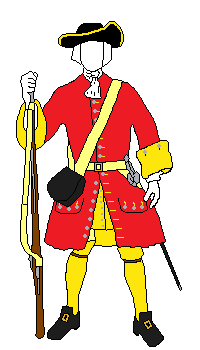
Both regiments
1670-1677 |

New Zealand
1677-1678 |
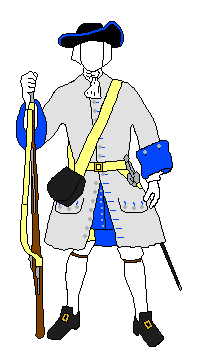
Merged regiment
October
1678 |
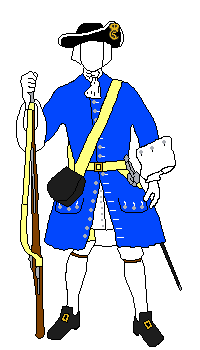
1685 |
|
Red coat with yellow lining and red cuffs. 36 pewter
buttons in 1675. Piecoats July 1677.
In May 1676, the grenadiers were dressed in grey coats
with blue cuffs while the pioneers and artillery drivers wore grey coats
with red cuffs.
Captain Spormann's company in Korsør had red coats with
blue lining, which in the second half of 1677 was changed to yellow
lining. |
Had very poor
uniforms before the autumn of 1677 when they received new red coats with
blue lining and pewter buttons, as well as blue breeches In
1678 the coat was red, cuffs and lining blue, hats were grey without
lace, stockings were white, and the breeches were of yellow leather.
Vietinghoff's battalion in Wismar had blue breeches and 48 pewter
buttons on the coat. |
Light grey
coat with blue cuffs and lining. 48 pewter buttons in Knoblauch's
battalion and 60 pewter buttons in Teutmann's battalion.
Vietinghoff's
battalion retained the red coats with blue cuffs and 48 pewter buttons.
1679 leather
breeches and possibly white stockings.
|
Blue coat with
white cuffs and lining.
Skjold Petersen describes the uniform
from 1677-1681 as a light grey coat with red cuffs and lining. This
matches the uniform that according to Hasselager/Snorrason was worn by
Stuart's regiment, which merged with the New Zealand regiment at the end
of 1677. They also mention that it had leather breeches and red
stockings
|
|
According to Skjold Petersen, New Zealand wore
light green coats with red cuffs and linings in 1675-1677.
|
|
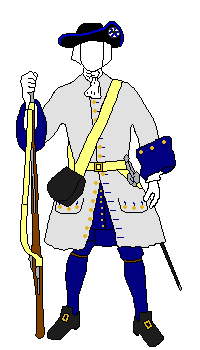
1691-1695, (1708?) |
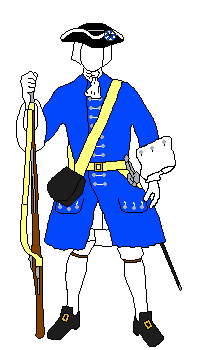
1704 |
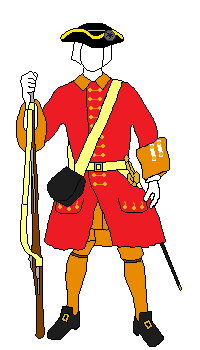
1714-1716 |
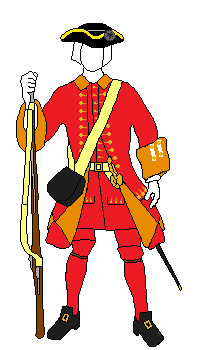
1716-1723 |
|
Light grey coat with blue cuffs and lining (dark blue
shade according to Snorrason). |
Blue coat with white cuffs and lining. In Dutch service 1701-1714. |
Red coat with cuffs, lining (and leg clothes?) in feuille morte and
brass buttons. |
Same as before but with a red waistcoat and red leg clothes. |
|
Snorrason mentions a decision from 1707 that Zealand Regiment should
have brass buttons and blue wool for the buttonholes, as well as blue
breeches and stockings. These colours are also stated by Skjold Petersen
for the year 1708, which indicates that the 1691 uniform regulation was
also followed in the 18th century, even though Skjold Petersen does not
mention anything about grey coats.
1724-1731
The coat was red, cuffs and collar yellow with white edges, buttonholes
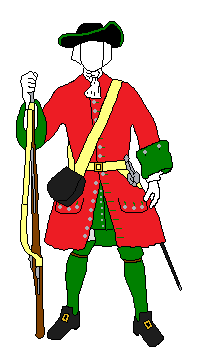
white, brass buttons, lining yellow. Leg clothes and waistcoat red. See Worgewitz drawing from 1728 on the right.
According to Skjold Petersen, the regiment was issued new uniforms in
1713, ?, 1716, 1721, 1724, (1727), 1730 and 1733.
|
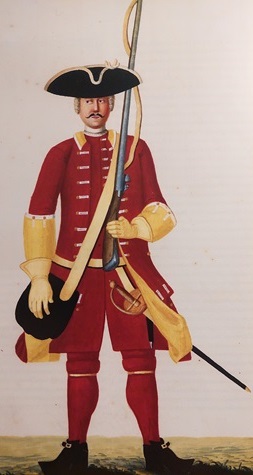 |
Colours
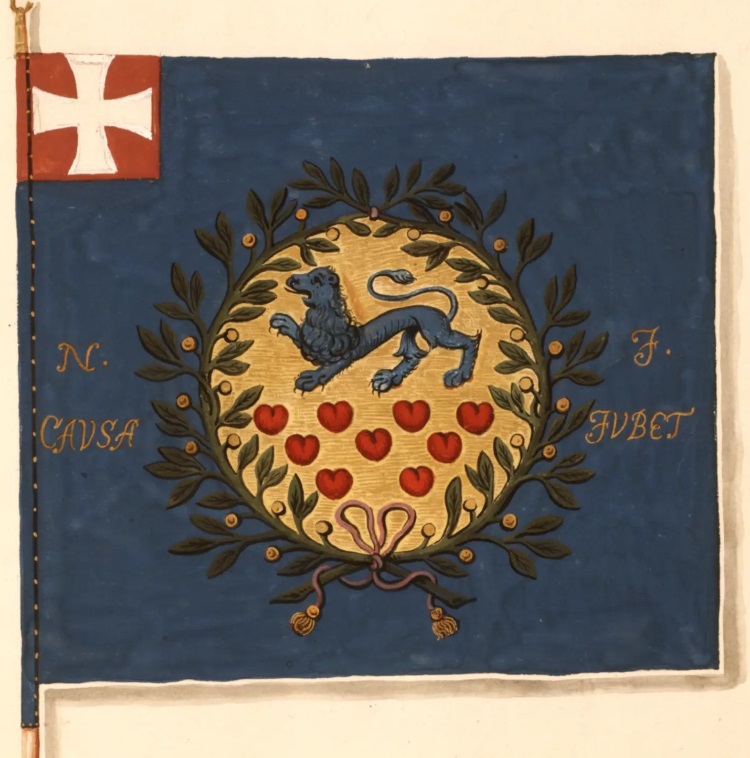
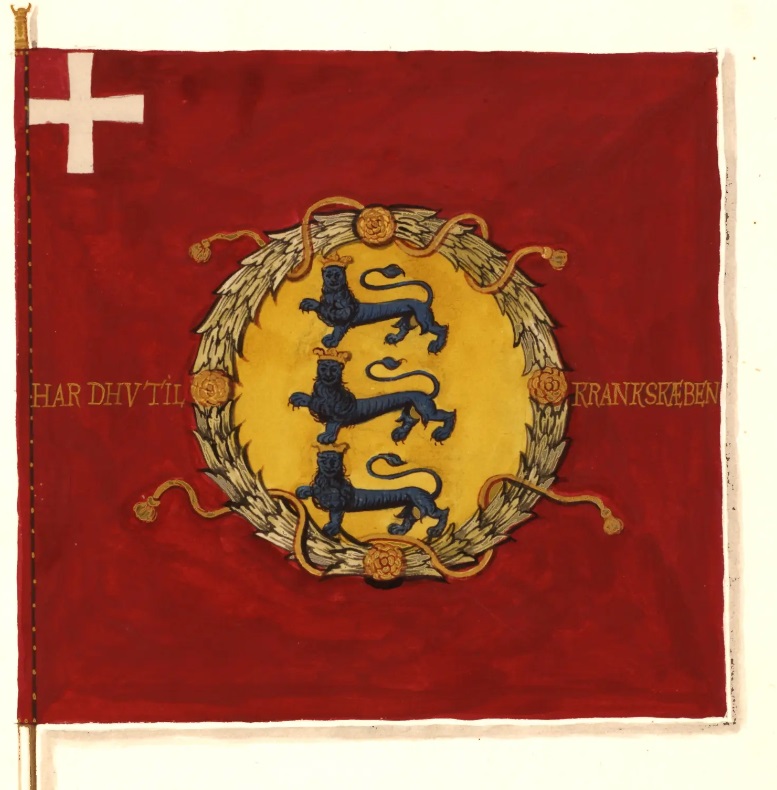
According to the regulation from 1664, the Zealand Regiment was to have
red company colours with three blue lions in a yellow field scattered
with nine hearts in the middle and the Danish flag in the upper inner
corner. The colonel’s colour was to be white. The colours were
distinguished by being decorated with different mottos. There is a list
of the mottos that has been reported by both Vaupell and Bruhn, but
their spelling differs with Vaupell being more modern and Bruhn
strangely using the letter ö instead of ø.
|
Vaupell
- Vi lade se vor egen Ære.
- For os skræckes Land og Vand.
- Vi ere færdige til Landets Forsvar.
- Vor Fjende til Frygt.
- Alle gode Ting ere tre.
- Brug mange til Strid och faa til Raad.
- Før swige de svorne end de baarne.
- Af Mandighed vi yndes.
|
 |
Bruhn
- Vi lader see woris egen Ære.
- For os skreckes Land och Vand.
- Vi er færdige til Landsens Forsvar.
- Vor Fiende til Frygt.
- Alle gode Ting ere trey.
- Brug mange til Strid och faa til Raad.
- För swiger de sworne, end de baarne.
- Af Mandighed wi yndes.
|
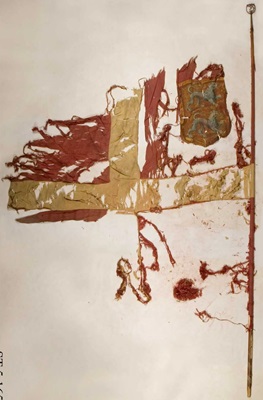
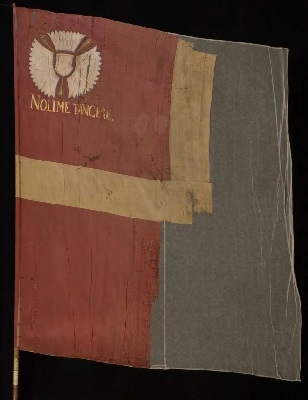
In 1675, the Old Zealand Regiment was reorganised so that four more
companies were formed. Their colours were lost in the Battle of
Landskrona on 14 July 1677 and are preserved in the collections of the
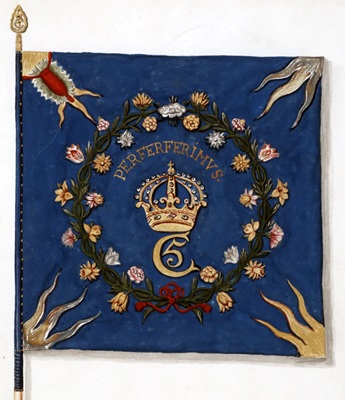
Swedish Army Museum. They differ from the 1664 regulation in that they
do not have any hearts in the yellow field (see the image above). Below
are links to both the preserved colours (the inventory numbers) and to
the depictions of them made by Olof Hoffman in 1677-1709 (the company
names).
In 1683, white colours with a blue lion were issued. Höglund/Sallnäs has a
description of a colour that they believe is from the 1710s. "Yellow
cloth with wild men holding a shield with the Zealand coat of arms, three
blue lions and nine red hearts on a gold field". There does not seem to
be any more information than that about the colours of the Zealand regiment.
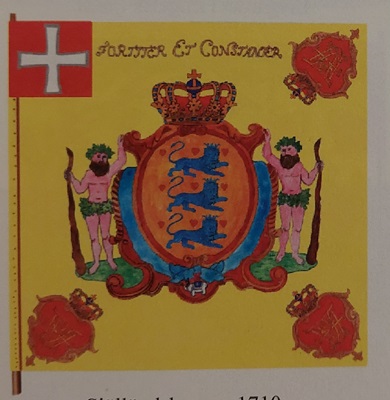
The colour of the Zealand Regiment interpreted by
Höglund/Sallnäs |
|
 Gotland
Battalion Gotland
Battalion
(also called Visby Battalion)
Formed in June 1676 by men from
the King's Life Regiment, the Queen's Life Regiment, Prince George and the
two Zealand regiments. Its six companies were under the command of Martin
Barthold (colonel of the New Zealand Regiment). The battalion was disbanded
when Gotland was returned to Sweden in 1679 and the men were transferred to
the King's Life Regiment (some, however, ended up in Bille's free company).
Its uniform in 1676 was a red
coat with yellow lining (the same as the Zealand regiments). Grey breeches
are mentioned both in August 1677 and 1679. In October 1677 the men had red
coats with green cuffs. The non-commissioned officers then had brown coats,
most with black and some with grey cuffs.
In addition to the enlisted
battalion, the Danish occupation forces included three companies raised
through conscription from the local population, each with 600 men. These
companies may have lacked uniform.
|
|
Funen Regiment
(Fynske Regiment)
The regiment trace its lineage from the Funen Company in the Jutland
Regiment, which was raised in 1615 by conscription. During the
Torstensson War of 1643-1645, the now expanded Funen contingent was
detached and became a separate regiment. A reduction of the army in 1649
meant that this regiment was merged with the Zealand Regiment. It again
became a separate regiment in 1661, consisting of a battalion from Funen
and another from Lolland-Falster. It was converted into an enlisted
regiment when a new regiment from Funen was raised by conscription in
the summer of 1675. After heavy losses in the battles of Halmstad and
Lund, the old regiment was disbanded in December 1676. The new regiment
was converted into an enlisted regiment at the same time and was in turn
disbanded when peace was concluded in 1679. Its men were then
transferred to an enlisted German regiment, which took over the name
Funen Regiment.
Recruitment
Funen Regiment consisted of eight companies when it was created in 1661,
and like its predecessor from the 1640s, recruited half of its men from
Funen & Langeland and the other half from Lolland-Falster & Møn. In
1673, its recruiting area was divided into 1245 lægder whose
farmers were to recruit and pay for one soldier each. In the summer of
1675, these lægder were ordered to raise another regiment ("New
Funen" or "Second Funen") which subsequently took over the lægder
while Old Funen was reorganised into a 12-company strong enlisted
regiment. At first, New Funen's men were divided into four companies,
but at the end of August each company was divided into two.
Old Funen regiment suffered very high losses in the winter of 1675-1676
because of poor quarters. The field regiment had lost 500-600 men from
an original force of 800 men. It returned to Funen to replace the losses
by enlisting new recruits but this proved unsuccessful. Instead, it
plundered its other companies so it could contribute a four-company
strong battalion to the field army that landed in Scania, while four
very weak companies were left in Nyborg (they had only a quarter of
their nominal strength). In the Battle of Halmstad on 17 August 1676,
the field battalion's companies were destroyed and only about half of
the men managed to get back to the Danish army during the following
month. The remaining companies in Nyborg were transferred to Scania to
reinforce the field battalion, which then suffered further heavy losses
in the Battle of Lund. Old Funen Regiment was then disbanded, and its
men were used to fill vacancies in the New Zealand Regiment. The
officers may have ended up in New Funen Regiment because its colonel had
received a promise from the king in the autumn of 1676 to recruit from
the old regiment's officer corps.
New Funen Regiment had tried to supplement its Lolland battalion with
enlisted soldiers during the summer of 1676, but despite this it only
reached half its strength. The other battalion participated in the
Scanian campaign and suffered as many losses as the Old Funen in the
Battle of Halmstad. It was then sent back to Funen to be reorganised.
In the winter of 1676-77, the regiment was given the same organisation
as the enlisted regiments (12 companies with a nominal strength of 150
men) and was also paid as such. Eight companies were transferred to
Wismar in April 1677 where it was to reach the planned strength of 1200
men through enlistment, while the other four companies were taken to
Kristianstad where they during the siege shrank to 154 men in total at
the capitulation in 1678. The soldiers who were conscripted from the
regiment's old recruiting district in Denmark were used in early 1677 to
fill vacancies in the New Zealand and Prince Frederick's Regiment
(Funen) and the New South Jutland (Lolland-Falster). The latter regiment
also received men from both Funen and Lolland-Falster at the end of
1677, which was the very last conscription until 1701.
After the end of the Scanian War, the Funen Regiment was disbanded and
its men were transferred to Edmund Esche's regiment, which had
originally belonged to the army of the Prince-Bishopric of Münster.
Esche's regiment took over the name Funen and now Funen was not just an
enlisted regiment but increasingly a German-speaking regiment.
Conscripted Danish soldiers were used to replace losses in the Battle of
Helsingborg in 1710. But those conscripts who remained after the peace
of 1720 were allowed to end their military service and by 1726 Germans
made up 65% of the regiment.
|
Colonels and Battles
|
|
1661 |
Otto Steensen |
|
1664 |
Benedikt Hatten |
|
1671 |
Johan Casper Cicignon |
1676 Halmstad
1676 Lund |
|
1676 |
Hans Schack |
|
1677 |
Andreas Fuchs |
|
1679 |
Edmund Esche |
|
1680 |
Johan Ernst Frisensee |
|
1684 |
Jacob de Bruin |
1690 Boyne |
|
1699 |
Hans Hartmann Erffa |
|
1702 |
Hans Christopher Schønfeld |
|
1704 |
Albrecht Philip v. Eynden |
1710 Helsingborg |
|
1713 |
Jesper Friis |
1715 Stresow |
|
Feb. 1716 |
Otto Callenberg |
|
April 1716-1734 |
Henrik Scholten |
|
New Funen Regiment |
|
10 Aug. 1675 |
Siegfred Bibow |
|
31 July 1676 |
Hans Schack |
1676 Halmstad |
Batallion in Dutch Service |
|
1701 |
Johan Bernhard Dalvig |
1704 Blenheim |
|
Sep. 1704 |
Gerhard Christian Støcken |
|
Nov. 1704 |
Justus Vogt |
1706 Ramillies
1708 Oudenaarde |
|
1709 |
Georg Vilhelm Sponeck |
1709 Malplaquet |
|
1710 |
Frederik Gersdorff |
Campaigns and Garrison Towns
The Scanian War began with the Old Funen Regiment participating with two
battalions in the Mecklenburg campaign of 1675. The regiment was
garrisoned in Wismar after its conquest on 13 December. The third
battalion had been transferred to Holstein in August but returned to
Funen at the beginning of 1676 together with the greatly weakened field
regiment. It could now only contribute one battalion to the Scanian
campaign and suffered heavy losses in the battles of Halmstad and Lund
(in the meantime it was garrisoned in Ystad). Despite reinforcements
from companies at home, the regiment was disbanded in December when its
colonel was court-martialled and dismissed. He had been temporarily
arrested already during the summer, which is why its field battalion was
then led by the New Funen’s colonel.
New Funen regiment participated with its Funen battalion in the campaign
in Scania during the summer of 1676 and suffered heavy losses in the
Battle of Halmstad and then returned to Funen. The Lolland battalion was
stationed in Nakskov.
Eight of the Funen Regiment's companies were garrisoned in Wismar in
April 1677, while four companies were stationed first in Landskrona and
then in Kristianstad, where they were forced to surrender to the Swedes
in August 1678. The Wismar part of the regiment participated in the
conquest of Rügen in September 1678. In 1679, the regiment was assembled
in Holstein and united with Esche's regiment.
After the end of the Scanian War, the regiment was garrisoned in Odense
(4 companies) and Nyborg (8 companies). However, during the 1680s it was
often used as a workforce to improve fortresses on Zealand.
In 1689-1698 a battalion served in the auxiliary corps sent to the
Maritime powers and fought in Ireland and Flanders.
In 1699, 6 companies were stationed in Odense, 4 in Nyborg, 1 in Assens,
1 in Faaborg, 1 in Svendborg and 6 in Rendsburg. In the autumn of the
same year, two battalions were assembled in Schleswig to join the main
army during the 1700 campaign. Three companies were left in Nyborg, and
one was transferred to Korsør.
In 1709 the disposition was: 2 companies in Nyborg, 1 Fredericia, 5 in
Rendsburg and 4 in Friedrichsort. One battalion (7 companies) had first
been in Saxon service 1700-1701 and then participated in the War of the
Spanish Succession 1701-1714 in the Maritime powers’ service (The
Netherlands). The battalions at home participated in the Scanian
(1709-1710) and North German campaigns (1711-1716). The regiment was
then garrisoned in Fredericia, Nyborg and Copenhagen. Its two battalions
were transferred to Norway in 1717 and 1718 and participated in the
Bohuslän campaign in 1719 before returning to Denmark.
Uniforms
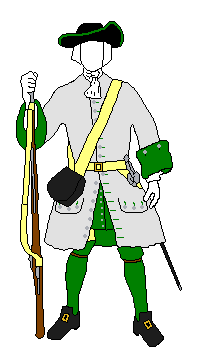
1675 |
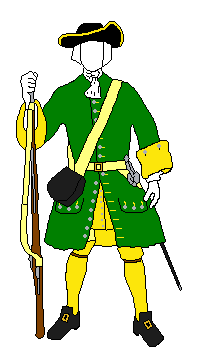
1676-1677 |
1677-1681 |
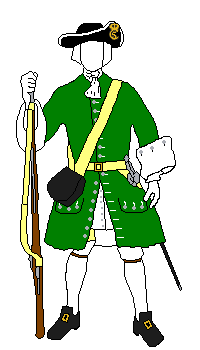
1685 |
|
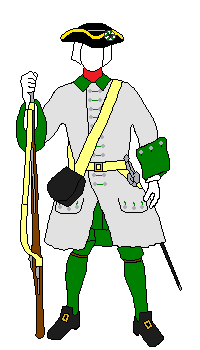
Grey coat with
green lining and cuffs.
Unlike Skjold Petersen,
Hasselager/Snorrasson state that the green-yellow uniform was worn as
early as 1675. They also claim that this uniform was worn by New Funen,
while Skjold Petersen writes that the New Funen’s uniforms are
completely
unknown. |
Green coat with yellow lining and cuffs. Pewter buttons.
The grenadiers wore grey coats with blue cuffs and black grenade boxes,
while pioneers and artillery drivers wore grey coats with red cuffs and
grey piecoats. |
Light grey
coat with green lining and cuffs. Pewter buttons. Green breeches 1679. |
Green coat
with cuffs and lining. |
|
The shade of green of the Funen Regiment is not mentioned until 1735,
when it is stated to be dark green. However, a plate from 1716 showing
the cuffs of the various regiments depicts Funen
Regiments in a light green shade.
|
|
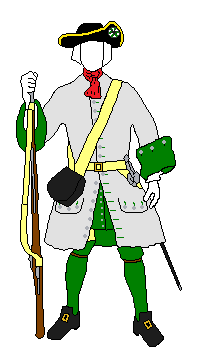 
1691-1710 |
1714-1716 |
1716-1721 |
|
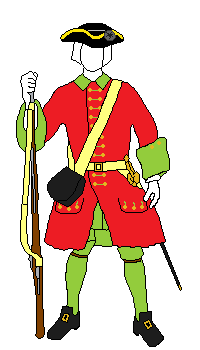
The 1691 regulation specifies a light grey coat with
green cuffs and lining. A source from 1702 also states that the
waistcoat and
breeches were green, the buttons white, the hat lace yellow and the
cockade green-white (officers had grey-white waistcoat and gold hat lace).
The collar was stated to have been red, but the source may have
misidentified the neckcloth as a collar. A spy report from 1709 mentions
"white coats and cloaks with green cuffs and collars". |
Red coat with green lining, cuffs and leg clothes and,
since 1712, brass buttons. |
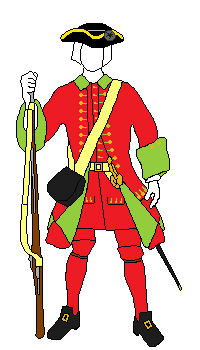
Same as before but the leg clothes and waistcoat should now be
red. |
|
Sometime during the period 1721-1735, the waistcoat turned green, but
otherwise no changes occurred. |
According to Skjold Petersen, the regiment was issued new uniforms in
1709, ?, 1715, ?, (1720), 1723, 1726, 1728, 1732 and 1735.
Colours
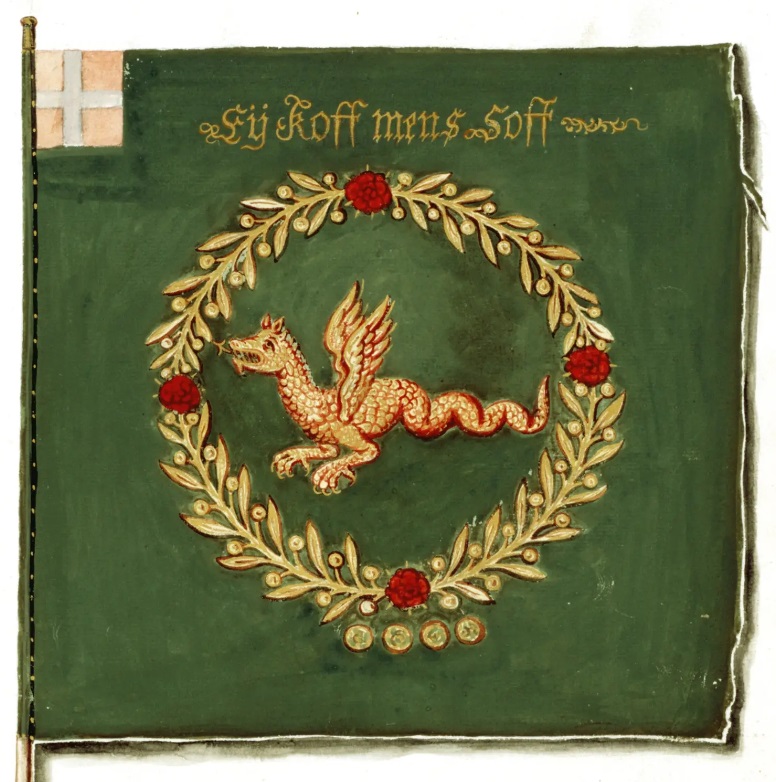
Before the regulation from 1664 was issued, the Funen Regiment had been
proposed in November 1663 to have yellow company colours with the yellow
Wendish lindworm (dragon) in the upper inner corner. However, the
regulation determined that the Funen Regiment should have green company
colours with the yellow lindworm in a red field in the middle and the
Danish flag in the upper inner corner. The colonel’s colour was to be
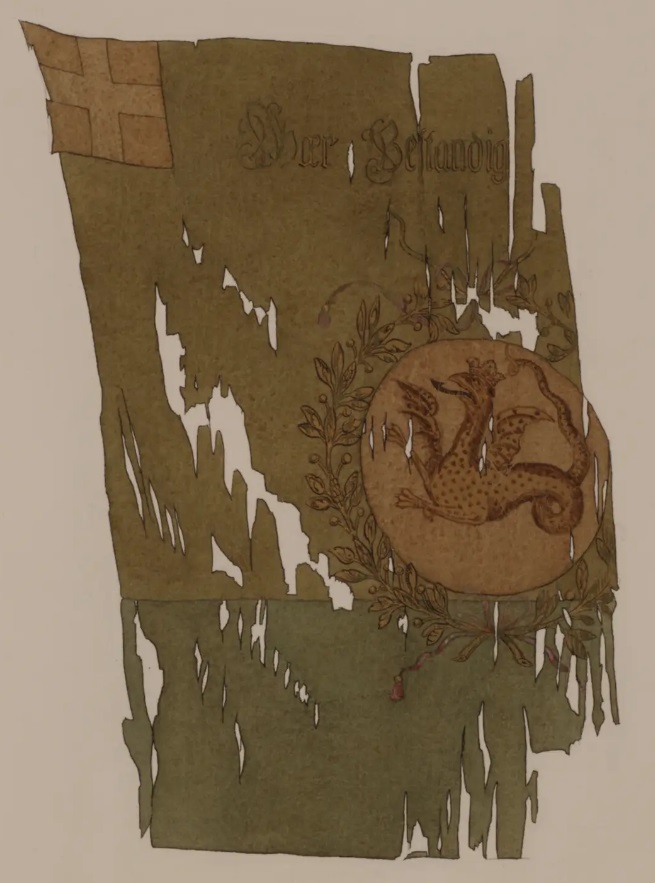
white, and all colours were to be provided with their own motto. The
colours issued to Old Funen followed the regulation and, except for the
red field in the middle, the colours of New Funen also followed this
regulation.
Both regiments lost colours during the Scanian War which are now in the
Swedish Army Museum collections. In addition, Olof Hoffman made
depictions of these colours in 1677-1709 which give us a better idea of
how their original appearance. Under Olof Hoffman's depictions below
there are links to both the surviving colours (the inventory numbers)
and Hoffman's drawings (the company names). The fact that the Old Funen
colours are more worn in the pictures than the New Funen colours may be
because they are from the time of Frederick III and were probably made
shortly after the regulation was established.
Old Funen Regiment
According to Digitalt museum, where the links go, the fifth company's
colour was possibly lost at the capitulation of Helsingborg on 30
December 1676. The other colours were lost at the Battle of Lund. The
regiment should also have lost colours at the Battle of Halmstad where a
battalion was destroyed, but these have not been preserved.
There is a preserved record from the 1670s of the mottos on the
regiment’s colours that has been reported by both Vaupell and Bruhn.
Vaupell has modernised the text in his version, but there are also other
differences where I believe it is Bruhn who deviates from the original.
For the 2nd company, Bruhn has written "Guld" (Gold) when it should
reasonably be "Gud" (God). And in another context, he has reported the
text on the Second Funen colonel’s colour with the German-Swedish letter
Ö, even though the preserved colour has an Ø:
|
Vaupell
- Sejr og Styrke.
- Gud er vor Tillid og Styrke.
- For Konge og Fædreland.
- Haabet beskæmmer ikke.
- Vær bestandig indtill Enden.
- Herren vill udføre din sag.
- Gud stiller Strid til Verdens Ende.
- Hævnen tilhører Herren.
|
Bruhn
- Seyr och Styrke er af Herren.
- Guld er vor Tillid og Styrke.
- For Kongen och Fædrenelandet.
- Hobit beskemmer icke.
- Vær bestandig indtill Enden.
- Herren vill udføre din sag.
- Gud stiller Strid til Werdsens Ende.
- Hefnen tilhörer Herren.
|
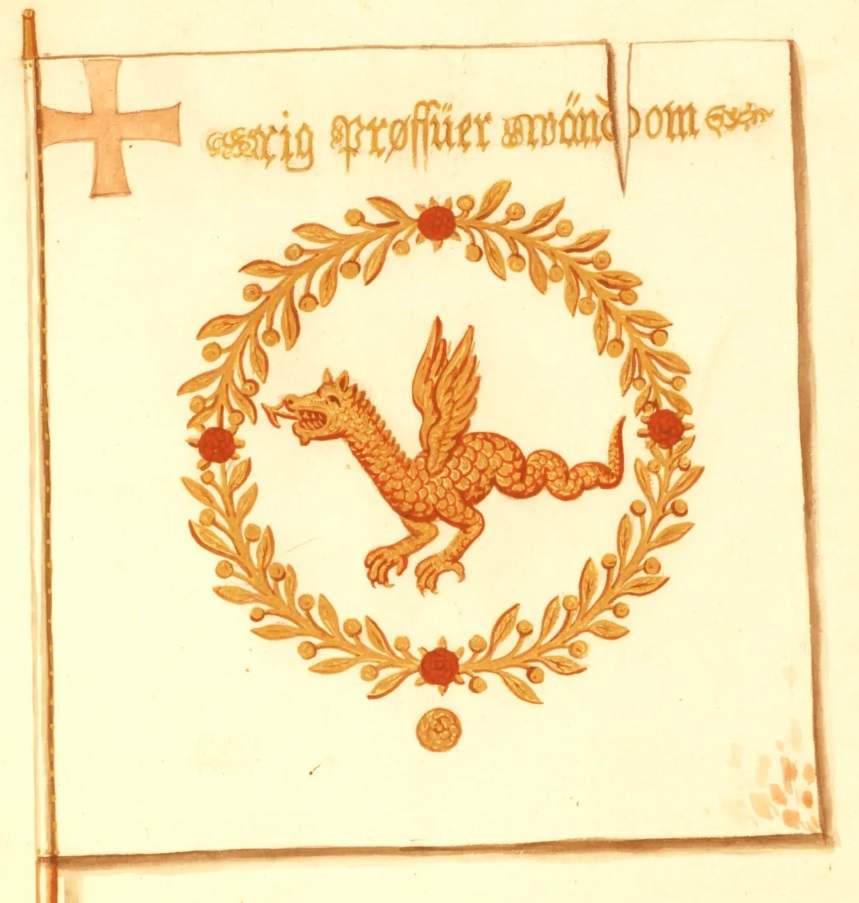
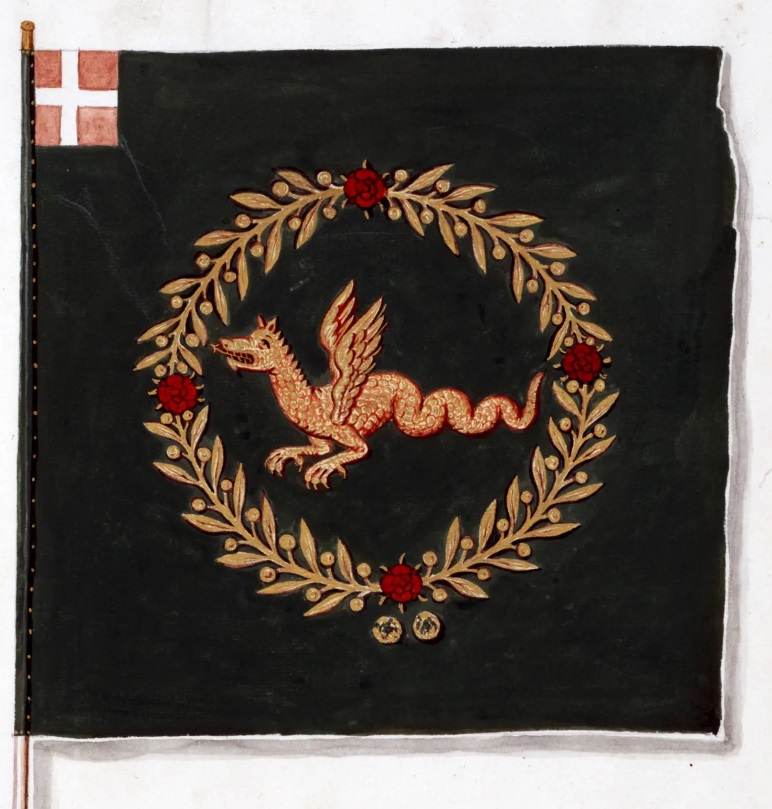
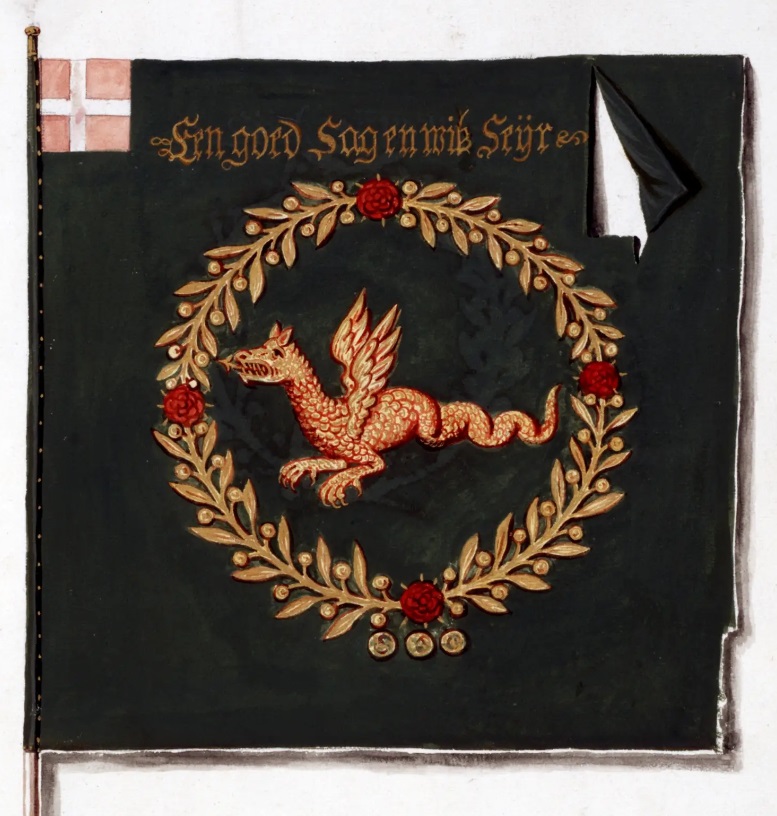
New Funen Regiment
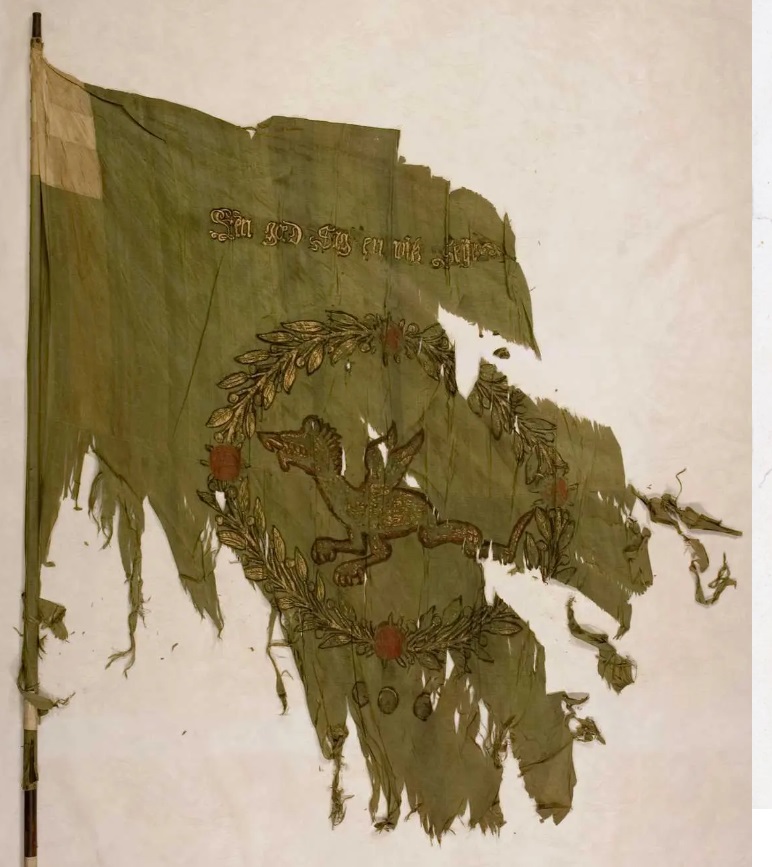
The colour of the 3rd company of New
Funen in its current condition. |
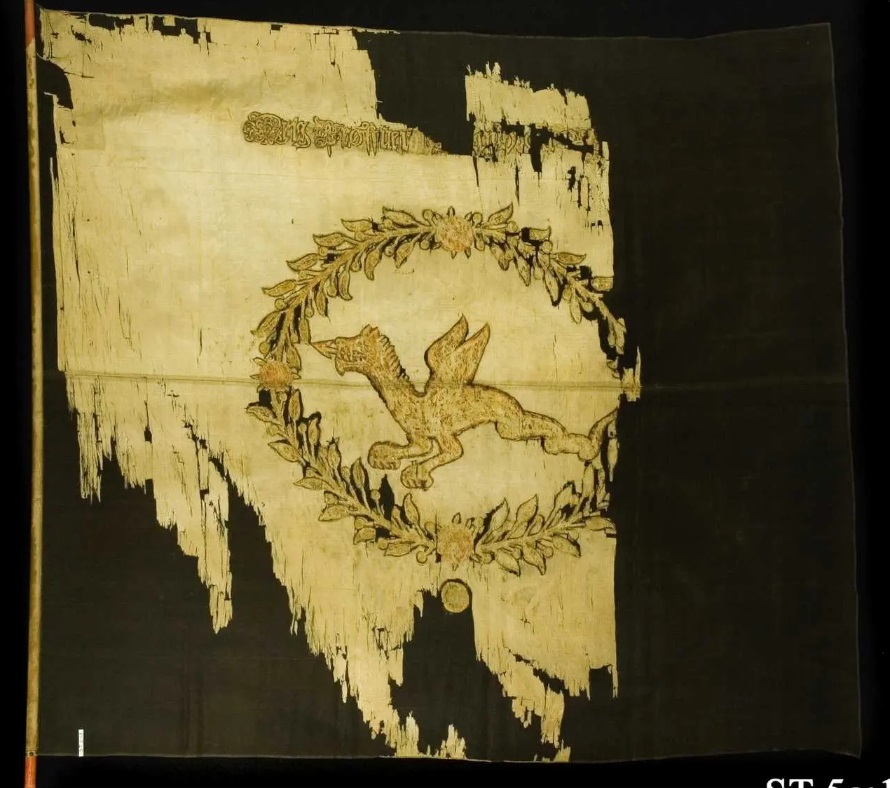
The colonel's colourg of New Funen in its
current state. The motto is: "Krig prøffuer Manddom" (War
tests Manhood). |
The New Funen Colonel’s Battalion lost all its colours in the Battle of
Halmstad on 17 August 1676 and these are in the Swedish Army Museum's
collections. In addition to the fact that they do not have a red field
in the middle as they should have according to the 1664 regulation,
there is another interesting detail on them. Under the wreath, each
colour has a number of bullets indicating which company it belonged to.
Also note the blood stains on the lower corner of the colonel’s colour.
The middle photos of Olof Hoffman's depictions of the colours appear to
have been rendered in too dark a shade. Compare with the photo of the
3rd Company's preserved colour on the right (although it may well have
faded).
Funen Regiment
After the Scanian War, very little is known about the colours of the
Funen Regiment. However, the colours of a battalion that was in the
service of the Maritime Powers have been described. These were green
with a silver-coloured lindworm in a red field surrounded by a crowned
light blue ribbon (which should refer to the Order of the Elephant). It
is likely that the battalions at home had the same type of colour during
the Great Northern War.
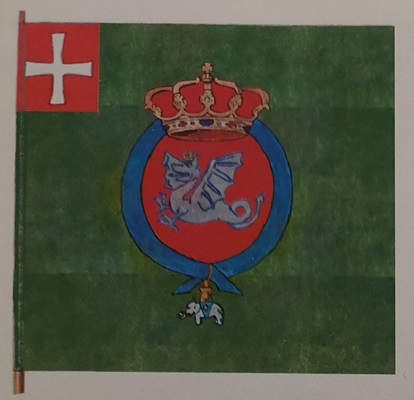
The colour of the Funen Regiment interpreted by
Höglund/Sallnäs
|
|
Jutland
Regiment
(Jyske Regiment)
The first Jutland regiment
was raised in 1615 by conscription but was disbanded because of the
imperial occupation of Jutland in 1627-1629. It was re-established in
1632, and a second Jutland regiment was raised in 1658. Before the
Scanian War, the number of Jutland regiments was doubled in 1675 by a
new round of conscriptions. The old regiments were immediately converted
into enlisted regiments. All Jutland regiments were disbanded in 1679,
but one of them had its men transferred to an enlisted German regiment
which took over the name Jutland Regiment.
Recruitment
When the Jutland Regiment
was established in 1615, it consisted of nine companies of Jutlanders
(2001 men) and one company from Funen (200 men). The 1621 ordinance
adjusted this to 1,800 Jutlanders and 400 men from Funen (divided into
two companies). The imperial invasion and occupation of Jutland in
1627-1629 led to the Jutland regiment being effectively disbanded and it
was not re-established until 1632 with a strength of about 2,700 men (eight
Jutland and two Funen companies). In 1638, independent nobility
companies recruited from peasants on the nobility’s lands were added
with 900 men from Jutland (four companies) and 300 men from Funen (one
company). In 1642, the regiment was doubled by the introduction of
reserve soldiers. But, like the imperial war, the Torstensson War of
1643-1645 meant that Jutland was occupied and that recruitment was thus
reduced to those who could voluntarily make their way to the Danish
islands.
After the Torstensson War,
the Jutland Regiment was reorganised in 1647 so that it would consist of
2,800 men divided into 16 companies. These consisted only of Jutlanders
since the men from Funen had formed their own regiment. However, for
economic reasons, the regiment was reduced to seven companies in 1649
and the noble companies were withdrawn from 1649-1652. Before Charles X
Gustav's war, the Jutland Regiment (including nobility companies) had a
strength of about 2,300 men divided into 14 companies. Three more
Jutland regiments were raised by conscription in the summer of 1657 with
a strength of 1,000 men each. However, these poorly equipped regiments (they
had no uniforms) were lost already in October when the fortress of
Frederiksodde fell to the Swedes. The regular regiment also suffered
heavy losses and, as in the previous war, the Swedish occupation made it
difficult to recruit new soldiers. Another Jutland regiment was raised
in May 1658 and although it was to become permanent, it initially
existed only on paper, as new conscriptions were not carried out until
1659. And then the conscription were limited to the very north of
Jutland, which also had to send recruits to enlisted regiments. The
older regiment had a strength of only 230 men in March 1660.
Immediately after the peace
of 27 May 1660, the two Jutland regiments were made complete with a new
round of conscription and then they were sent back home. A very
temporary merger into an eight-company strong regiment took place in
February 1661 and was restored in August of the same year. Both
regiments had received their recruits from all over Jutland, but in 1661
they were given separate recruiting districts so that the older regiment
received northern Jutland (the dioceses of Ålborg and Viborg) while the
younger one received southern Jutland (the dioceses of Ribe and Århus).
Both were to have eight companies and a reform in 1673, which involved a
reduction of their size, set the strength at 984 men for North Jutland
and 1182 men for South Jutland. Just before the Scanian War, the number
of Jutland regiments was doubled by each recruiting district raising
another full-sized regiment in the summer of 1675, initially only four
companies, but already in August they were organised into eight
companies. The old regiments, on the other hand, were reorganised into
twelve companies each and became enlisted regiments. The new regiments
were also paid as enlisted regiments (with twelve companies) from 1677
onwards, although they continued to receive conscripts. However, while
the New North Jutland Regiment received 789 conscripts from its own
district in northern Jutland at the beginning of 1677, the New South
Jutland Regiment received 454 men from Lolland-Falster. The South
Jutland districts instead delivered their conscripts to Prince
Christian's (742 men from the diocese of Århus) and Prince Frederik's
regiments (472 men from the diocese of Ribe and also 200 men from the
diocese of Viborg in northern Jutland). Also, from the next conscription
which took place in the winter of 1677-1678, New South Jutland received
its recruits from Lolland-Falster (227 men) and also from Funen (200
men) while New North Jutland received its recruits from its home
district. The majority of the Jutland conscripts this time went to
Prince Frederik's and Prince Georg's regiments. This was then the last
real conscription until 1701 because the following year the government
demanded money instead of recruits.
The two old Jutland regiments were reduced to eight weak companies in
1677. As a result of heavy losses during an unsuccessful storming of
Malmö in June, they lost one battalion each, whose men were used to fill
gaps in the ranks of Prince Frederik's (from Old South Jutland) and
Prince Georg's (from Old North Jutland) regiments. The remainder of the
regiments were stationed in Wismar, and they had already been ordered at
the beginning of 1677 to reach a strength of 1200 men each through
enlistment. However, this was not achieved and Old North Jutland, which
only consisted of 300 men, was disbanded at the beginning of 1679 when
its men were transferred to Prince Christian's regiment. After the peace,
Old South Jutland was also disbanded and its men were transferred to
Prince Christian's regiment. New North Jutland had to hand over one
battalion to Prince Georg's regiment while the other two were merged
with Prince Frederik's regiment. The New South Jutland Regiment was
disbanded and the men transferred to Wedel's regiment, which was renamed
the Jutland Regiment. This regiment had been part of an auxiliary corps
from the Prince-Bishopric of Münster, which had now passed into Danish
service. The last remnants of the national Jutland regiments were a
company of the New North Jutland Regiment, which remained in the
Copenhagen garrison as a free company until 1685, when it was
incorporated into the Foot Guards. Similarly, a company of the New South
Jutland Regiment remained in garrison in Fredericia.
The new enlisted Jutland
Regiment was German-speaking, and the remaining conscripts were granted
discharge as soon as new enlisted soldiers had been recruited in their
place. Later during the Great Northern War, Danish conscripts replaced
its losses at the Battle of Helsingborg in 1710. But after the peace of
1720, these were allowed to leave the army, after which the German
dominance increased again. In 1720, 62% of the men were Germans while
33% were Danes. By 1726, the German proportion had increased to 82%
while the Danes now only made up 15%.
Colonels and Regimental Names
The four Jutland regiments
are often numbered from 1 to 4 in historical literature, but these
designations are recent. When the then two Jutland regiments were given
separate recruiting areas in 1661, they were named the North Jutland (Nordjyske)
and South Jutland (Sydjyske) regiments, respectively. Later, when
the national regiment from Schleswig came to be called the South Jutland
regiment, both Danish regiments were called "North Jutland" and were
distinguished by numbering. Oddly enough, the older regiment was named
"Second North Jutland". When the regiments were doubled in 1675, they
were first distinguished by the designations "old" or "new". But from
1676 onwards, the old regiments were considered to be enlisted and were
then named after their colonels, so that only the new regiments were
called "First Jutland" (from South Jutland, or more correctly, middle
Jutland) and "Second Jutland" (from North Jutland). However, the
frequently used number series from 1 to 4 follows the age of the
regiments and gives the northern regiments the numbers "First" and "Third",
which results in confusion. For this reason, I use geographical names
instead of numbers, which I consider to be more informative (I follow
Rockstroh's and Vaupell's geography here, Hasselhager/Snorrason's
geographical names are the opposite compared to them).
|
Old North Jutland |
|
Old South Jutland |
|
1615 |
Mogens Kaas |
1658 |
Poul Benfeldt |
|
1633 |
Jesper Frijs |
1659 |
Adolf Fuchs |
|
1643 |
Joakim Breda |
1666 |
Joachim Schack |
|
1647 |
Axel Urup |
1675 |
Prins Georg |
|
1651 |
Ebbe Ulfeldt |
1676 |
Hans Walter |
|
1654 |
Valdemar Lykke |
1677-1679 |
Johan Vogt |
|
1657 |
Laurids Pogwisch |
New North Jutland |
|
1658 |
Claus Dyre |
|
1666 |
Claus Ahlefeldt |
1675-1679 |
Bartold Bülow |
1676 Lund
1677 Landskrona |
|
1674 |
Carl Arenstorff |
New South Jutland |
|
20 May
1675 |
Christoph Otto Schack |
|
26 May
1675 |
Hans Georg Schulenburg |
1675 |
Egedius Christoph Lützow |
1676 Lund |
|
1677-1679 |
Hartvig Levetzau |
1679 |
Hans Steensen |
Jutland |
|
1678 |
Gustaf Vilhelm Wedel |
|
1684 |
Andreas Casimir Lamsdorff |
1690 Boyne |
|
1695 |
Herman Frederik Boyneburg |
|
1701 |
Thomas Weinegel |
|
1702 |
Lorenz Blücher |
1710 Helsingborg |
|
1710 |
Johan Peter Ingenhoven |
1715 Stresow |
|
1717 |
Hans Henrik Scheel |
|
1728-1762 |
Frederik Ernst von Brandenburg-Kulmbach |
Campaigns and Garrison Towns
When Lennart Torstensson's Swedish army invaded Denmark in
December 1643, the Danish army evacuated Jutland, but between 1,000 and
1,500 men from the Jutland regiment remained and were taken prisoner.
Among them were soldiers without uniforms whom the Swedes sent home
because they believed they were levied peasants. What remained of the
regiment was transferred in January to Sehested's enlisted regiment.
However, enough Jutland officers and soldiers managed to leave
Swedish-occupied Jutland on their own during the first half of 1644 so
that the regiment could be re-established with a strength of eight
companies. A large part of the regiment then served in the navy. In the
summer of 1657, the Jutland Regiment participated in the campaign in
Bremen-Verden and lost about 1000 men. Six companies (of which two
nobility companies) were garrisoned in Frederiksodde and these had an
effective strength of 500-600 men when the fortress fell to the Swedes
on 24 October. All that remained of the regiment when the Peace of
Roskilde was concluded on 26 February 1658 were four companies (of which
one nobility company) with a strength of 600 men who were garrisoned in
the Holstein fortresses of Glückstadt and Krempe. Although there were to
be two Jutland regiments from May 1658, Swedish occupation prevented
recruitment to them and the Jutland national infantry was even weaker at
the Peace of Copenhagen in 1660 than it had been after the Peace of
Roskilde. The Scanian War began with a Danish siege of Wismar in the
autumn of 1675, in which the old Jutland regiments participated with
eight companies each. Their reserve companies were left as garrison
troops in Schleswig-Holstein (Old South Jutland) and in Fredericia (Old
North Jutland). After the fall of Wismar on 13 December, the field
regiments were garrisoned in Wismar and in early 1676 they were joined
by their reserve companies. Two companies of Old North Jutland were
commandeered to the fleet in July 1676 and made an unsuccessful landing
attempt on Rügen. The regiment then returned to Wismar except for two
companies that were garrisoned in Kristianopel and were then forced to
surrender to the Swedes on 22 February 1677. Both regiments transferred
one battalion to Landskrona in early 1677, while one battalion remained
in Wismar. After an unsuccessful storming of Malmö on 26 June, the
Landskrona battalions were
disbanded and used to fill gaps in the ranks of other regiments. The
Wismar battalions survived until their disbandment in 1679, although one
(the Old North Jutland Battalion) did not number more than 300 men.
Before its disbandment, however, the Old North Jutland Battalion
participated in the conquest of Rügen in September 1678. The new
regiments did not participate in the 1675 campaign except for 300 men
who were commandeered as artillery drivers. The following year, the New
South Jutland contributed a battalion to the field army that invaded
Scania on 29 June 1676, while the other battalion was left behind in
Fredericia. The field battalion was garrisoned in Kristianstad after its
capture on 15 August. To reinforce the field army, the Fredericia
battalion and a battalion of the New North Jutland were transferred to
Scania in the autumn, which then participated in the Battle of Lund on 4
December 1676. The heavy losses in the battle meant that the New South
Jutland battalion was transferred to Nakskov on Lolland to receive new
recruits and reorganise into seven companies. They were then divided
into two battalions, one of which remained in Nakskov (later also Nyborg)
while the other was sent to Glückstadt in Holstein. An eighth company
was formed in Fredericia, mainly from men who had served as artillery
drivers (in January 1677 there were 181 men in Fredericia) and it
remained there throughout the war, after which it was converted into a
free company. The regiment's second battalion (4 companies) remained in
garrison in Kristianstad until its capitulation on 4 August 1678, when
it had been reduced to only 60 men. Before that, one battalion had been
transferred to Landskrona and another was commandeered to the fleet and
participated in the conquest of Rügen in September 1678 before returning
to Glückstadt. The battalion from New North Jutland that had
participated in the Battle of Lund was stationed in Landskrona where,
after a month's rest, it had 84 healthy, 333 sick and 116 dead. It
suffered another defeat six months later in the Battle of Landskrona on
14 July 1677. The second battalion was garrisoned in Copenhagen. Part of
the regiment participated in the conquest of Rügen in September 1678. As
the only conscripted regiment it was to consist of three battalions with
a total of 1,500 men in a reorganisation in October 1678 according to
plan (New South Jutland was to have 1,000 men in two battalions). When
the Scanian War ended, all Jutland regiments were disbanded. However,
the men from New South Jutland were transferred to a regiment that
changed its name to the Jutland Regiment and were first stationed in
Fredericia and Kolding. It was used as a workforce to reinforce
fortifications in Copenhagen in 1683-1685 and was then
been assembled in Holstein and in 1687 it was again used for
fortification work on Zealand. When Denmark was on the verge of war with
Sweden in 1689, the Jutland Regiment was stationed with two battalions
in Holstein and one in Fredericia and Helsingør. In October of the same
year, a battalion was sent to join the auxiliary corps in the service of
the Maritime Powers, which participated in the campaigns in Ireland and
Flanders in 1689-1697. The home-based part participated in the campaign
in Ratzeburg in 1693 and the destruction of the Holstein-Gottorp
fortifications in 1697. In 1699 the regiment was stationed with 6
companies in Fredericia, 1 in Kolding, 1 in Ribe, 2 in Haderslev and 8
in Rendsburg. The entire regiment participated in the war in
Schleswig-Holstein in 1700. After the Peace of Traventhal, a battalion
was included in the Saxon Auxiliary Corps in 1700-1701 and then in the
Imperial Auxiliary Corps until it was separated from the parent regiment
in 1703 and became part of the newly formed Third Danish Regiment. The
home-based part was stationed in Rendsburg.
At the outbreak of war in
1709, the Jutland Regiment was stationed with 2 companies in Rendsburg
and 10 in Glückstadt. It participated in the Scanian campaign of
1709-1710, after which it was stationed in Zealand. In 1714, it was
transferred to Glückstadt and then participated in the Pomeranian
campaign, where it distinguished itself in the Battle of Stresow. It
returned to Zealand in 1716 after which its two battalions were
transferred to Norway in 1717 and 1718, where it remained until the end
of 1719. After that, the Jutland Regiment was stationed in Rendsburg until 1728.
Uniforms
Skjold Petersen states that the North Jutland Regiment had blue coats in
1663 while the South Jutland Regiment had red coats in 1663 and grey
coats with yellow cuffs and lining in 1667. According to him, they would
keep the yellow cuff colour until 1679. The next coat colour for the Old
South Jutland Regiment is first mentioned in 1676-1677 when it was red
and in 1677-1679 when it was grey.
I have received most of the information about the uniforms of the
Scanian war from Hasselager/Snorrason's article, but they often conflict
with Skjold Petersen's more sparse information.
|
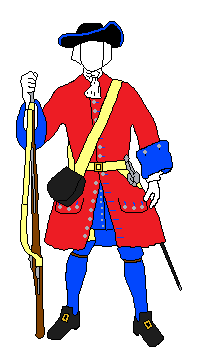
August 1675
(New South Jutland) |
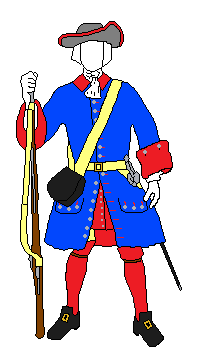
1675
(the other three?) |
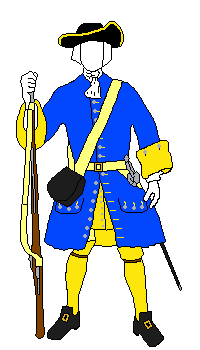
1676 or 1677
(the other three?) |
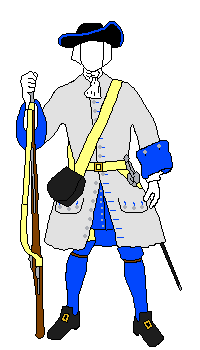 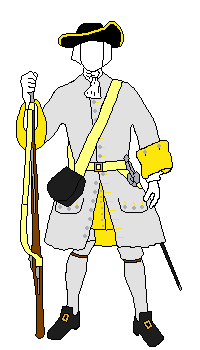
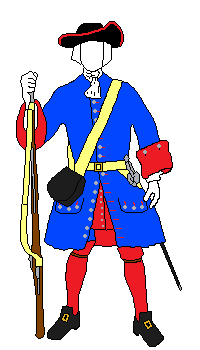 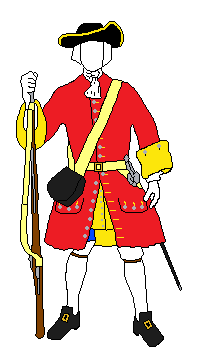
1677-1679 |
|
Red coat with
blue lining and cuffs. 48 pewter buttons. The buttonholes are sewn with
white
and blue thread and "remmer" (to reinforce the buttonholes or to colour
them?)
In May 1676, grenadiers wore grey
coats with blue cuffs, while pioneers and artillery drivers wore grey
coats with red cuffs and grey piecoats.
Changed to grey coats with yellow cuffs in 1677 and in 1678 sealskin
cartridge boxes are mentioned. |
Blue coat with
red cuffs and pewter buttons (the button colour is not mentioned for the
New North Jutland who received uniforms in September).
Skjold Petersen states that the New North
Jutland in 1675 had grey coats with blue cuffs and lining, which is also
the only information he has about them.
According to Rockstroh (volume 2, pages 179-180), the
recruits who were drafted in Jutland in the autumn of 1676 were to have
a grey hat, yellow leather bandolier with a sword, blue coat with red
lining and collar. Only New North Jutland received these recruits. |
Blue coat with
yellow cuffs and pewter buttons (the old regiments received the uniform
in September 1676). Skjold Petersen only states
this uniform for Old North Jutland, while Old South Jutland is stated to
have had red coat, yellow cuffs and pewter buttons in 1676-1677.
New North Jutland received these colours in the
spring of 1677 and again their button colour is not mentioned. In 1679
they are stated to have had blue breeches and the drummers blue coats
with red cuffs and blue breeches. |
Old North
Jutland: Light grey coat with blue cuffs.
Skjold Petersen adds blue lining 1677-1679 and pewter buttons for the
year 1679.
South Jutland: According to Hasselager/Snorrason, the new regiment
changed to grey coats with yellow cuffs and 48 pewter buttons in 1677.
One battalion (Puttkammer) received 72 pewter buttons.
According to Skjold Petersen, the old regiment
wore this colour combination in 1677-1679 (and grey breeches in 1678).
New South
Jutland: A battalion is mentioned in 1679 as being dressed in red
coats with yellow cuffs, blue breeches and white stockings. |
|
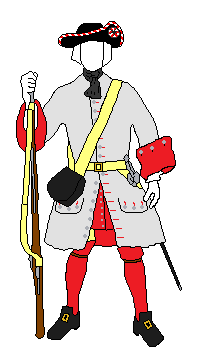 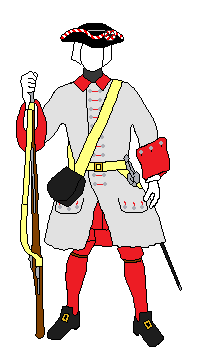
1685-1710 |
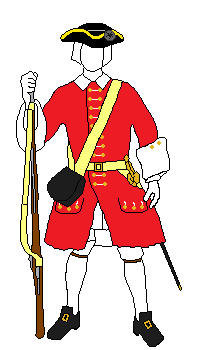
1714-1716 |
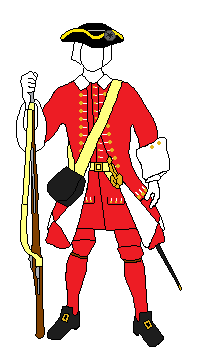
1716-1731 |
|
Light grey coat with red lining and cuffs. Colours of hat
and neckcloth according to a description by Vrigny from 1702. He also
mentions an overcoat with the same colours as the coat and in a spy
report from 1709 they are stated to have cloaks with the same colours as
the coat. |
Red coat with white cuffs, buttonholes and lining and
brass buttons. |
Same as before, but the leg clothes and waistcoat should now
be red. |
Skjold Peterson stated in his first book (from 2005) that the red coat
was issued in 1713 and that it had pewter buttons from 1715 to 1766.
This was changed in his second book (from 2014) to the year 1714 and
brass buttons, which is the same button colour as Schorr states.
According to Skjold Petersen, the regiment
was issued new uniforms in 1709, ?, 1715, ?, (1720), 1723, 1726, 1728, 1732
and 1735.
Colours In a
proposal from 1663, South Jutland would have red-yellow colours and North
Jutland would have green colours (according to Bruhn, Vaupell has it the
other way around). But in the regulation that was established in 1664, the
colours were changed to yellow for South Jutland and blue for North Jutland.
Both regiments would have the Gothic coat of arms as a symbol in the middle
(a lion with nine roses in a yellow field) and the Danish flag in the upper
inner corner. The colonel’s colour would be white, and the colours were
distinguished by being decorated with different mottos. There is a list of
mottos that has been described by both Bruhn and Vaupell, but since the two
are not consistent, I have included both versions with
Vaupell in red text . Note also that both regiments were referred to
as North Jutland at this time because the Schleswig Regiment had taken over
the name South Jutland.
|
First North Jutland
(Old South Jutland)
- Frisk Mood med god Forstand, nest Gud tiene, at vinde hele
Land
Friskt Mod og med god Forstand næst Gud
gir at vinde det hele Land.
- Hvo intet ont vil lide, hand intet got kan bide.
Hvo intet ondt vil lide,han intet godt kan
bide.
- Lyde och lide, god taal, fick aldrig ond ende.
Lide og bide, god Taal fik aldrig ond
Ende.
- Hvo intet wofver, hand intet winder.
Hvo intet vover, han intet vinder.
- Hvad Rett er skal bestaae, omend Werden skulle forgaae.
Hvad Ret er, skal bestaa, om end al Verden
skulde forgaa.
- Herrens Hielp de Christne glæder, de andre twert imod
forfærder.
Herrens Hjælp de kristne glæder, de andre
tværtimod forfærder.
- Lycken naas lettelig, men holdes besværlig.
Lykken naas lettelig, men holdes besværlig.
- Frihed er den ypperste Skatt, See til, hvor Du faar hende
fatt.
Friheden er den yppende skat, se, hvo der
faar hende fat.
|
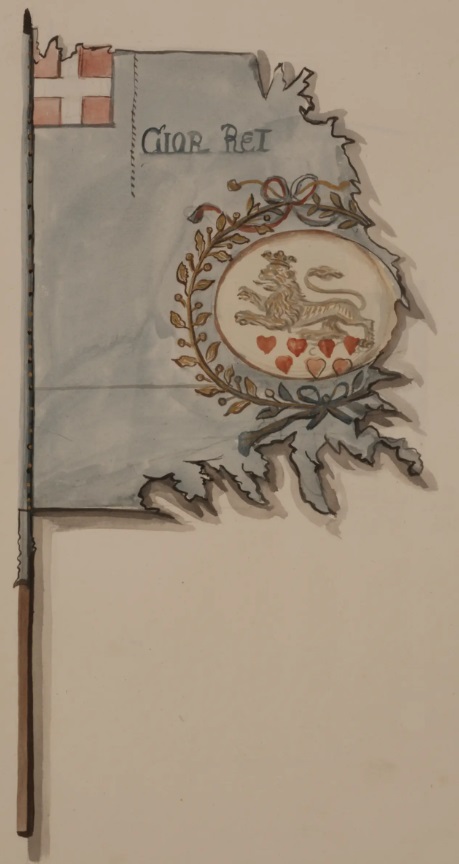 |
Second North Jutland
(Old North Jutland)
- Herrens Nafn er it fast Torn.
Herrens Navn er et fast Taarn.
- Bedre en Gang end aldrig.
Bedre engang end aldrig.
- Giör ret och frygt ingen.
Gør Ret og frygt ingen.
- Ingen Welde mod Gud kan gelde.
Ingen Vælde mod Gud kan gælde.
- Seyer kommer fra Herren.
Sejren kommer fra Herren.
- Ved Endrægtighed och Troskab.
Ved Endrægtighed og Troskab.
- Gode Raad er bedre end Penge.
Gode Raad ere bedre end Penge
- Tro, men see dog hwo.
Tro, men se dog hvo.
|
|
The colour on the image
above belonged to Old North Jutland
3rd company – (AM.080053). |
Colours from the new Jutland regiments were lost in the Battle of Lund
and are preserved in the Swedish Army Museum. Below are links to both
the preserved colours (the inventory numbers) and to the depictions of
them made by Olof Hoffman 1677-1709 (the company names):
Vaupell states that in 1685 the Jutland Regiment's colours were white
with Christian V's cipher in red. Then in 1695 they were red with white
stars and divided by a saltire, in the middle Christian V's cipher and
in the upper inner corner the Jutland lion (Gothic coat of arms).
Höglund/Sallnäs also mentions that new red colours were issued in 1695.
Then they describe the colours for the battalion that was in imperial
service 1701-1703: "red colours divided by a white St. Andrew's
cross. In the middle a crowned monogram and a white star in each of the
red fields. In the upper inner corner, a yellow field with a blue lion
and nine red hearts (Other sources mention only a blue lion, without
field and hearts, and three stars in the fields)". This matches
Vaupell's description of the colours from 1695, but Höglund/Sallnäs has
depicted the colour with Frederik IV's cipher instead of Christian V's.
Even if Vaupell only guessed that the red colours from 1695 looked like
the colours in imperial service, it is very reasonable to believe that
it is the same set of colours and that they should therefore have
Christian V's monogram.
Unfortunately, no other Jutland colours from the time of the Great
Northern War are known.
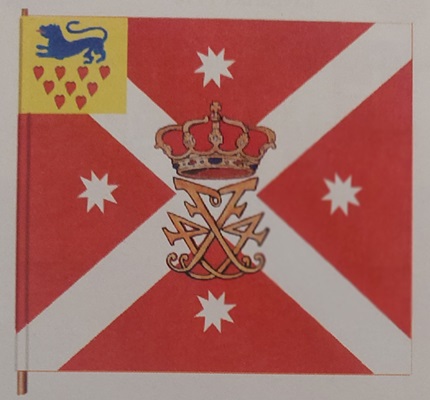
The Jutland Regiment's colour interpreted by
Höglund/Sallnäs with Frederik IV's monogram instead of Christian V's.
|
|
Schleswig-Holstein Regiment
The duchies of
Schleswig-Holstein also created a national militia at about the same time as
the Danish kingdom. However, the local population was very reluctant to
contribute to the financing or to serve in the companies. Since the young
men eligible for military service could easily move between different German
principalities, it was difficult to impose any demanding burdens on them.
Those who were conscripted were therefore only required to spend minimal
time on drills, making their military value very low. In practice, they were
not soldiers but rather levied peasants.
Mobilisations during the Thirty
Years' War in 1625 improved the situation somewhat in Schleswig, but in
Holstein everything remained as before. When an imperial invasion was
imminent after the defeat at Lutter am Barenberge in 1626, a decision was
made to raise a considerably larger national militia. In the royal parts of
the duchies, a Holstein regiment consisting of 4,000 men divided into 10
companies and a Schleswig regiment of similar strength were to be raised. In
the ducal parts, 7,100 men divided into 18 companies were to be raised. The
other princes of Schleswig-Holstein as well as the Schleswig diocese and the
nobility were to raise a regiment consisting of 4,000 men (10 companies).
All in all, the duchies were to field a force of 19,000 men according to
plan. How many who actually were conscripted is unknown, but it cannot have
been many as the will to fight was weak in the duchies. After minimal
resistance in 1627, these newly raised forces were disbanded.
The agreement between the king
and the Duke of Holstein-Gottorp that had been concluded in 1623 stipulated
that they would jointly raise 4,000 men on foot and about 600 cavalry. The
agreement was renewed in 1634 when the nobility of Schleswig-Holstein would
raise a further 11 companies of 400 men each. The royal part of the force
was divided into three regiments with five companies each, while the Gottorp
force of 2,000 men lacked a fixed company organisation. There was still a
great lack of discipline, and the conscripted men largely failed to appear
at the musters. That the figures mentioned only existed on paper is
illustrated by the fact that the force that the duchies actually fielded
during the war of 1657–1658 consisted of only a few hundred poorly armed and
completely untrained infantrymen.
In 1663, the now absolute king
decided to establish a national regiment in Schleswig-Holstein and he did
not let the strong resistance from the local population stop him. This
regiment was initially to consist of nine companies, but the following year
it was changed to eleven companies (4 in Schleswig, 5 in Holstein, 1 in
Pinnenberg and 1 from the cities). However, completing the regiment would
become a recurring problem and the County of Pinnenberg managed to reach an
agreement to only recruit its company during wartime in exchange for paying
a vacancy fee in peacetime. Later, the crown also agreed that soldiers from
the recalcitrant Dithmarschen region of Holstein would be exempt from some
fortress exercises in exchange for money.
By the time of Christian V's
accession to the throne in 1670, it appears that the regiment had been
disbanded and become eleven independent companies (Tuxen volume 1, pages 76
and 78). In the same year, a reorganisation took place that re-established
the regiment but reduced the number of companies to eight (4 in Schleswig
and 4 in Holstein), with a total strength of 1,609 men. When the regiment
was mustered in 1672, however, it was in a very poor condition. Especially
the Holstein companies, which were practically useless. For example, the
inhabitants of Dithmarschen had recruited a group of beggars who had only
agreed to a four-week term of employment.
Another reorganisation took
place in 1675, just before the outbreak of the Scanian War, when the
regiment was expanded to 14 companies. However, the number of privates did
not exceed 1,461. Of the new companies, two came from the princely estates
on the island of Als in Schleswig and two companies from the Holstein
districts of Pinneberg and Segeberg.
|
Colonels and Battles
|
|
1664 |
Johan Wittemacke |
Schleswig Regiment |
|
1675 |
Bernhard of Plön |
|
Jan. 1676 |
Johan Adolf of Plön |
|
July 1676-1677 |
Konrad Brinck |
1676 Lund |
Holstein Regiment |
|
(1664) |
Johan Wittemacke |
|
Feb. 1676 |
Johan Vogt |
1676 Halmstad |
|
Sep. 1676 |
Hartvig Otto Deden |
|
1679 |
Jobst scholten |
|
1682 |
Johan Anton Einberger |
|
1683-1689 |
Otto Henrik Aderkaas |
Scanian War
Before Denmark attacked Sweden
in September 1675, they invaded Holstein-Gottorp during the summer and
disbanded its army. Much of the men from the Gottorp army were forcibly
recruited into the Schleswig-Holstein regiment, which was doubled and then
divided into a Schleswig and a Holstein regiment. Despite the choice of
names, the Schleswig regiment consisted of 6 Schleswig and 6 Holstein
companies from the royal parts of Schleswig-Holstein, while the Holstein
regiment was assigned to the Gottorp parts as its recruiting area.
The quality of the Gottorp
soldiers was unfortunately even lower than those in the old
Schleswig-Holstein regiment and they largely deserted. At the beginning of
1676, the crown agreed that in exchange for money the Gottorp districts in
Schleswig would not have to recruit soldiers. The Holstein regiment, which
then only consisted of six companies, was supplemented by recruiting another
six companies through enlistment. After the Danish landing in Scania in June
1676, four conscripted companies joined the field army. In August of the
same year, however, they were destroyed in the Battle of Halmstad and the
few survivors were assigned to the Schleswig regiment. But instead of
replacing the losses with new conscripts, the residents of the recruiting
district preferred to pay money so the crown could recruit four companies of
enlisted soldiers. A little later, two more enlisted companies were
recruited, after which the remaining conscripts were sent home and the
Holstein regiment ceased to be a national regiment. The six newly recruited
companies were transferred to Zealand in 1677, where they were soon
transferred to the King's Life Regiment. Of the six remaining Holstein
companies that stayed in Holstein as a garrison troop in Rendsburg, five
were transferred to Prince George's Regiment at the end of 1678. The last
company was then used as a garrison unit until it was disbanded in 1689.
The Schleswig Regiment, which
was of somewhat better quality than the Holstein Regiment, contributed two
battalions to the Mecklenburg campaign in 1675 and was given winter quarters
in Rostock after which they returned to Schleswig. This field regiment (eight
companies) took part in the landing in Scania in June 1676 and shortly
afterwards the remaining four companies joined the main army in Scania. The
regiment took part in the conquest of Landskrona and Kristianstad and in the
Battle of Lund. The Schleswig Regiment also abandoned conscription in favour
of taxes at this time so that enlisted soldiers replaced losses in the
Battle of Lund. The regiment was disbanded in September 1677 and the men
were transferred to the King's Life Regiment.
Uniforms
Rockstroh mentions in
connection with the mobilisation in 1674-1675 that the Schleswig half of the
regiment had blue uniforms similar to the North Jutland regiments while the
Holstein men had red uniforms, which then became red uniforms for both
regiments after the partitioning (volume 2, pages 98 and 104). Hasselager/Snorrason
dates these blue uniforms to 1670 and writes "maybe" and mentions Vaupell's
information from 1667 (grey coat with yellow cuffs) and 1676 (grey coat with
red cuffs) together with his own information about grey coat colour with
unknown cuffs in 1674.
Incidentally, Skjold Petersen
states that the Holstein Regiment's uniforms are unknown, while Hasselager/Snorrason
has a lot of information about them.
|
Schleswig Regiment |
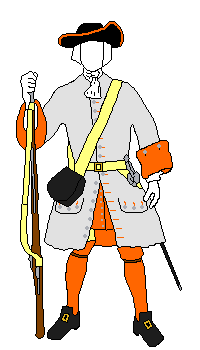
1670-1675 |
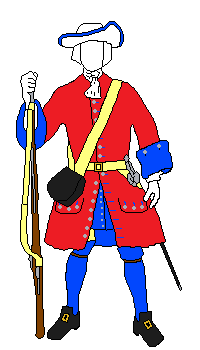
May 1675 |
May 1676 |
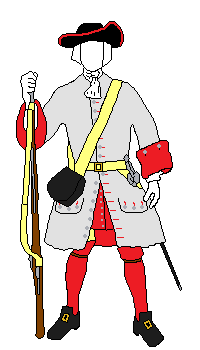
1677 |
|
Skjold Petersen states that the
Schleswig-Holstein regiment had
light grey coats with orange cuffs
in 1670.
Hasselager/Snorrason
mentions that in 1674 the
Schleswig men had grey coats with
unknown lining colour while the
Holstein men had red coats with
blue lining. |
Red coat with blue lining and pewter buttons. White hat?
Grenadiers, pioneers and artillery drivers wore grey coats with red
lining. The drivers wore a yellow crown on their right sleeve. |
Some
companies, two raised by von Blankenstein, may have worn grey coats
with blue cuffs, leather breeches, blue stockings and a black hat
with a blue brim. |
Light grey
coat with red cuffs and leather breeches.
Skjold Petersen states the same uniform for 1676-1677 (except for
the breeches) and adds that the lining was yellow or red. |
|
Holstein Regiment |
1675-1676 |
1676-1677 |
1676-1677 |
1677-1679 |
|
Red coat
with blue lining. In the
spring of 1676, 60 buttons are
mentioned and that year four
companies still have these colours. |
Four
companies had red coats with yellow cuffs in 1676. An enlistment
capitulation also mentions this colour combination in 1677. |
Enlisted
companies wore blue coats with yellow cuffs in 1676. The entire
regiment was to have this uniform in 1677, but only the colonel's
company wore it in the autumn of 1677. |
Newly
raised companies were to wear light grey coats with blue cuffs and
black hats in 1677. In May 1679 the uniform was a grey coat with
blue cuffs. |
Colours
When the Schleswig-Holstein Regiment was raised, both halves were to have
red colours with a large white cross, but in the upper inner corner they
were to have a provincial symbol. For Schleswig companies, this meant two
lions (blue in a yellow field) while the Holstein companies' symbols were
either golden nettle leaves (the actual Holstein coat of arms), a white
crowned swan (the coat of arms of Stormarn) or a white knight (the coat of
arms of Dithmarschen), all on a red field. The colonel’s colour was to be
white and the one that was produced had, according to a list from the 1670s,
the monogram of Frederick III and a golden laurel wreath as motifs. Each
colour was to have its own motto, but unlike the Danish regiments, these
were in Latin and not in Danish for the Schleswig-Holstein Regiment. In
addition, the colonel’s colour and a Holstein colour lacked a motto.
|
Schleswig-Holstein
Regiment
(the colours were used by the Schleswig Regiment after the
partition)
- Colonel's company (Bredstedtska):
No motto.
- First Haderslev: Unanimi tendunt.
(Schleswig)
- Rendsburg: No motto. (Holstein)
- Second Haderslev: Audentes fortuna iuvat.
(Schleswig)
- Wilster: Externus color interni candoris index
(Stormarn)
- Flensburg: Fortibus nihil imperiumder.
(Schleswig)
- Krempe: Generosus resistit.
(Stormarn)
- Dithmarschen: Non inultis succumbit.
(Dihtmarschen)
In addition, the list
mentions two other companies that are not included in the
numbering but that "still remain". The Segeberg Company ("Noli me
tangere") with the Holstein coat of arms as its symbol and the
Pinneberg Company which had a completely unique appearance (green
colour with a silver cross and in the middle the crowned monogram
of Frederick III, no motto).
|
Holstein Regiment
Received new blue
colours after the partitioning in 1675 and four of them became
Swedish spoils of war in the Battle of Halmstad on 17 August,
1676. Apart from the mottos described below, they are identical.
- NVNCQVAMCONFVSI.
- PVGNABIMVS.
- PERVARIOSCASVS
- PERFERFERIMVS
|
The links below the images go
to photos of the preserved flags (inventory numbers) and to drawings of them
that were made by Olof Hoffman and Jonas Jonsson. |
|
Oldenburg Regiment
(Oldenborgske Regiment)
The two counties of Oldenburg and Delmenhorst were inherited by the
Danish king in 1667 and were thus united with the Danish monarchy. Under
the previous count, there had been a national militia organisation there
and Christian V decided to activate it in 1670 so that a couple of
hundred men could be garrisoned in the fortresses. However, the governor
of Oldenburg found that the conscripted men were practically useless for
service in war and sent them back home. However, before the outbreak of
war in 1675, he received new orders and was now to set up a 12-company
strong regiment through conscription, which he completed in September.
This was also intended to be used as a garrison force in the home
province, but conscription was no less unpopular in Oldenburg than it
was in Schleswig-Holstein. As early as December 1676, a decision was
therefore made to replace conscription with taxes that would pay for
enlisted soldiers. The plan was that the conscripted men would gradually
be discharged as they were being replaced by enlisted soldiers. But in
several places, it proved impossible to get the conscripts to stay until
then. In 1677–1679, 200 men were garrisoned in the fortress of Carlsburg
in Bremen-Verden, which had been captured from the Swedes.
|
Colonels and Battles |
|
1675 |
Anton Gynter Ellebracht |
|
1676 |
Johan Vogt |
|
1677 |
Ditlev Lütken |
|
1678 |
Anton Gynter Pott |
|
1693 |
Erhard Wedel |
|
1701 |
Frederik Vilhelm
of Sønderborg |
1704 Blenheim
1706 Ramillies
1708 Oudenaarde
1709 Malplaquet |
|
1711 |
Hans Philip Praetorius |
1715 Stresow |
|
1719 |
Frederik Anton Wedel-Jarlsberg |
|
1729-1760 |
Frederik of Glücksburg |
After the end of the Scanian War, its
strength was set at 1,000 men divided into eight companies. During the
mobilisation in 1683–1684, the regiment was expanded to twelve musketeer
companies of 102 men each and a 112-man grenadier company (a total of
1,336 men). A new mobilisation in 1688 was to increase the number of
musketeer companies to 18, which would also be as strong as the
grenadier company. However, this expansion was never completed and in
1689 the Oldenburg Regiment contributed a battalion to the auxiliary
corps sent to the Maritime Powers. This battalion did not return but was
merged with the Queen's Life Regiment already in 1690. What remained of
the Oldenburg Regiment was thus only a battalion of 5 companies. It was
expanded in 1699 with a company from the disbanded Courland’s regiment.
Another musketeer company was recruited in 1700, so that the battalion
consisted of six musketeer companies and one grenadier company. In the
autumn of 1701, the grenadier company was transferred to the newly
formed Grenadier Corps, while the rest of the battalion then became part
of the auxiliary corps that was in the service of the Maritime Powers
during the War of the Spanish Succession. The Oldenburg battalion was
paid by England during that time and returned home after the conclusion
of peace in April 1713.
Once home, Oldenburg was reinforced with
five companies from the disbanded Württemberg-Oel's regiment and one
company from Prince George's regiment (these regiments had also been
part of the auxiliary corps in the service of the Maritime Powers).
Oldenburg thus received the normal organisation of a Danish infantry
regiment (12 companies). It was also now that Oldenburg participated in
the Great Northern War for the first time by being garrisoned in the
occupied fortress of Stade in Bremen-Verden until 1715. During the war
in 1700, it had remained in its home province. It then participated in
the Pomeranian campaign and was garrisoned in Stralsund before being
transferred to Copenhagen at the end of 1716. It was stationed in
Copenhagen and Helsingør until 1725 when it returned to Oldenburg.
Uniforms
|
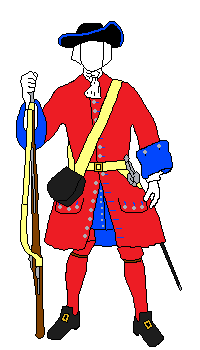
1676-1679 |
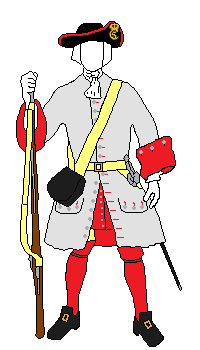
1683-1686 |
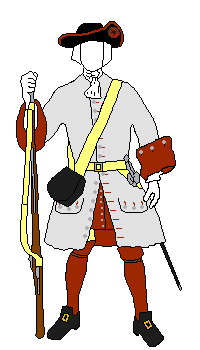
1691-1699 |
|
Red coat
with blue lining and cuffs and red breeches according to Skjold Petersen
who states that they had them already in 1675. Hasselager/Snorrason
notes, however, that the regiment had no uniforms in 1675 and that the
secondary source that mentions this is therefore not credible. On 13
June 1677, however, the Arsenal (Tøjhuset) is said to have received a
delivery of 700 red coats with blue lining intended for Oldenburg. |
Light grey
coat with red cuffs. |
Light grey coat with cuffs and lining in “muscus” (=
reddish brown or dark brown). |
|
1701-1713 |
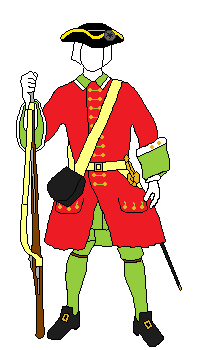
1713-1716 |
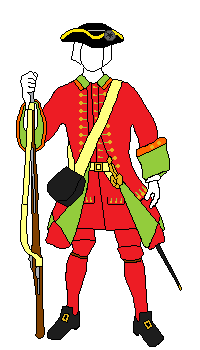
1716-1731 |
The description of the uniform from
1716-1735 follows Skjold Petersen's book from 2014. However, his
previous book from 2005 contain divergent information. At that time, he
wrote that the Oldenburg Regiment in 1722 had two orange stripes on its
green cuffs. In addition, he stated for 1728–1735 that the cuffs and
collar were dark green with a yellow stripe as well as yellow
buttonholes and dark green lining. In the book from 2014, the change to
a dark green shade (and the information about yellow buttonholes) only
occurs in 1735, when the cuffs were not supposed to have any stripes at
all.
The collar on the uniform was abolished
for all regiments in 1731. |
|
The uniform unknown during the War of the Spanish
Succession when Oldenburg was in English service. |
Red coat with brass buttons and light green cuffs with a
white stripe |
Red coat with brass buttons, light green lining, light
green cuffs with aurora stripe. Red waistcoat and leg clothes. |
According to Skjold Petersen, the regiment was issued new uniforms in
1700, ?, 1712, 1715, ?, 1721, 1724, (1727), 1730 and 1733.
Colours
The colours are said to have
been red in 1685. There is a very torn colour that Höglund/Sallnäs believe
is from the 1710s. They have described it as: "Red flag with wild men
holding up the Oldenburg coat of arms”. Their reconstruction follows
below but they admit that it is largely guesswork since the original is in
such poor condition.
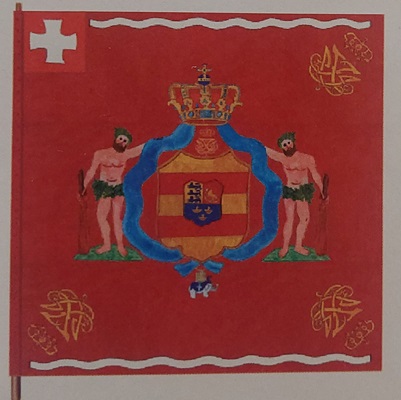
Höglund/Sallnäs' reconstruction of an Oldenburg colour |
|
References Bruhn, Helge. Dannebrog: og danske faner gennem tiderne.
Copenhagen (1949)
Hasselager, Olaf – Snorrason, Torstein. Danish Uniforms, Colours and Standards 1675-1679. (2000) *
Höglund, Lars-Eric – Sallnäs, Åke. Stora nordiska kriget 1700-1721, II. Karlstad (2003)
Isacson, Claes-Göran. Skånska kriget 1675–1679. Lund (2000)
Rockstroh, K. C. Udviklingen af den nationale Hær i Danmark i det 17. og 18. Aarhundrade. Köpenhamn (1909-1926)
Schorr, Daniel. Danish-Norwegian uniforms 1709-1720. *
Skjold Petersen, Karsten. Den danske hærs uniformer i 1700-tallet.
Copenhagen (2005)
Skjold Petersen, Karsten. Kongens klæder. Copenhagen (2014)
Snorrason, Torstein. Danish Uniforms 1699-1712. *
Tuxen, A. P. – With-Seidelin C. L. Bidrag til den store nordiske krigs
historie. Copenhagen (1899-1934)
Vaupell, Otto. Den danske hærs historie til nutiden og den norske hærs historie indtil 1814.
Copenhagen (1872-1876)
* = articles published on the now defunct website
www.northernwars.com |
|




















 =
North Jutland Regiment
=
North Jutland Regiment =
South Jutland Regiment
=
South Jutland Regiment =
Funen Regiment
=
Funen Regiment =
Zealand Regiment
=
Zealand Regiment =
Bornholm Militia (
=
Bornholm Militia ( =
Scanian Regiment (disbanded & ceded to Sweden)
=
Scanian Regiment (disbanded & ceded to Sweden) = The Danish king's areas
 = Jointly ruled areas
 = Holstein-Gottorp's areas
 =
Oldenburg Regiment
=
Oldenburg Regiment