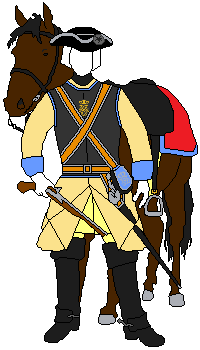
|
Organisational History
The Horse Guards were established on 19 January 1661 and initially consisted
of a single company of 132 men, all officers. The unit had been created
because of the demobilization after the war with Sweden had ended in 1660.
This had resulted in many redundant officers that the king wanted to keep in
his service as a reserve for future expansions of the army.
As part of the preparations for the Scanian War, the Life Guards on Horse
were expanded to a full regiment in 1675, consisting of six companies of 80
men each. After the end of the war in 1679, it was reduced to four companies
(a total of 408 men) but was again six companies strong in 1683. A new
reduction took place in 1699, but the number of companies remained unchanged.
This is according to Karsten Skjold Petersen. Tuxen states that, like the
other enlisted cavalry regiments, it was expanded to nine companies in
1683-1684, each with 46 men, which was expanded to 57 men in 1689. After the
threat of war disappeared in 1689 when Denmark signed the Treaty of Altona,
the number of companies was reduced to six, each with 82 men. But Tuxen does
not mention the further reduction in manpower that must obviously have
occurred later, since it reports the following organisation for the Horse
Guards in August 1699:
|
Regimental Staff |
|
Colonel's Company |
|
Lieutenant Colonel's &
Major's Companies |
|
Regular Companies
(three) |
1 Colonel
1 Lieutenant Colonel
1 Major
1 Regimental Quartermaster
1 Judge-advocate (Auditeur)
1 Surgeon with assistant
1 Kettledrummer
1 Adjutant
1 Clerk
1 Provost with assistant |
1 Captain Lieutenant
1 Cornet |
1 First Lieutenant
1 Cornet |
1 Captain
1 First Lieutenant
1 Cornet |
1 Quartermaster
3 Corporals |
1 Quartermaster
3 Corporals |
1 Quartermaster
3 Corporals |
|
2 Trumpeter |
2 Trumpeter |
2 Trumpeter |
|
50 Troopers |
50 Troopers |
50 Troopers |
Sum: 363 men
Before and
during the war in 1700, the other Danish regiments were expanded, but the
organisation of the Horse Guards did not change. Although the Horse Guards
had two majors in 1701, in both 1699 and 1709 there was only one major. When
Denmark re-entered the war in 1709, the Horse Guards therefore had the same
organisation as at the outbreak of the previous war. In 1714, however, the
regiment was expanded to eight companies of 60 men. After the war had ended,
the strength of each company was reduced to 56 men in 1721 and to 48 men in
1746.
At the end of
1763, the Horse Guards and the Foot Guards merged to form the "Combined Life
Guards", which consisted of five foot companies and two squadrons of 65 men.
They were separated as early as February 1764, but the Horse Guards would
continue to consist of only two squadrons. It was again merged with the Life
Guards on Foot from 1 April 1767 until New Year 1768, when it became
independent again. The regiment was disbanded in May 1771 but was
re-established on 27 May 1772, still consisting of only two squadrons but
with a total strength of 10 officers, 1 adjutant, 2 "vagtmestre" (watch-masters),
8 corporals and 144 privates. The number of privates was reduced in 1790 to
120 men. The lower staff then included 1 drummer, 6 trumpeters, 2 farriers
and 2 saddlers, which was reduced in 1798 to 1 drummer, 5 trumpeters, 1
farrier and 1 saddler. The regiment was reduced to a squadron in 1842 and
was finally disbanded on 31 May 1866.
Colonels and Battles
(Green background indicates victories, red background
defeats)
|
1661 |
Frederik Arenstorff |
1676 Lund
1677 Landskrona |
|
1678 |
Samuel Christoph Plessen |
|
1699 |
Niels Krabbe |
|
1708 |
Henri de Cheuses |
|
1709 |
Bernhard Joachim Mørner |
1710 Helsingborg |
|
1712 |
Baltasar Frederik Oertzen |
1712
Gadebusch |
|
1723 |
Joh. Fredr. Bardenfleth |
|
1735 |
Verner Schulenburg |
|
1738 |
Carl Chrisrian Erdman af Würtemberg-Oels |
|
1747 |
Verner Schulenburg |
|
1753 |
Ludvig Kalckreutz |
|
1754 |
Frederik Christian Plessen |
|
1756 |
Albrecht Christoph Schaffalitzky de Muckadel |
|
1763 |
Caspar Herman Gotlob Moltke |
|
1766 |
Frederik Carl Ulrik Ahlefeldt |
|
1767 |
Carl Frederik Görtz |
|
1767 |
Christian Magnus Frederik Moltke |
|
1772 |
Hans Henr. Eichstedt |
|
1784 |
Joachim Melchior Holten von Castenschiold |
|
1798 |
Nik. Aug. Kardorff |
|
1802 |
Frederik Blücher |
|
1806 |
Gotfred Vilh. Christian Schmettow |
1807 Copenhagen |
|
1823 |
Frederik Vilhelm Carl Ludvig Hessen-Philipsthal |
|
1834 |
Frederik Løvenørn Bardenfleth |
|
1842 |
Christian af Glücksborg |
|
1854 |
Adolf Frederik Schack-Brockdorff |
|
1859-1866 |
Frederik Ludvig Gotlob Wedell-Wedellsborg |
|
|
Horse Guards Campaigns
Scanian War 1675-1679
Before the outbreak of war, the Life Guard was expanded to a full regiment
consisting of six companies in June 1675. Two of these companies were
detached to guard the coast in southern Zealand (Næstved and Prestø) while
the other four were part of the main army during the campaign in Mecklenburg
and Pomerania. During the siege of Wismar, the Guard was stationed in
Greifswald. The following year, it was part of the army that invaded Scania
in June 1676 and it participated in the Battle of Lund on 4 December. After
the battle, the Life Guard returned to Copenhagen but was back in Scania in
1677 and participated in the Battle of Landskrona on 14 July. It was also
involved in a minor skirmish against 120 Swedes south of Laholm in 1678,
which was more successful than the major battles. In 1679, the Life Guard
was in Holstein and returned to Copenhagen after the conclusion of peace.
The War of 1700
When the Danish army began the invasion of Holstein-Gottorp on 21 March
1700, the Life Guards on Horse were kept in Copenhagen as a garrison. It was
not until 9 June that two of its three squadrons were ordered to be sent to
Kolding in Jutland where they were to be quartered to "spare the new
uniforms". Once there, they received orders on 29 June to go to Tønder
in the ducal part of Schleswig to collect contributions. But just as they
arrived in Tønder on 2 July, new orders arrived, prompted by reports that a
force from the enemy coalition was advancing towards the city of Schleswig.
They were now to go there to hold the Dannevirke as a defensive line and
after a forced march they arrived in Flensburg the next day. But new
information that a 2,000-strong Gottorp force was also on its way to
Schleswig made the regimental commander Krabbe decide to turn back north to
Haderslev as he did not want to expose the Horse Guards to "manifest
danger". However, the rumours of the enemy offensive turned out to be
false and the Horse Guards interrupted their retreat and returned to Tønder.
The Horse Guards then continued for a little over a month to be part of a
mobile force that was to protect northern Schleswig against Gottorp attacks
and at the same time collect contributions. All this while the main army was
in Holstein where it confronted a Swedish-Lüneburg-Dutch coalition army.
Apart from manoeuvre warfare, the Horse Guards were not involved in any
actual fighting until the morning of 9 August when a larger Gottorp force
attacked the Danish camp at Arleved. After a couple of hours of fruitless
firefight, the Gottorp force gave up and called off the attack. This was the
very last battle that the Danish army was involved in in the year 1700, as
the Peace of Traventhal was concluded on 18 August, after which the Horse
Guards squadrons returned home to Copenhagen.
Great Northern War 1709-1720
When Denmark re-entered the war, the Life Guards were part of the field army
that invaded Scania in 1709 and were defeated in the Battle of Helsingborg
in 1710. The regiment then participated in the campaigns in Mecklenburg and
Pomerania in 1711-1716 and fought the Battle of Gadebusch in 1712. From 1716
onwards, it was garrisoned in Copenhagen.
|
|
Horse Guards Uniforms
According to Karsten Skjold Petersen, it is only in the following years that
it is possible to determine with certainty that the Life Guards on Horse
received new coats: "1661, ?, 1684, (1686), 1688, 1692, 1694, ?, 1712,
1714, ? 1721, 1724, ?, 1729, 1731". (page 152). However, in another
place he states the years when they received new uniforms as: "?, 1700,
1703, ?, 1713, ?, 1721, 1724, ?, 1729, 1731 " (page 657). Torstein
Snorrason, on the other hand, states that the Life Guards received new
uniforms on 12 June 1695, October 1699 and 15 April 1700 (Frederik IV's
coronation), and that they were mustered in a new uniform on 20 May 1707.
Uniforms
of the Scanian War
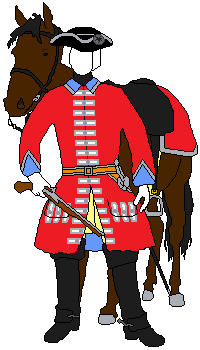
When the Life Guards on Horse were raised in 1661, they were given coats and
cloaks of scarlet cloth with yellow lining. On the left upper sleeve, they
had the royal coat of arms richly embroidered with gold, silver and coloured
thread. After that, according to Karsten Skjold Petersen, there is no
further uniform information about the regiment until 1678 when the king
decided that the Life Guards should have grey coats with large white buttons
and wide gold lace on the cuffs.
In Hasselhager/Snorrason's article on the Scanian War, the Horse Guards are
stated to have had red coats with yellow lining and cuffs, as well as
gold-silver buttons and red shabraques with gold. For the year 1677, the
Horse Guards are also stated to have had red coats with 18 buttons that may
have had yellow lining and were embroidered with the king's coat of arms. In
the same year, both leather and cloth breeches were delivered, as well as C5
monograms to be placed on the coats. In 1682, the Horse Guards also had new
red cloth breeches and red coats.
Hasselhager/Snorrason mention that the Horse Guards may have had buff coats
with red cuffs, since cavalry with that colour combination frequently appear
in Møinichen's battle paintings from 1686-1688. But it could also be a
question of paille yellow coats made of cloth that private guardsmen seem to
have worn before 1686. When the Horse Guards were expanded in 1683, a cost
estimate for uniforms was drawn up that mentioned paille yellow coats, red
cloaks, new cuffs for the buff coats, and lace on hats and carbine belts.
Note also that the officers in Møinichen's paintings have red coats and that
the Horse Guards until 1675 consisted only of officers.
|

Horse Guards officer 1676? |

Horse Guards private 1676? |
|
Details from
Claus Møinichen's two paintings of the conquest of Landskrona on 2
August 1676 (painted 1686-1688) |
Interwar Uniforms
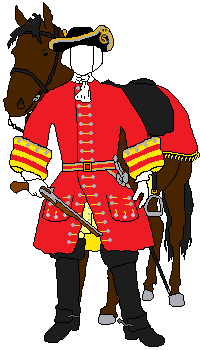
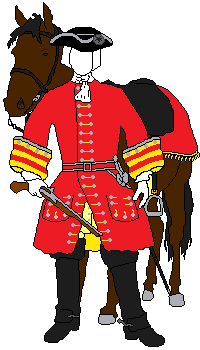
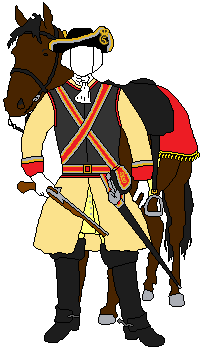
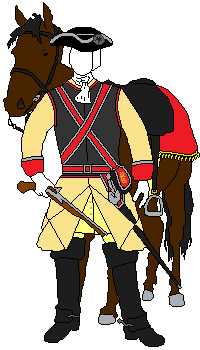
The pictures above largely follow the uniform description from 1686. However,
since the cuffs of the buff coats are only stated to have silver lace in
1699, I have made an assumption that all gold lace on the uniform
disappeared in the 1690s. I have also depicted the striped cuffs so that
they look like the coat of arms of the House of Oldenburg (the Danish royal
house).
In the table below, black text = Karsten Skjold Petersen,
red text = Torstein Snorrason.
|
|
|
1684 |
1686 |
1692 & 1694 |
1699
(October) |
1703 |
|
Hat: |
Hat with gold and silver lace, feather and a gilded
buckle. |
Hat with gold and silver braid and tassel (no feather)
and buckle depicting the king's gilded monogram. |
|
A decision from 1695 states that the hat would not have
feathers when the next uniform was issued. |
Tricorne hats depicted in engraving. In 1702, permission
was granted to purchase silk crepe for hat cockades. |
|
Cloak, cassock: |
Red cloak. |
Red cassock with 11 dozen (!) buttons covered with silver
and aurora, and the royal coat of arms embroidered in gold and silver
(on the left upper arm?). Lining of yellow baize and collar of yellow
kersey. |
The royal coat of arms on the shoulder should now be
surrounded by gold and silver lace. |
Red cassock with yellow lining and with
the king's (crowned?) monogram on the front and back
(Skjold Peterson only writes "both sides").
It is unclear whether the monogram was still C5 or if it had been
replaced with F4 (Christian V died on 25 August). |
An engraving depicts the Horse Guards apparently without
a cassock. |
|
Coat: |
Paille yellow coat (according to cost estimate from
1683). NCOs were to have red coats as before. |
Red coat with 60 white buttons and lining of yellow baize,
red-yellow striped cuffs of velvet plush adorned with gold and silver
lace. |
Silver-plated buttons. |
Red with yellow lining and silver buttons.
Red and yellow striped velvet cuffs. |
A royal decree from 10 June 1702 established that the
colour of the coat would be crimson and that the lining and embroidery
would be the same as before. |
|
Cuirass & buff coats: |
The buff coat had red velvet cuffs. |
The buff coat had red velvet cuffs and a wide gold and
silver lace. |
Buff coat with silver buttons and red cuffs with lace. |
In 1695 it was decided that the
cuirass should have both a breastplate and a back piece, and that
the buff coat should have red cuffs with silver lace. |
In 1707, the regiment replaced 169 worn-out buff coats
with red cuffs of plush and silver lace. |
|
bandolier & belts: |
The carbine bandolier was covered with crimson fabric and
decorated with wide gold and silver lace. The cartridge box was adorned
with embroidery. |
The carbine bandolier was covered with red plush and a
wide gold and silver lace. The belt should also be covered with red
velvet plush and gold and silver lace. |
|
|
Shabraques & pistol covers: |
|
Shabraques and pistol covers made of red cloth with
yellow fringes and embroidered edge, as well as an embroidered crown
with a name cipher. |
|
Uniforms
of the Great Northern War
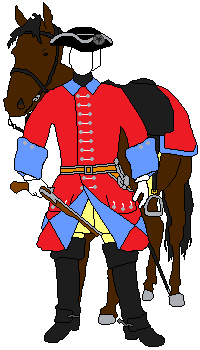
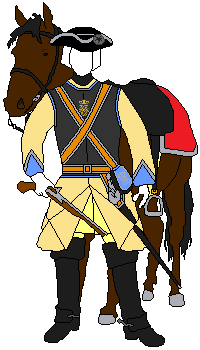
The most detailed
description of the Horse Guards' uniforms is from 1708 and this differs
from the previous ones in that the previous yellow regimental colour had
now become bleumerant (light blue). Torstein Snorrason believes that a
cost estimate from 6 June 1705 may have been the introduction of the
red-blue uniform. New shabraques, pistol covers, cartridge box covers
were then embroidered in Hamburg in 1706. The regiment was mustered on
20 May 1707 wearing what Snorrason believes was the new uniform
described in 1708.
The description from 1708 does
not mention the shape of the cuffs, but since the decoration and colours are
so similar to the uniform of the Grenadier Corps from the same time, I have
made the assumption that the Horse Guards also had small, pointed cuffs.
In the table below, black text = Karsten Skjold Petersen,
red text = Torstein Snorrason,
pink text = Lars-Eric Höglund,
green text = Daniels Schorr.
|
|
|
Quartermaster, Corporal & Trumpeter 1708 |
Privates
1708 |
Privates
1710-1721 |
Privates
1721-1731 |
|
Hat: |
Hat with 2 5/16 ells of silver lace and a
button with braid to hold a cockade consisting of five ells of black
silk. |
Hat with silver lace and black cockade held in place by a
button with a silver buckle. Iron skullcap under the hat. |
Iron skullcaps were acquired.
According to Höglund, the hat was to have
silver lace in 1711. |
1731: hat with 2 5/16 ells of silver lace and black
cockade consisting of 5 ells of silk. |
|
Neckcloth: |
Three neckcloths. Black velvet with three
camel hair buttons and lace ("litzen"). Apparently, no buttons for NCOs. |
The neckcloth was made of black velvet lined with black
silk and equipped with three buttons covered with black camel hair. |
|
|
|
Cloak: |
Crimson cloak with blue lining. The
coat and its collar were adorned with 7 ½ ells of silver lace (according
to Skjold Petersen 7 ¼ ells). |
Crimson cloak with blue lining and blue collar with
silver lace. The cloak had no buttons and there is no mention of any
embroidered coat of arms on it. |
Madder red cloak. |
1731: Red cloak with blue baize lining. |
Coat: |
Crimson coat with cuffs and lining of
blue cloth. Decorated with 48 3/16 ells wide silver lace for bows and
lacing (according to Skjold Petersen 48 5/16 ells)
and edged with 9 ¼ ells “Einfass Gallunen”. |
Crimson coat with two dozen
"English" pewter buttons. Lining of blue (bleumerant) baize and
cuffs and collar of blue cloth edged with silver lace. Decorated with 20
¼ ells of silver lace which went to 44 bows and two round lapels
("Papellen”). |
A madder red coat that should now have the same design as
the rest of the army. From 1711 the cuffs would be made of plush
(blue with two buttons and no lace according to
Daniel Schorr). From 1714 the Colonel’s Company uniforms would
differ from the others (probably finer silver lace). |
1721: Red coat with a collar of blue plush. The Colonel’s
Company's coats had finer silver lace. The collar was abolished in 1731
when the coat was to have 27 ½ ells of silver lace. |
|
Cuirass & buff coat: |
|
Black painted cuirass edged with blue cloth and adorned
with the king's crowned name cipher in gilded brass. Buff coat with blue
cuffs like the regular coat and six silver buttons. |
|
1728 full cuirass with brass fittings, black straps, blue
lining and royal name cipher. |
|
Small clothes: |
Three shirts. Deerskin breeches ("Ziegenbock").
One blue and one undyed pair of stockings. |
White linen shirt. Leather breeches. Blue stockings
(one blue and one undyed pair of stockings). |
May have had a blue camisole (waistcoat) from 1710 which was
made from the lining of the old coat. This garment is first mentioned in
1713 but the blue colour is not confirmed until 1735.
Snorrason mentions that small clothes of leather
were acquired. |
|
|
bandolier & belts: |
Did not have a bandolier or a cartridge
box. The belt was made of leather, but for the parade uniform they were
covered with velvet in the regimental colours and seven ells of silver
lace. |
The cartridge box lid was covered with blue cloth and
decorated with 1 ¼ ells of silver lace and
silver embroidery. The carbine bandolier and the cartridge box bandolier
were of light brown leather and decorated with five ells of silver lace
each. The belt was of light brown leather and decorated with seven ells
of silver lace. |
|
In 1731, bandoliers and belts for daily use were
introduced to avoid wear on the silver lace. |
|
Shabraques & pistol covers: |
Crimson shabraques and pistol covers
adorned with 13 21/2 ells of wide silver lace (13
ells of wide silver lace according to Skjold Petersen)
along with pearl embroidery. |
Crimson shabraques with silver edges. |
Madder red shabraques with white edges.
Snorrason states that the edge was made of camel
hair in 1710 and that the colour according to m/1711 would be light
blue. |
Shabraque with silver lace 1721. |
|
Hair bag: |
Black hair bag with 3 ¼ ells of taffeta
and "rather narrow silver lace on it". |
Black velvet hair bag. |
|
|
|
Other: |
Two pairs of gauntlets. Two pairs of
shoes. Tin-plated stirrups and spurs. |
Gauntlets of light yellow leather.
The sword had a knot that was probably made of silk dyed in the company
colour.. |
|
All fittings and buckles in 1721 should be made of
silver-plated brass. |
In December 1709, the postmaster in Malmö wrote a spy report that mentioned
"The King's Guard on Horse, with red coats and cloaks, and blue cuffs,
silver-laced". However, in the Battle of Helsingborg, the Guard is said
to have fought in buff coats with six silver buttons and cuirasses. The
silver buttons on the buff coats were removed after the battle because they
got in the way of the cuirass. When the heavy losses in this battle were
replaced, the uniform was also made less expensive to save money, which
meant that the silver lace disappeared and the crimson shade was replaced
with the cheaper madder red shade.
  According
to Daniel Schorr, the m/1711 and m/1716 cuffs were to be blue with two
buttons without any other decorations (see his picture on the left,
coloured by me). On the right is a detail of a
plate
from 1716 showing what the Danish army cuffs would look like.
Silver lace on the cuffs was reintroduced with the m/1721 uniform, as
can be seen in the pictures below (it is not uncommon for colours on old
drawings to be darker than the actual uniform colours). According
to Daniel Schorr, the m/1711 and m/1716 cuffs were to be blue with two
buttons without any other decorations (see his picture on the left,
coloured by me). On the right is a detail of a
plate
from 1716 showing what the Danish army cuffs would look like.
Silver lace on the cuffs was reintroduced with the m/1721 uniform, as
can be seen in the pictures below (it is not uncommon for colours on old
drawings to be darker than the actual uniform colours).

Drawing from 1722 |

Drawing by Zimmer from 1730 |
Officer, NCO
and Trumpeter Uniforms
Except for the year 1708 as
shown in the table above (when trumpeters and non-commissioned officers
wore largely the same uniforms), there are only a few notes on the
uniforms of officers and musicians. Until 1707-08, however, it was
customary for officers to wear reversed colours compared to the men.
This seems to have been the case for the non-commissioned officers at
least in 1683-1684, when the privates wore yellow coats with red linings,
while the non-commissioned officers wore red coats with yellow linings.
Unlike the privates, the
non-commissioned officers were not armed with carbines until 1740.
Consequently, they did not have cartridge boxes either. They had
pistols, but until 1737 these were privately purchased. In addition, all
hilts and buckles were to be of silver-plated brass.
|
Officers |
NCOs |
Musicians |
1684:
The collar of the cloak was made of red velvet and adorned with gold
and silver lace.
1695: Staff officers were to have
sword hilts and buttons made of silver. |
1684:
Wide gold and silver lace on the hat.
1686: Feathers in the hat and buff
coats with 3–4 wide laces on the sleeves.
1694: Bows at the buttonholes and
lace on the pocket flaps.
1695: It was decided that when the
next uniform was to be issued, it should have two rows of double
buttonhole lace in gold and silver. The NCOs were also allowed to
keep their hat feathers until further notice.
1708: See table above.
1710: NCOs would distinguish
themselves by having narrow silver lace on their coat and, unlike
the men, they would continue to have a silver edges on their
shabraques. In addition, they would have broadswords instead of
rapiers. The sword hilt was made of silver.
1713: Silver buttons.
1714: From now on, paille yellow
camisole (waistcoat). |
1683:
The trumpeters had fringed belts in red, yellow, blue and
silver. Like the officers, their cloak collars were made of red
velvet with gold and silver lace.
1686: The musicians, unlike the
men, were allowed to keep their feathers in their hats
1691: The musicians received buff
coats with wide gold and silver lace on the sleeves and cuffs.
1708: The trumpeters had the same
uniform as the non-commissioned officers but with a "liberi" coat.
1710: The musicians took over the
NCOs old rapiers when they received broadswords. In addition, their
buff coats were to have silver buttons.
1714: From now on, paille yellow
camisole (waistcoat). |

Detail from Claus Møinichen's painting of the
conquest of Landskrona on 2 August 1676 (painted 1686-1688)
The painting above appears to show guardsmen in yellow, while their officer,
trumpeter and drummer wear red coats. Note the trumpet flag, which has
vertical stripes of white-blue-red-white.
|