|
Modern Austria
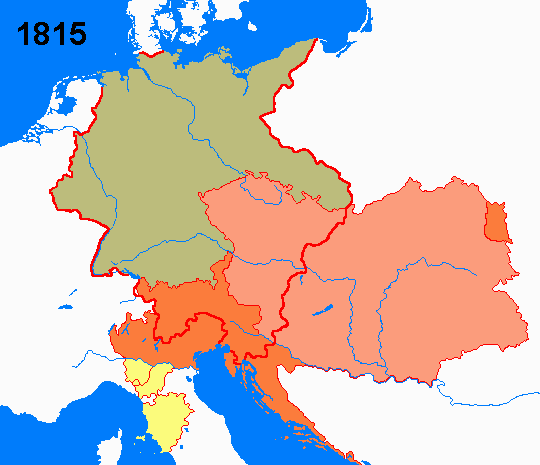
 = Austria
 = Territorial gains 1815
 = Other states in the German Confederation
 = States ruled by collateral branches of the house of Habsburg
After the humiliation of Austria in 1809, Napoleon's fortunes would come
to an end. His armies suffered great defeats in Spain and Russia, and
Austria joined the Sixth Coalition which would finally defeat France
1813-14. The Congress of Vienna was given the task to rewrite the
European map and they followed the Principle of Legitimacy. This meant
that Austria regained almost all territories that had been lost since
the beginning of the Revolutionary Wars. The only exceptions were the
Austrian Netherlands, West Galicia and the Swabian possessions. Austria
was compensated for these old losses with a much stronger position in Italy,
where collateral branches of the Habsburg dynasty were also given
principalities of their own. As a replacement for the Holy Roman Empire,
which had been dissolved in 1806, a German Confederation was created
(of which the Austrian emperor was the permanent president).
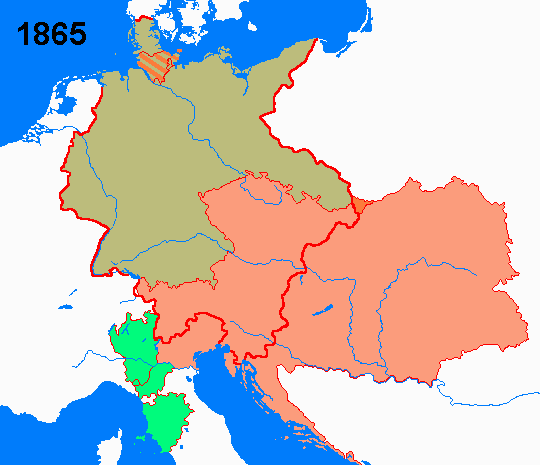
= Austria
= Other states in the German Confederation
= Territorial gains 1846 and 1865
 = Territorial losses 1859-60
Something the Congress of Vienna did not
take any regard of was the emerging forces of nationalism. The Austrian Empire was
consisted of a many different nationalities. Germans, Italians, Poles and Hungarians
all demanded to create Nation states that threatened the continued existence of
Austria. Krakow, which had been an independent city republic since 1815, was annexed
by Austria in 1846 with approval from Russia and Prussia because it had become a
centre for Polish nationalism. An insurrection in Hungary erupted during the
revolutionary year of 1848, which could only be subdued with the help from Russia.
And it was also with aid from Russia that Austria the following year could prevent
the Prussian king from creating a unified Germany without the inclusion of Austria.
The Austrians also managed to resist attempts from the Italian nationalists to throw
out the Habsburgs from Italy.
But these developments were not possible
to stop in the long run. The French Emperor Napoleon III allied himself with the
Italian nationalists and in a war in 1859 Lombardy was conquered from Austria. Shortly
afterwards the Collateral Habsburg branches were deposed in Tuscany, Modena and Parma
whereby these states joined the kingdom of Sardinia to create a unified kingdom of
Italy. Danish nationalists would a few years later try to create a Danish nation
state by creating a common constitution for both the duchy of Schleswig and the
kingdom of Denmark. This resulted in a declaration of war from Prussia and Austria
because Schleswig was also included in the German nationalist's plan for a unified
Germany. The war resulted in the conquest of the Danish ruled duchies of Schleswig
and Holstein. But because Prussia did not want another German petty state these
duchies were put under Prussian and Austrian administration, the latter being in
charge of Holstein.
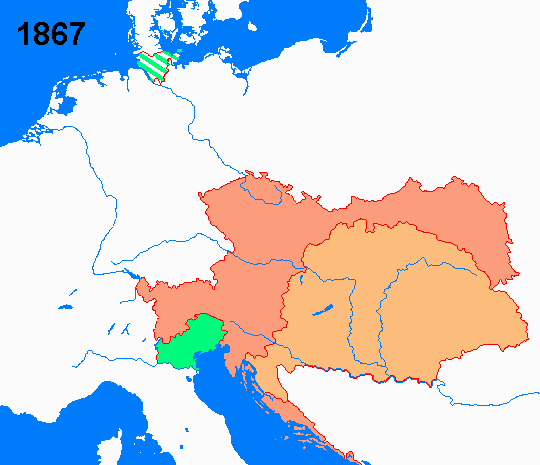
= Austria
 = Hungary
= Territorial losses 1866
= Hungary
= Territorial losses 1866
The differences between Austria and
Prussia regarding the future status of Schleswig-Holstein proved to be irreconcilable.
Prussia wanted to annex both duchies and did not accept Austria's proposed exchange
of Holstein with territories in Silesia. Thus a war between Austria and Prussia broke
out 1866. Most German states sided with Austria, but Prussia was allied with Italy and
possessed a more modern army. That enabled Prussia to win a clear victory and to
dissolve the German Confederation, replacing it with a confederation of its own (and
without Austria), which would be transformed into the German Empire (Reich) in 1871.
Austria had thus lost its position as the leading German state, a position it had had
since 1438. But apart from this the peace treaty was relatively mild and Austria was
only forced to cede Holstein to Prussia and lost Venetia to Italy.
Because the unification of Germany and
Italy had seriously weakened Austria's status in central Europe it was now important to
reach a settlement with the Hungarian nationalists if the Austrian monarchy was to have
any future. A compromise was negotiated in 1867 with the result that Austria was divided
into a union of two realms. One of the realms was a Hungarian nation state and the new
joint state was thereafter called "Austria-Hungary". The Hungarians were satisfied
with this solution but there were plenty of other nationalities who envied the
Hungarian's achievement, such as Czechs, Romanians, Poles and South Slaves.
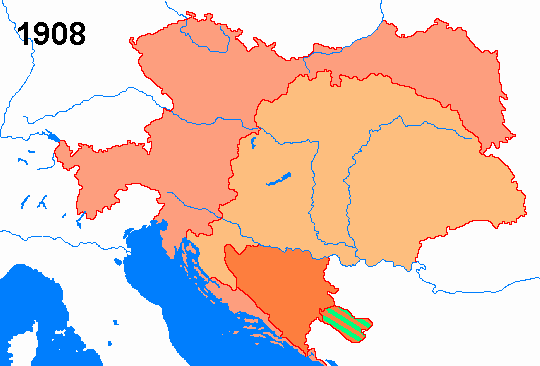
= Austria
= Hungary
= Territorial gain 1878/1908
 = Occupied 1878-1908
A rebellion against the Ottoman Empire
broke out 1875 in Bosnia-Herzegovina.
This escalated to a war between Russia and the Ottoman Empire 1877-78, which ended
with a clear Russian victory and the creation of a large pro-Russian Bulgarian
state in the Balkans. The other great powers could not tolerate such a large
expansion of Russian influence in the region so they called for a congress in
Berlin where all the great powers could meet and settle their differences in 1878.
The result was a great reduction in size of the Bulgarian state and permission for
Austria-Hungary to occupy Bosnia-Herzegovina and Sancak-Novi Pazar as a way to
preserve the balance of power. The occupation would last until 1908 when the Young
Turks seized power in Istanbul and made a permanent solution of Bosnia's status
necessary. Austria-Hungary decided to annex Bosnia-Herzegovina but returned Sancak-Novi
Pazar to Turkish administration. This action worsened the relations between Austria-Hungary
and Russia who rivalled each other over influence in the Balkan Peninsula. The Russian
discontent with the annexation made Russia very determined to prevent a repeat in 1914
and thus contributed to the break out of the First World War.
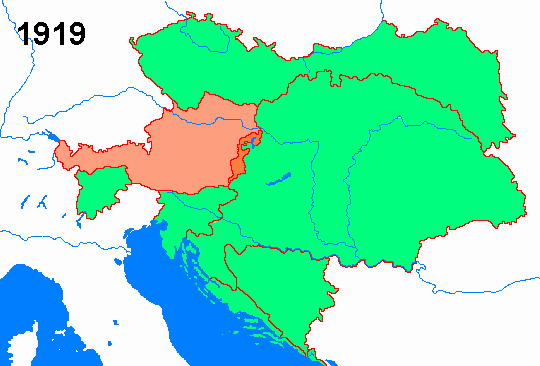
= Austria
= Territorial gain 1919
= Territorial losses 1919
When Austria-Hungary's heir to the throne
was killed 1914 by Serbian nationalists in Sarajevo a series of events began that would
lead to the First World War 1914-18 and the dissolution of the Austro-Hungarian Empire.
Austria-Hungary fought on the losing side and the victorious allies allowed
the various nationalities in the empire to create their own nation states
with borders drawn unfavourably for the German-speaking Austrians and the
Hungarians. The little that remained of the Austrian state after the treaty
of Versailles in 1919 was an almost homogenous German-speaking republic. The
only territorial gain was a strip of Hungarian land, which had
voted in a referendum 1919 to join Austria as the part state of Burgenland.
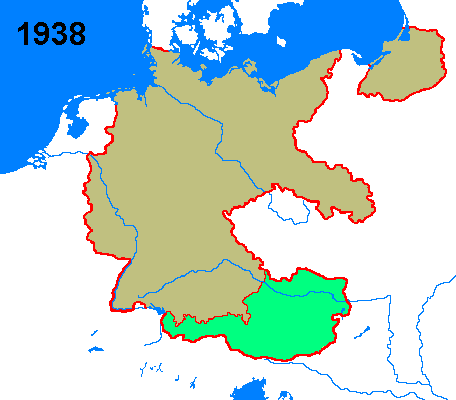
= German Reich
= Austrian territorial losses 1938
In the new Austrian republic there was a
large support for joining the country with Germany. But the allied powers had prohibited
this in the Treaty of Versailles. The reluctantly independent Austria was to be tormented
by internal conflicts between Christian Democrats and Social Democrats. The former
were in power for the most of the time. But the economic depression in the 1930s
made an election defeat inevitable so the Christian Democrats choose
to prevent this by turning Austria into a dictatorship in 1933. The Social
Democratic movement was thereafter wiped out. But this did not make the regime
more popular and instead the Nazis became the leading opposition force.
The regime would then fall when German troops marched into Austria in 1938, which were
not met with any resistance but rather by enthusiastic crowds. "Anschluss" was
now a fact.
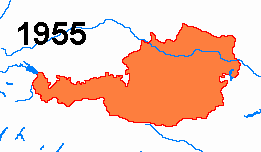
As a part of Germany, Austria lost the Second World War 1939-45 and was
occupied by the allied powers for ten years after the war. They had decided
that Austria would be restored as an independent state and this happened in
1955 when Austria became a democratic state with permanent neutrality.
Back to
Austria's start page. |




























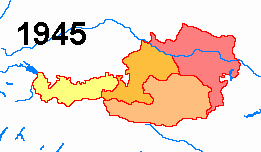
 = Soviet occupation zone
 = American occupation zone